


Key points
- Software provider RoomPriceGenie warns that price cuts can spread across an entire market through revenue management systems.
- Adrian Hillenbrand of ZEW offers another possible explanation for falling rates: many small providers set their prices too high.
- Using the same software as competitors is not in itself a problem. It becomes sensitive when confidential competitor data flows together.
- Small hotels should set up processes for prompt price changes and check which operational data the provider combines.
- Update 19 November 2026: A second US appeals court has revived a similar lawsuit against hotels in Atlantic City. Nothing has been decided yet.
When one hotel cuts its room rates, neighbouring properties may respond without anyone picking up the phone. Their pricing software can do it for them. An economist from ZEW explains what automated pricing means for competition, why falling rates are not necessarily bad news and what independent hoteliers should consider before handing over control.
It is an ordinary Tuesday. A hotel still has several rooms to fill and decides to lower its rates. Moments later, the pricing software used by a neighbouring property detects the change and recommends a reduction of its own. Other hotels could follow, even though demand across the destination has not changed at all. A decision made by one business might eventually influence prices across an entire market.
This is the scenario highlighted by revenue management software provider RoomPriceGenie. On 2 November 2026, German hospitality publication Hotel vor9 reported on the warning, referring to an article by the company on Revenue Hub.¹ ² RoomPriceGenie itself sells automated hotel pricing software. Its argument raises a question for its own industry: what happens when increasing numbers of hotels rely on systems that respond not only to demand but also to the decisions of their competitors?
To explore the issue, we asked Prof. Dr. Adrian Hillenbrand, a researcher in the Market Design Research Unit at ZEW – Leibniz Centre for European Economic Research in Mannheim and Professor of Economics, specialising in Experimental Economics for Market Design, at the Karlsruhe Institute of Technology (KIT). His assessment suggests that the impact of pricing algorithms is considerably more complicated than a simple race to the bottom.

When a lower rate is actually a better decision
Adrian Hillenbrand does not dispute that automated pricing can lead to lower rates. But falling prices do not necessarily mean that hotels are copying one another into an unhealthy downward spiral. Sometimes, a pricing system may simply be correcting a mistake.
“Individual studies suggest that prices for providers can fall while occupancy and revenues increase,” he tells eingecheckt®. “One possible explanation is that many small providers set their prices too high and adjust them too infrequently.”
It is an observation that may resonate with independent hoteliers. When rates are managed manually, there is not always enough time to respond to every shift in bookings. A hotel might continue charging a rate that seemed reasonable when it was first set, even as the prospects for selling its remaining rooms have changed. If those rooms remain unsold, an algorithm suggesting a lower price may be doing precisely what the hotel needs.
That is a very different mechanism from the chain reaction described by RoomPriceGenie. In the first case, a property adjusts its own pricing to reflect its commercial position. In the second, hotels may react to competitors’ decisions without knowing what prompted them. Both can produce lower room rates, but they tell us different things about how a market is functioning.
The wider effect is still an open research question. “How it works when everyone in a market uses the same or similar software is being actively investigated,” he explains. He also points out that evidence from other markets shows that profit margins can increase. In a recent experimental study, he showed how widely used design choices in pricing tools, particularly in online retail, can lead to higher prices. He also discusses this in the ZEW podcast Wirklich Wirtschaft (in German). There is therefore no sound basis for assuming that automated pricing universally pushes hotel rates in either direction.
What a competitor’s rate cannot tell you
The central weakness in the scenario described by RoomPriceGenie is the information missing from a publicly advertised room rate.
The Revenue Hub article illustrates the problem with a hotel reducing prices because it is struggling with occupancy. Competing systems could register that reduction and treat it as evidence of weaker demand throughout the destination. Yet the advertised price alone tells them nothing about how many rooms the hotel has left to sell or why its management made that particular decision.²
Consider two similar hotels in the same town. One has only a handful of rooms remaining for the coming weekend. The other still needs to sell a substantial proportion of its inventory. They may be competing for the same guests, but their commercial positions are very different. A pricing recommendation based too heavily on the competitor’s advertised rate could overlook those differences unless other relevant information is taken into account.
RoomPriceGenie argues that hotels should give appropriate weight to their own booking pace, remaining inventory and demand forecasts. Sometimes the evidence may support a price increase, sometimes a reduction, and sometimes no change at all.² The downward spiral it warns of remains a software provider’s assessment, not proof of such a development in the hotel industry.
Is using the same software as your competitor a problem?
As automated pricing becomes more widespread, another question emerges. If several competing hotels subscribe to the same software provider, how independent are their pricing decisions?
From an economic perspective, Adrian Hillenbrand sees nothing inherently troubling about competitors observing one another’s prices. Indeed, he believes many hotels could benefit from paying closer attention to the market and responding more effectively.
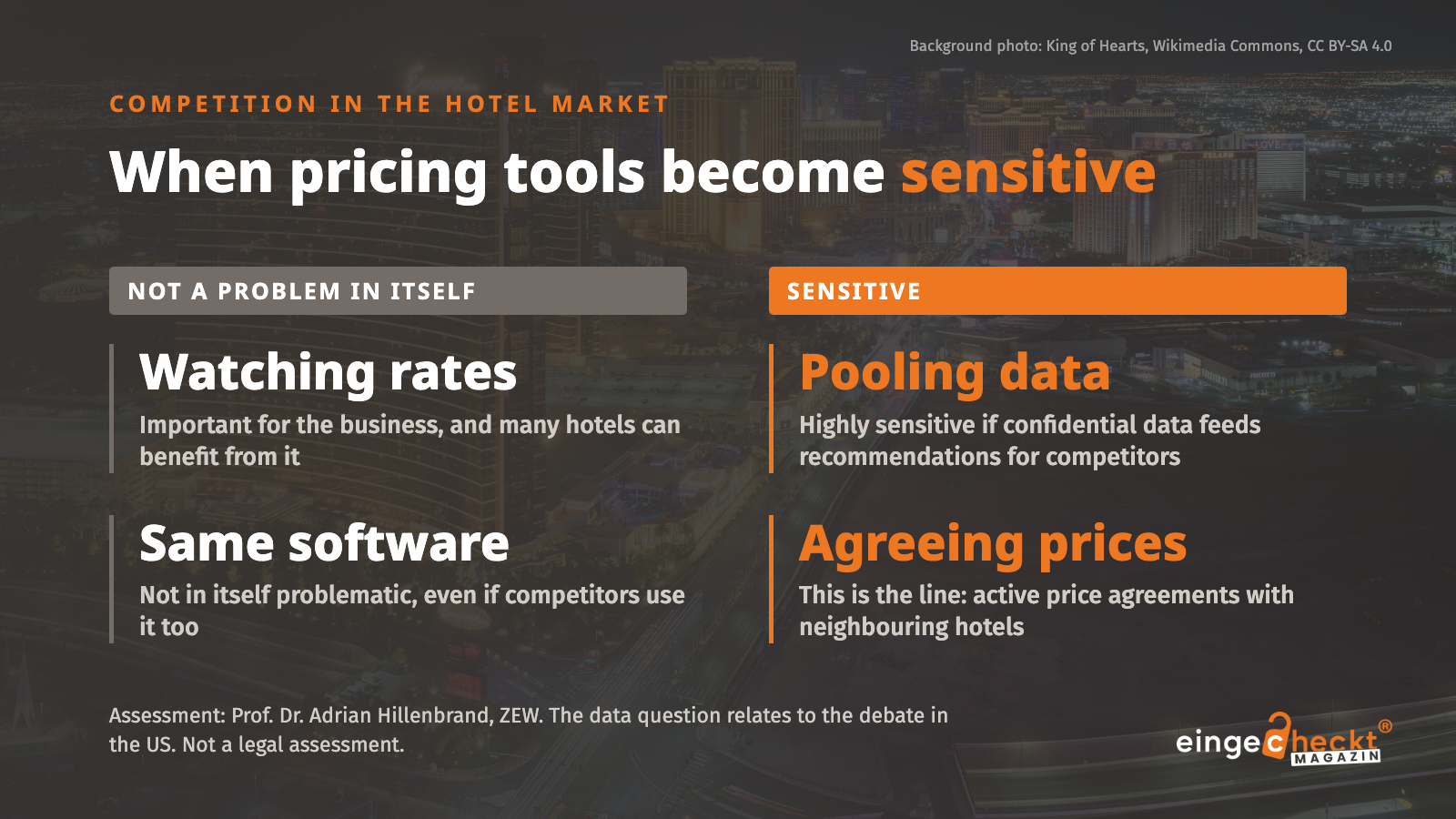
“That is not a problem as long as no active price agreements are made with neighbouring hotels. Using the same software as your competitors is not, in itself, problematic to begin with.”
The important distinction concerns the information used to generate recommendations. Publicly advertised room rates are one thing. Confidential occupancy figures, current booking information and unpublished prices are quite another. Such data could be commercially valuable to competing hotels precisely because they would not normally have access to it.
The concern becomes more serious if a central software provider combines confidential information from different competitors and uses it to formulate recommendations for other properties. In that situation, software could potentially turn commercially sensitive information into a common input for competitors’ pricing decisions.
This is one of the issues attracting scrutiny in the United States. It is considerably more complex than simply asking whether two neighbouring hotels happen to use the same revenue management platform.
The Las Vegas case raises the opposite concern
A US court case demonstrates why algorithmic pricing is attracting attention from a very different direction. Guests who had stayed at hotels on the Las Vegas Strip brought a lawsuit against several hotel operators and software provider Cendyn. They alleged that the use of common revenue management technology had contributed to artificially inflated room rates.
On 15 August 2025, the US Court of Appeals for the Ninth Circuit upheld the dismissal of the case. Under the circumstances alleged, the court found that competing hotels independently choosing to license the same pricing software was not sufficient to establish a breach of Section 1 of the Sherman Act, the relevant US antitrust provision.³
One detail is particularly important. According to the plaintiffs, hotels did supply the software provider with confidential pricing and occupancy information. However, the plaintiffs did not allege that Cendyn pooled those confidential data or incorporated one hotel’s information into recommendations made to its competitors. Nor were the hotels obliged to follow the software’s recommended rates.³
The decision was therefore not a blanket endorsement of every conceivable form of shared pricing technology. It addressed the specific claims brought before the court and left other scenarios open. In its analysis, international law firm Baker McKenzie noted that the applicable US law on algorithmic pricing remained far from settled.⁴
Update, 19 November 2026: A second US appeals court has since reached a different conclusion in a similar case. On 29 July 2026, the Third Circuit reversed the dismissal of a lawsuit against hotel-casinos in Atlantic City (Cornish-Adebiyi v. Caesars Entertainment, No. 24-3006).⁶ That case also concerned Cendyn’s Rainmaker revenue management software. According to the plaintiffs, the properties fed non-public pricing and occupancy data into the system and accepted its recommended rates around 90 per cent of the time. For the court, that was enough for the case to proceed.⁷
This is not a finding that the law was broken. The court only held that the allegations were plausible enough for the claim to continue, and it expressly did not call every shared pricing tool into question. But the case shows where the line lies: it becomes sensitive when competitors’ confidential data flows together at one provider and its recommendations are largely adopted.
Adrian Hillenbrand also highlights the US concern that commercially sensitive, non-public information could flow through software providers and return to competing businesses in the form of pricing recommendations. “In addition, as a hotel you can, if it comes to it, be held liable if you know about such practices,” he says. His comments relate to the debate in the US and are not a legal assessment of the situation in Germany or the European Union.
The practical challenge for independent hotels
For a smaller property considering automated pricing, the most immediate problem may be much closer to home: what happens when the software recommends a rate that the owner simply does not feel comfortable charging?
Adrian Hillenbrand believes smaller providers can benefit from automation, but their internal processes must be capable of supporting it. There is little point paying for a system that produces timely recommendations if the hotel consistently delays acting on them or overrides them out of uncertainty. In that situation, the business may incur the cost without realising the potential benefit.
There is also the question of trust. Hoteliers accustomed to setting rates themselves may find algorithmic suggestions surprisingly low. That initial reaction does not necessarily mean the software is making a poor decision. The hotel’s previous pricing may itself have been too ambitious.
The increasingly common promise of AI-powered pricing adds another consideration. More sophisticated marketing terminology does not automatically establish that a premium service delivers better commercial results. The economist advises hoteliers to look closely at what additional features actually provide before agreeing to higher costs.
- Make timely price adjustments possible: Establish internal processes that allow recommendations to be implemented promptly or automatically. Delays can reduce their value.
- Expect some recommendations to feel too low: If previous prices were set too high, the software may suggest reductions. An unexpectedly low recommendation is not necessarily a mistake.
- Check the value of AI-powered extras: Before paying for premium features, establish what additional benefit they deliver and whether it justifies the cost.
- Understand how your operational data will be used: Ask which pricing and occupancy information the provider combines and whether it is used to generate recommendations for competing hotels.
The commercial judgement still belongs to the hotel
For an independent hotel, the appeal of automated pricing is easy to understand. A task that previously required regular market monitoring, experience and time can increasingly be handled by software. That can be valuable, particularly in a business where the same people are responsible for numerous day-to-day decisions.
The broader discussion, however, reveals two developments that must be considered separately. An algorithm may help an individual hotel respond more accurately to its own booking situation. At the same time, widespread reliance on similar information and recommendations raises new questions about how competing businesses influence one another.
Researchers are still investigating those market-wide effects. The uncertainty is not, in itself, an argument against automation. It does suggest that hoteliers should look beyond how quickly a system calculates a new rate and understand the reasoning and data behind its recommendations.
ZEW podcast Wirklich Wirtschaft: Adrian Hillenbrand discusses pricing algorithms and competition in online retail. The episode examines repricing tools and experimental research, rather than hotel room pricing specifically.⁵ Listen to the episode on the ZEW website (in German)
This article provides general information and is not a substitute for legal advice on individual circumstances.
This article is based on trade articles, opinions from two US appeals courts, legal analyses and our own editorial interview.
-
Hotel vor9 (2026)
Wenn Algorithmen die Hotelpreise nach unten treiben
Article of 2 November 2026. RoomPriceGenie’s warning about falling rates across a market. Original publication in German. -
RoomPriceGenie on Revenue Hub (2026)
Are Hotels Accidentally Teaching Each Other to Lower Their Rates?
Article, accessed on 6 November 2026. Possible chain reaction and the software provider’s recommendations. -
United States Court of Appeals for the Ninth Circuit (2025)
Gibson v. Cendyn Group, LLC, No. 24-3576
Opinion of 15 August 2025. Dismissal of the claim against Las Vegas Strip hotel operators and Cendyn upheld. -
Baker McKenzie (2025)
United States: Ninth Circuit on Algorithmic Pricing
Analysis of 26 August 2025. Assessment of the ruling and the wider legal position in the US. -
ZEW – Leibniz Centre for European Economic Research (2026)
(Kompakt) EARIE Exclusive: Wie Preisalgorithmen den Wettbewerb verändern
Episode of the ZEW podcast Wirklich Wirtschaft. Conversation with Adrian Hillenbrand about repricing tools in online retail. Original publication in German. -
United States Court of Appeals for the Third Circuit (2026)
Cornish-Adebiyi v. Caesars Entertainment, Inc., No. 24-3006
Opinion of 29 July 2026. Dismissal of the lawsuit against Atlantic City hotel-casinos reversed; the case continues. -
Covington & Burling (2026)
Third Circuit Reinstates Algorithmic Pricing Antitrust Lawsuit: Cornish-Adebiyi v. Caesars Entertainment, Inc.
Analysis, August 2026. Assessment of the ruling and how it differs from Gibson v. Cendyn.


