


Key points
- Wyndham, Hilton and WorldHotels (formerly BWH Hotels) are expanding their soft brands and bringing independent hotels and brands on board.
- Privately owned hotels and small hotel groups keep their ownership and identity and gain international distribution and access to loyalty schemes.
- In a US analysis by CBRE, sales and marketing costs at urban soft-brand hotels were 12.6 per cent of revenue, against 7.3 per cent without one.
- Hartwig Bohne names three points to check in the contract: term, cost structure and hotel name.
Running a hotel that bears its own name, keeps its character and still benefits from the worldwide fame of a major hotel group? That is exactly what so-called soft brands, hotel collections run by major groups, make possible. More and more international hotel groups are trying to win privately owned hotels for their networks. For independent hoteliers this opens up new opportunities, but not without something in return.
A hotel can appear on Marriott’s booking site without being a typical Marriott hotel. It can keep its own name, be individually furnished and be run by a private entrepreneur. At the same time, its operators benefit from the group’s booking systems, international advertising and large customer base.
This works through a contractual partnership. Put simply, an independent hotel joins an international network. The group helps make the property better known worldwide and win additional guests. In return, the hotel pays fees and commits to meeting certain requirements. It does not necessarily have to be sold or fully converted into a classic chain hotel.
In the industry, such alliances are known as soft brands or collections. Behind these somewhat unwieldy terms lies a business model that is becoming increasingly interesting for independent hotels and small hotel groups. While a single hotel often has to reach its guests on a limited marketing budget, groups such as Marriott, Hilton and Wyndham have global distribution networks and loyalty programmes with millions of members.
The prospect sounds tempting: the hotel keeps its personal identity and gains the capabilities of an international company. But this also raises an important question. What remains of a business’s independence when a large group suddenly has a say in marketing, brand standards and commercial terms?
Why hotel groups are turning to stand-alone hotels
Several developments from 2026 show how interesting this business model has become. In early November, for example, Wyndham Hotels & Resorts announced that it would add more than 40 luxury hotels from HotelREZ’s Elegant Hotels of the World portfolio to its Registry Collection. The properties are to keep their individual identity while benefiting from the group’s international reach and its loyalty programme.¹
Hilton is pursuing a similar approach. With the Select by Hilton platform presented in March, the group wants to bring established hotel brands on board. YOTEL is the first, and its properties are to continue operating under their own brand.² BWH Hotels, meanwhile, announced in late October that it would unite around 4,000 hotels and 18 brands under the WorldHotels masterbrand, with individual hotel identities being retained.³
For the international hotel groups, this makes commercial sense. They can add interesting hotels to their offering without having to build every new property themselves or develop it as a classic chain hotel. At the same time, they gain locations, guests and hotel concepts that were previously outside their own brand world.
“Expansion is easier and faster,” says Prof. Dr. Hartwig Bohne in a written interview with eingecheckt®. The groups also benefit from established hotels and their employees, he says. A larger network for career development then opens up to those employees, which makes the whole chain more attractive. New target audiences can be reached and existing loyalty programmes strengthened.
Hartwig Bohne has worked on international hospitality for many years. The Professor of International Hotel Management at SRH University in Dresden combines academic research with extensive professional experience. His career began with an apprenticeship at the Kempinski Hotel Taschenbergpalais in Dresden. He later worked at the German Hotel Association, among other places, and for Kempinski in the field of talent development. His research interests include cooperation and staff development in the hotel industry.⁴

From the perspective of the big hotel groups, the particular appeal lies in gaining something that is hard to create through uniform brand standards: individuality. A historic city hotel, an unusual design hotel or a family-run retreat in the mountains offers a different experience from a classic standardised chain hotel. Within a collection, these differences are not necessarily removed and can be an explicit part of the shared offering.
What a hotel gains, and what it gives up
For independent hoteliers and small hotel groups, the other side of this partnership can be extremely attractive. A well-run property may be known in its region, have many regular guests and receive excellent reviews. Becoming visible internationally is another matter. Smaller businesses and groups in particular rarely have their own sales departments, extensive international marketing campaigns or the technological capabilities of large hotel companies.
This is where soft brands come in. A member property can become bookable through the group’s central reservation systems and gain access to its international distribution structures. Established loyalty programmes are often added to this. A traveller who uses Marriott Bonvoy, for example, may thus discover an individual Dresden boutique hotel that they would not have considered in their original search.
Hartwig Bohne sees this as a key advantage: “You therefore retain ownership and economic sovereignty, but use international marketing tools whose effect you could not achieve on your own.”
Membership also gives access to a professional network. Hotels can benefit from other well-known and renowned properties. Additional prospects can also arise for employees if a network opens up career development opportunities.
However, belonging to a collection is not the same as a non-binding membership of an advertising network. The hotelier remains the owner of the business but has to enter into contractual obligations. Certain quality requirements, technical specifications or brand standards can become part of the arrangement. Which freedoms remain, and where the group may exert influence, varies from provider to provider.
Hartwig Bohne therefore does not speak of a model that suits every hotel as a matter of principle. Rather, he says, each property has to weigh this up individually. For those who want access to international markets and guests, joining is certainly worthwhile.
More guests do not automatically mean more profit
The financial side of such partnerships deserves particular attention. After all, joining an international group is not a free service. Hotel groups invest in booking systems, marketing, brand management and loyalty programmes. Member hotels bear part of these costs through the agreed fees.
A study by the real estate services company CBRE shows how differently this can play out. For an analysis published in 2024, the company compared the 2023 operating results of American hotels belonging to a soft brand with those of comparable independent businesses. It looked at hotels in the upper-upscale category operated by third-party hotel management companies.⁵
At the urban hotels studied, spending on sales and marketing, including the brand costs recorded in this area, averaged 12.6 per cent of total revenue at soft-brand hotels. Independent properties came in at 7.3 per cent. Outside cities, the ratio was 11.9 to 6.0 per cent.⁵
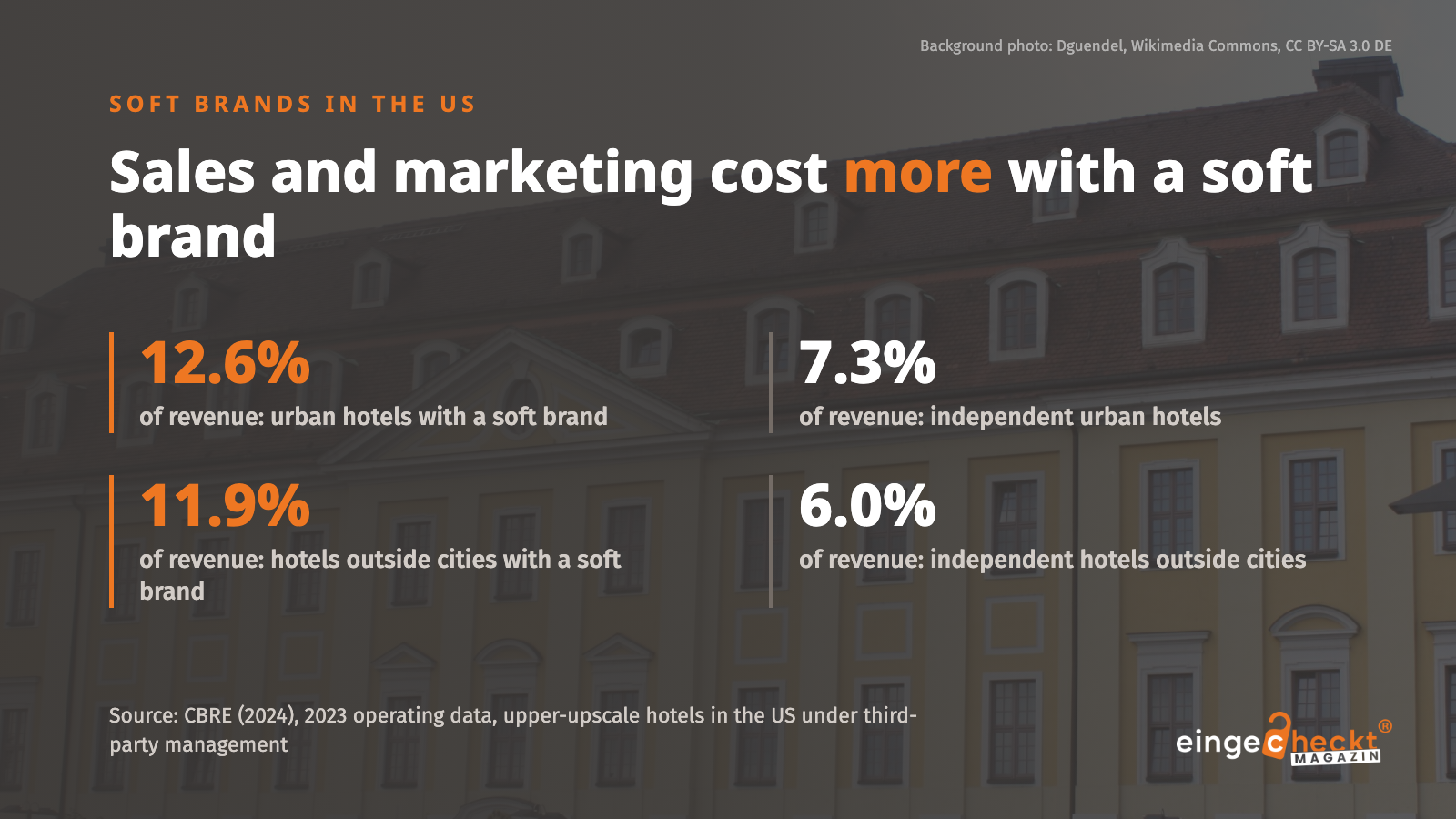
At first glance, this comparison speaks against joining a soft brand. But the picture is not clear-cut. The independent hotels had higher in-house sales payroll costs and achieved higher operating profit margins. On EBITDA, that is, earnings before interest, taxes, depreciation and amortisation, the soft-brand hotels performed better. CBRE points, among other things, to possible purchasing advantages of large networks.⁵
The figures come from the American hotel market and cannot simply be transferred to Germany or other European countries. They do show, however, why hoteliers should look closely at such a decision. Additional bookings and greater international visibility only pay off if the costs of the partnership are in reasonable proportion to the benefits actually achieved.
The contract decides how independent a hotel remains
Anyone interested in joining an international soft brand should therefore not be persuaded by the group’s fame alone. In his answers, Hartwig Bohne highlights three points that should be settled before joining.
- Term: Joining can bring changes to the logo, advertising materials and signage. The length of the contract should therefore fit long-term planning.
- Cost structure: Is the fee charged as a flat rate, or does it depend on the bookings actually generated through the network?
- Hotel name: If the name is extended, the combination should work in different languages, not confuse regular guests and be checked under name and trademark law.
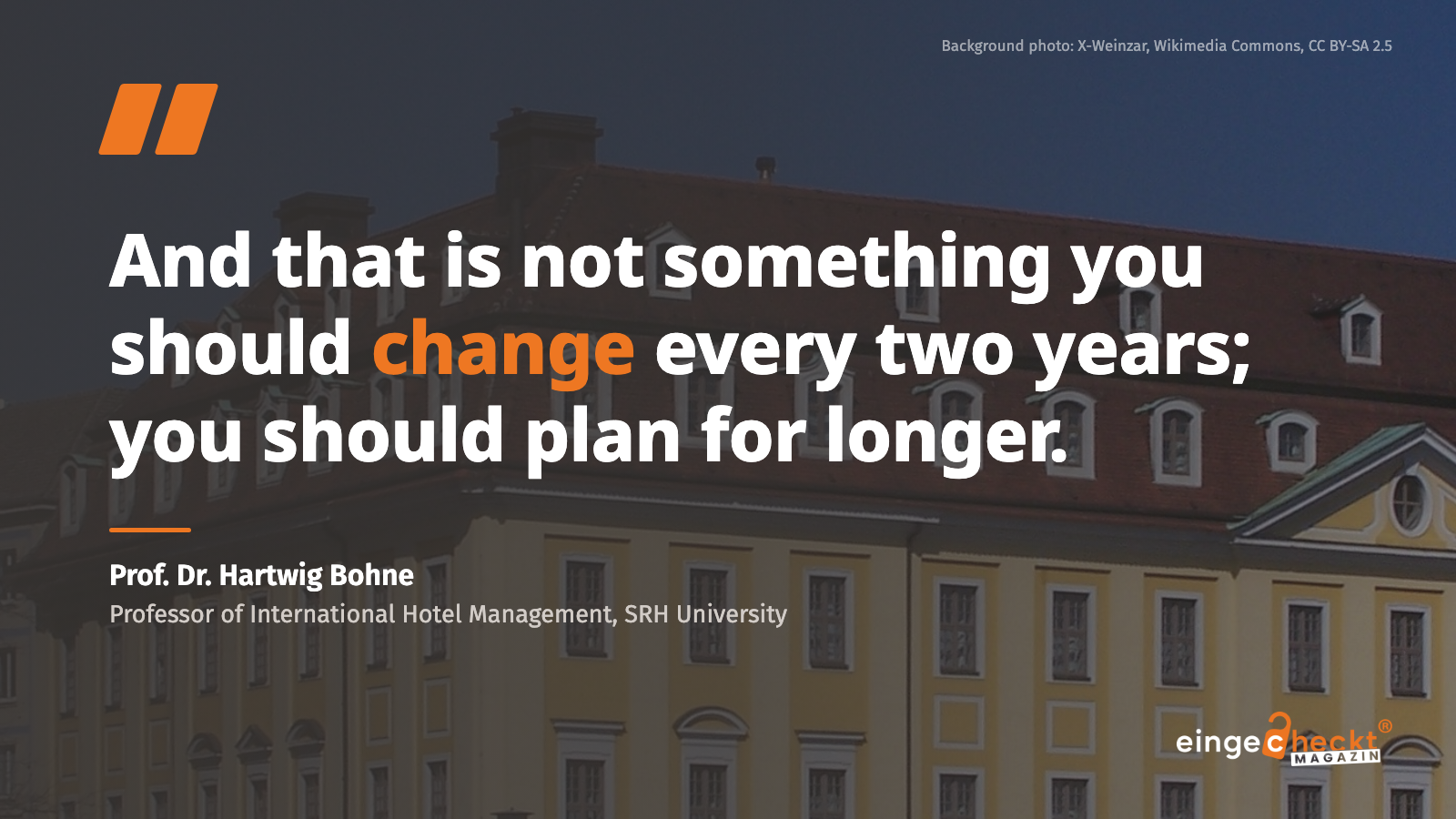
The handling of the hotel name in particular shows how sensitive such decisions can be. For a family that has built up a business over generations, its own name means far more than lettering above the entrance. It stands for the history of the property, the relationship with its guests and possibly decades of personal work.
A Dresden example: the Gewandhaus
For Hartwig Bohne, Gewandhaus Dresden, Autograph Collection shows why a small hotel group might market its property under an international brand. Behind it is the Seaside group, a family business founded by Theo Gerlach that now runs hotels in Germany, the Canary Islands and the Maldives as the Seaside Collection.⁶
The building dates from 1768 to 1770 and is now a boutique hotel in the Seaside Collection.⁷ It reopened in April 2015 after an extensive refurbishment and joined Marriott’s Autograph Collection the same year as the collection’s second hotel in Germany.⁸

“Even small groups or individual hotels with brand recognition in their home market can position themselves internationally by joining an overarching brand family, without building an additional sales organisation and without losing their own individuality,” says the professor. Some brand cooperations have proved this, he adds, among them Romantik Hotels, which now has almost 200 properties in eleven European countries.⁹
A hotel’s identity should not only come into being by joining a network. A hotel must already know what sets it apart and why guests want to stay there of all places. An international partnership can reinforce this positioning, but it cannot automatically replace it.
Independence becomes a matter of negotiation
Soft brands are not an invention of 2026. Marriott, Hilton and other hotel groups have been working with comparable concepts for some time. The latest developments show, however, how intensively international companies are now courting independent hotels and established brands.
For hotel owners and small groups, this widens the business options. They no longer necessarily have to choose between complete independence and full integration into a classic hotel chain. A partnership within a collection can open up a middle way, in which the hotel keeps its character while benefiting from international reach.
Even so, the decision remains demanding. Anyone who has worked independently for decades will not want to join a group simply because its name is well known. It takes commercial advantages, reliable contract terms and the certainty that their own idea of hospitality still has a place.
Hartwig Bohne sums up his view for eingecheckt® as follows:
“Within a strong soft brand, you can contribute your strengths and at the same time benefit from the strengths of the others and of the network as a whole. This brings advantages both for selling rooms and food and beverage and for positioning yourself as an attractive employer.”
This article is based on trade press reports, company information, a CBRE analysis and an original written interview. As of 6 November 2026.
-
Tageskarte (2026)
Wyndham integriert mehr als 40 Luxushotels in Registry Collection
Article of 2 November 2026. Addition of the Elegant Hotels of the World properties, timetable and size of Wyndham Rewards. Original publication in German. -
Hilton (2026)
Hilton Announces Exclusive Agreement with YOTEL to Expand Global Footprint in Lifestyle Segment
Press release of 18 March 2026. Launch of Select by Hilton with YOTEL as its first partner. -
Travel Market Report (2026)
BWH Hotels Unites Global Portfolio Under WorldHotels Masterbrand
Article of 28 October 2026. Around 4,000 hotels and 18 brands under the WorldHotels masterbrand. -
SRH University (2026)
Prof. Dr. Hartwig Bohne
Profile page, accessed on 4 November 2026. Career and publications. -
CBRE (2024)
Soft Brands: A Third Alternative
Analysis of 6 September 2024. Comparison of upper-upscale hotels with and without a soft brand in the US, 2023 operating data. -
Seaside Collection (2026)
Seaside Collection
Company website, accessed on 6 November 2026. Family business, founder and hotel locations. -
Gewandhaus Dresden (2026)
Hotel
Hotel website, accessed on 6 November 2026. Construction date and membership of the Seaside Collection. Original publication in German. -
Hotel Online (2015)
Germany’s Gewandhaus Dresden, Following an Extensive Refurbishment Joins Autograph Collection
Article of 8 July 2015. Reopening and admission to the Autograph Collection. -
Tageskarte (2026)
Romantik erweitert Portfolio zum Jahresbeginn 2026 um vier Hotels
Article of 12 January 2026. Number of Romantik properties and countries. Original publication in German.


