


Key points
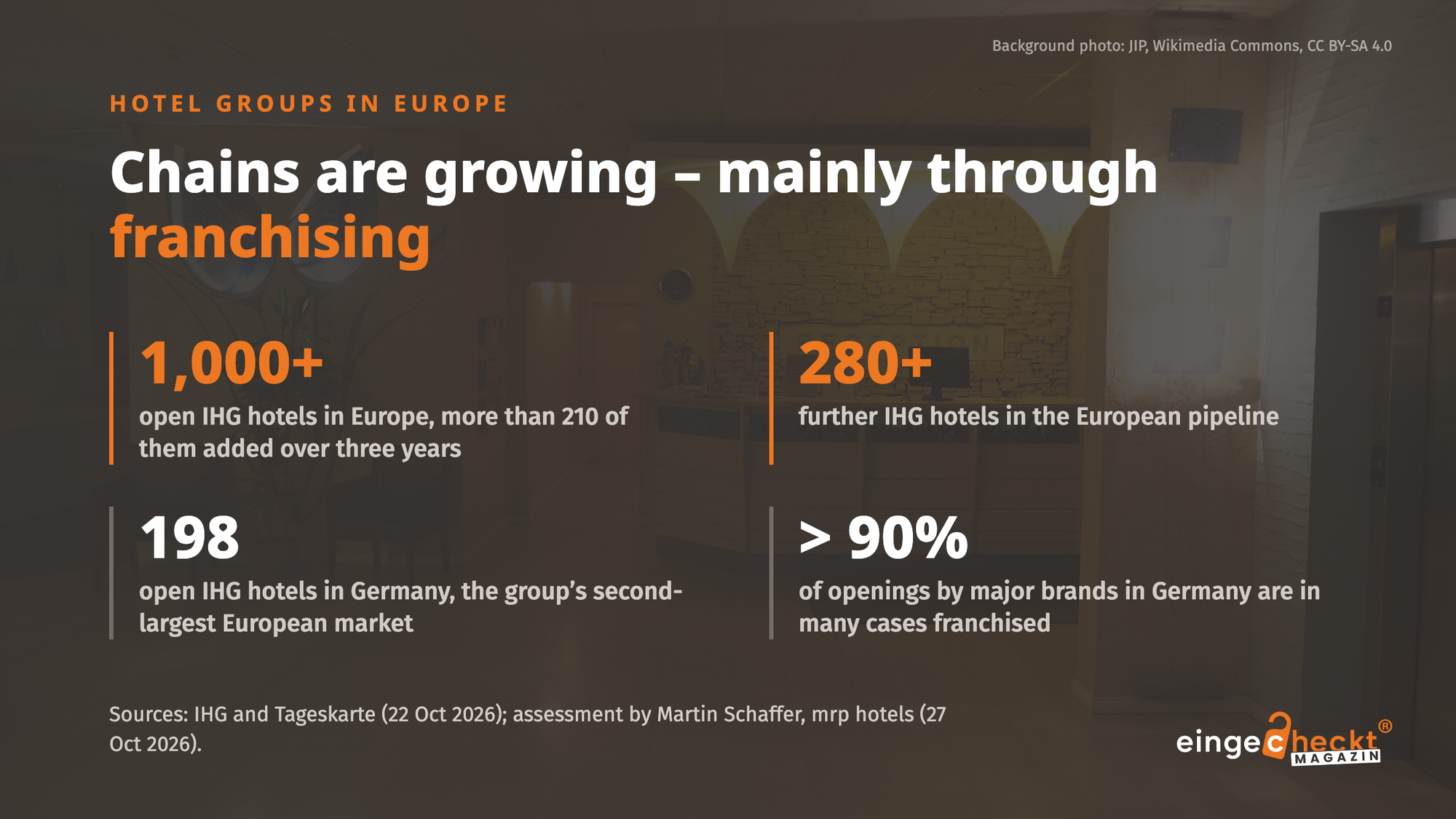
- International hotel groups are growing fast: IHG now has more than 1,000 hotels in Europe. In Germany, the major brands are expanding mainly through franchising.
- Depending on the model, a brand costs around 3 to approximately 10 per cent of revenue. To pay off, RevPAR often needs to rise by 10 to 15 per cent.
- Between franchising and full independence there are cooperatives and soft brands, such as the partnership between Ringhotels and CPH Hotels.
- Modern software gives independent hotels access to international distribution. According to Martin Schaffer, their disadvantage is far smaller than ten years ago.
International hotel groups are expanding at remarkable speed. But joining a global brand does not automatically make a hotel more profitable. A hotel consultant explains why the decision requires careful financial consideration – and why independent hoteliers may be in a stronger position than they think.
The figures are enough to make an independent hotel owner stop and think. In October 2026, IHG Hotels & Resorts announced that it had surpassed 1,000 open hotels across Europe. More than 210 properties had been added over the previous three years, with another 280-plus in development.¹ Germany is now the group’s second-largest European market, with 198 open hotels and 54 further projects in the pipeline.²
Around the same time, Hilton and Scandinavian hotel operator Scandic announced a strategic agreement to develop new properties across Sweden, Norway, Denmark and Finland.³ The international brands are extending their reach, raising an uncomfortable question for some independent hoteliers: how much longer can they compete successfully without joining a larger network?
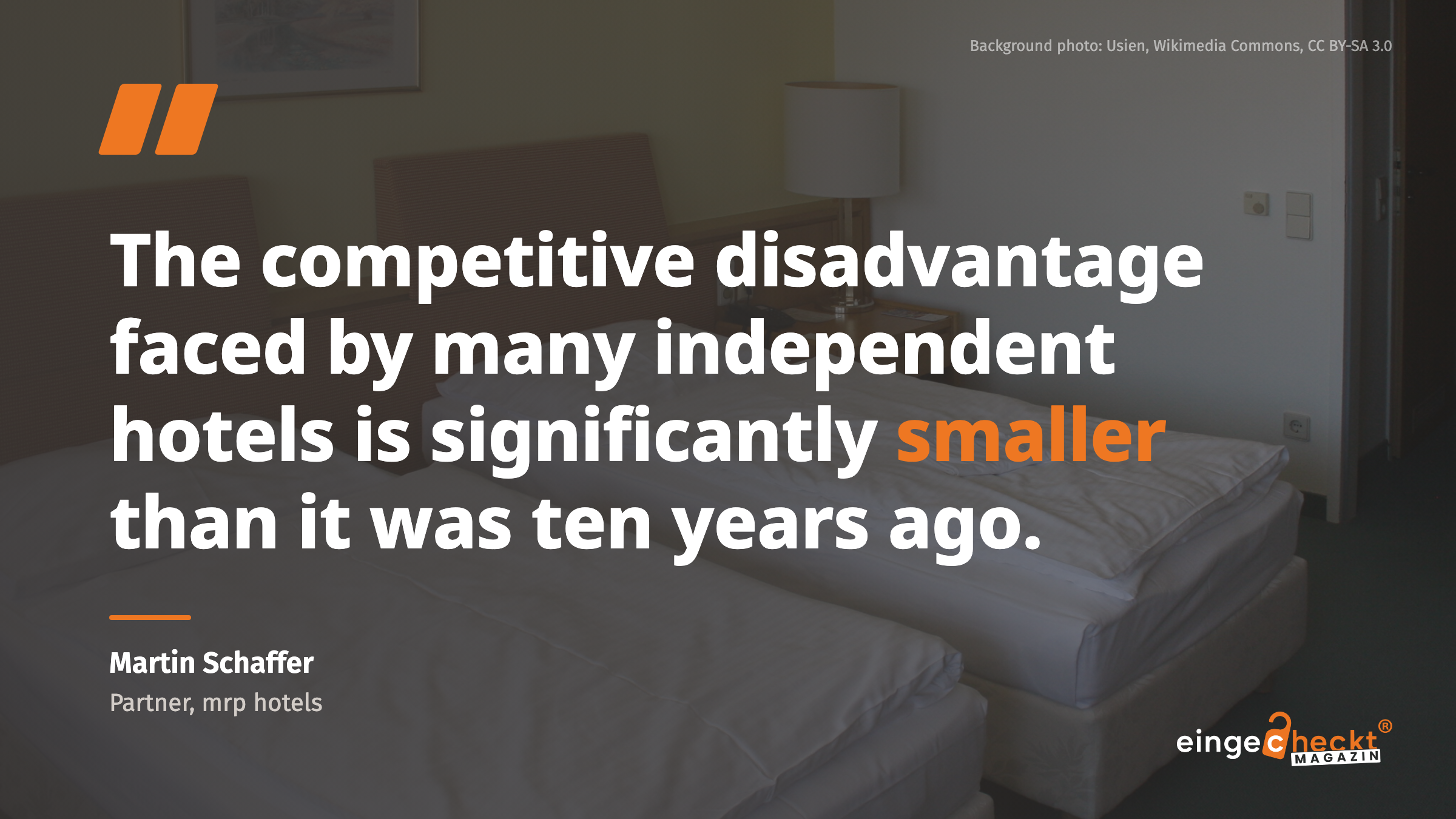
Martin Schaffer, a partner at hotel consultancy mrp hotels, which has offices in Vienna, Berlin and Munich, offers a surprisingly encouraging perspective. His work focuses on hotel investment, operating structures and the commercial decisions shaping the international hospitality industry. In a written interview with eingecheckt®, he challenges the assumption that independent properties are inevitably losing ground. In his view, “The competitive disadvantage faced by many independent hotels is significantly smaller than it was ten years ago.”
Growth without owning the buildings
Understanding the growth of international hotel companies requires clearing up a common misconception. A new Hilton, Marriott or Holiday Inn does not necessarily mean that the company behind the brand owns the building or operates the hotel itself.
Much of this expansion follows an asset-light business model. Hotel groups provide their brands, distribution networks, reservation technology and management expertise, while external owners and operators supply much of the capital. Franchise agreements are particularly attractive because they allow a brand to expand without having to invest directly in every additional property.
According to Martin Schaffer, franchising has accounted for the overwhelming majority of recent openings by several major international brands in Germany, in many cases well above 90 per cent. Their extensive brand portfolios also allow them to target almost every part of the market, from budget-conscious business travellers to luxury guests.
The new Hilton–Scandic agreement illustrates how flexible such arrangements can be. A 284-room Hilton Hotels & Resorts property is planned near Copenhagen Airport, with an expected opening in 2029. Scandic will operate the hotel under a franchise agreement. Importantly, the wider partnership is not a broad conversion of Scandic’s existing portfolio to Hilton brands. Instead, it combines Hilton’s international distribution capabilities with Scandic’s regional expertise and operational infrastructure.³
What a global hotel brand can actually deliver
The attraction for an independent hotelier is easy to understand. International brands offer recognition that an individual property may struggle to achieve. They provide access to corporate accounts, established booking networks, sophisticated distribution technology and loyalty programmes with millions of members.
Martin Schaffer sees a particular advantage for branded hotels in international business travel markets. Companies arranging regular stays for employees in cities such as Frankfurt, Munich or Berlin may favour familiar brands, established standards and negotiated corporate arrangements. An independent property can find it harder to capture that demand.
However, not every hotel competes on the same terms. An established resort in a popular leisure destination, an owner-operated boutique hotel or a property with a distinctive culinary identity may appeal to guests for entirely different reasons. Travellers may choose it because of its location, individual character or the people who run it.
Technology has also changed the balance of competition. Modern property management systems, booking engines and distribution services now give smaller hotels access to international markets without the substantial in-house technology departments they might once have needed.
The financial calculation behind a famous name
The real question is therefore not whether a well-known hotel brand offers advantages. It is whether those advantages justify the cost.
Martin Schaffer estimates that fees can range from approximately three per cent of revenue for distribution and cooperation networks to around ten per cent for established, more heavily standardised brands. Depending on the agreement, hotel owners may face additional charges for reservation technology, marketing contributions and loyalty programmes.
The important measure is the additional revenue that the affiliation genuinely generates. He suggests that a RevPAR increase of around 10 to 15 per cent is often needed to justify the expense. RevPAR, or revenue per available room, combines the effects of occupancy and average room rate. The required improvement varies considerably according to the property and its cost structure.
A model calculation in the current mrp hotels Expert Paper, “Booking the Future”, illustrates just how demanding the economics can become. For a 118-room city hotel, combined franchise, systems, distribution and loyalty costs were estimated at approximately nine to eleven per cent of total revenue. Under the assumptions used in that model, RevPAR would need to rise by roughly 17 to 20 per cent simply to offset the additional costs, without producing any extra profit.⁴ ⁵
- Around 3% of revenue: a possible cost level for distribution networks and hotel cooperatives with relatively limited standardisation
- Up to approximately 10% of revenue: a potential cost level for established, more tightly standardised hotel brands; additional systems and marketing charges must be assessed according to the agreement
- Around 10–15% additional RevPAR: a frequently required improvement according to Martin Schaffer, depending on the property; the more comprehensive mrp model suggests 17–20% under different assumptions
- What really counts: the additional operating profit after fees, changes in distribution costs and investment requirements. Higher occupancy alone does not establish whether joining a brand is financially worthwhile
Investment requirements can be particularly significant. A hotel may have to refurbish bedrooms, redesign public spaces or upgrade its technology to meet brand standards. Those costs can arise well before the first additional reservation arrives.
There is also the question of whether the brand is attracting genuinely new business. If existing customers simply switch from the hotel’s own booking channels to the brand’s reservation system, the hotel may be paying for bookings it would have received anyway.
mrp hotels offers the full Expert Paper, including the model calculation, as a download on its website (in German).⁴
Working together without losing independence
Independent hotels are not standing still. In Germany, Ringhotels and CPH Hotels (Collection Privater Hotels) have been working together under a service agreement since 1 July 2026. Under the arrangement, the Ringhotels service office in Munich provides operational support to CPH member properties, giving them access to Ringhotels’ structures and services. The CPH Hotels brand remains intact.⁶
The arrangement offers an interesting alternative to full brand conversion. It demonstrates that collective distribution and professional support do not have to come from an international hotel corporation.
There are several other options between complete independence and a traditional franchise. These include hotel cooperatives, shared distribution arrangements and soft brands, which can provide access to larger commercial platforms with fewer restrictions on a property’s identity.
The most suitable approach depends on the hotel’s market and its owner’s ambitions. A city hotel seeking more international corporate business may have very different priorities from a country-house hotel whose bookings are driven mainly by repeat guests, recommendations and the appeal of its destination.
Where independent hotels have the edge
For all their commercial strength, large international hotel groups cannot always match one of the independent sector’s greatest advantages: the freedom to make decisions locally.
An independent owner can change a restaurant concept, introduce a new guest experience or respond to regional demand without navigating a complex corporate approval structure. They may also have a deeper understanding of local businesses, communities and the individual preferences of returning guests.
Martin Schaffer does not regard independent hotels as an outdated part of the industry. Quite the opposite: “Independent hotels are often innovation leaders, thanks to bold entrepreneurs.” Their individual character, authenticity and personal approach to hospitality can create a meaningful competitive advantage.
That freedom does, of course, need to be supported by professional management. A distinctive guest experience cannot compensate indefinitely for weak distribution, poor financial planning or an uncompetitive product. Independent properties need many of the same commercial disciplines as their branded counterparts.
The decision starts with the hotel itself
International hotel groups will continue to expand. Their business models are designed to bring brands and distribution systems to a growing number of properties. For independent hoteliers, this creates greater competition, but also more opportunities to access professional services and commercial networks.
For some properties, joining an international brand will be the right way to reach new customer segments or support a major repositioning. Others may benefit more from a cooperative arrangement. And some will be strongest precisely because they remain fully independent.
The decision should begin with a careful assessment of the individual hotel. Which guests does it want to attract? Which capabilities does it genuinely lack? And how much additional operating profit could a proposed partnership realistically produce?
A hotel brand can take many responsibilities off an owner’s shoulders. Making the right business decision is not one of them.
This article draws on announcements from IHG, Scandic and Ringhotels, reports by Tageskarte and Hotel vor9, the mrp hotels Expert Paper and an original editorial interview.
-
IHG Hotels & Resorts (2026)
IHG Hotels & Resorts hits 1,000 open hotels in Europe
Press release of 22 October 2026. More than 1,000 open hotels in Europe, more than 210 hotels added in three years, more than 280 in the pipeline. -
Tageskarte (2026)
IHG meldet mehr als 1.000 eröffnete Hotels in Europa
Report of 22 October 2026. Germany is IHG’s second-largest European market, with 198 open hotels and 54 further projects. Original publication in German. -
Scandic Hotels Group (2026)
Scandic and Hilton sign new Nordics strategic agreement
Press release of 19 October 2026. Strategic agreement with Hilton to develop new hotels in the Nordic region, including a Hilton at Copenhagen Airport. -
mrp hotels (2026)
Booking the Future – Expert Paper Hotels 2026
Client magazine, 2026. Feature on franchising and developments in the brand and operator market. Original publication in German. -
Hotel vor9 (2026)
Hotelwachstum allein reicht nicht mehr aus
Report of 16 October 2026. Report on the mrp online event “Booking the Future”, including the model calculation of brand affiliation costs: 9 to 11 per cent of revenue, 17 to 20 per cent required RevPAR increase. Original publication in German. -
Ringhotels (2026)
Starkes Signal für die Zukunft der Privathotellerie: Ringhotels stellt CPH Hotels künftig seine Services und Strukturen zur Verfügung
Press release of 2 June 2026. Cooperation with CPH Hotels under a service agreement from 1 July 2026. Original publication in German.


