
Why Booking.com and Expedia can show two very different versions of the same property
Sahin Toprak still remembers one particular hotel listing.
About three years ago, he was asked to assess the revenue potential of a four-star hotel in Munich that was being prepared for sale. When he opened the property on Booking.com, the first image he saw was not the best room, the lobby or an inviting view of the terrace.
It was a close-up of a simple flowerpot.
Not a catastrophic mistake. But a revealing one.
Because small details like this can say a great deal about the way hotels manage their presence on online travel agencies. The information may not necessarily be wrong — but it can be unstructured, outdated, poorly prioritised or simply fail to show the property at its best.
Toprak does not approach this subject solely from spreadsheets and data analysis. He spent many years working in hotel management himself before focusing on OTA content and pricing through Ananas OTA Consulting
His basic principle sounds surprisingly simple:
“Content is physics. Pricing is mathematics.”
In other words: before a hotel starts worrying about increasingly sophisticated pricing strategies, the digital product that guests actually see should be in order.
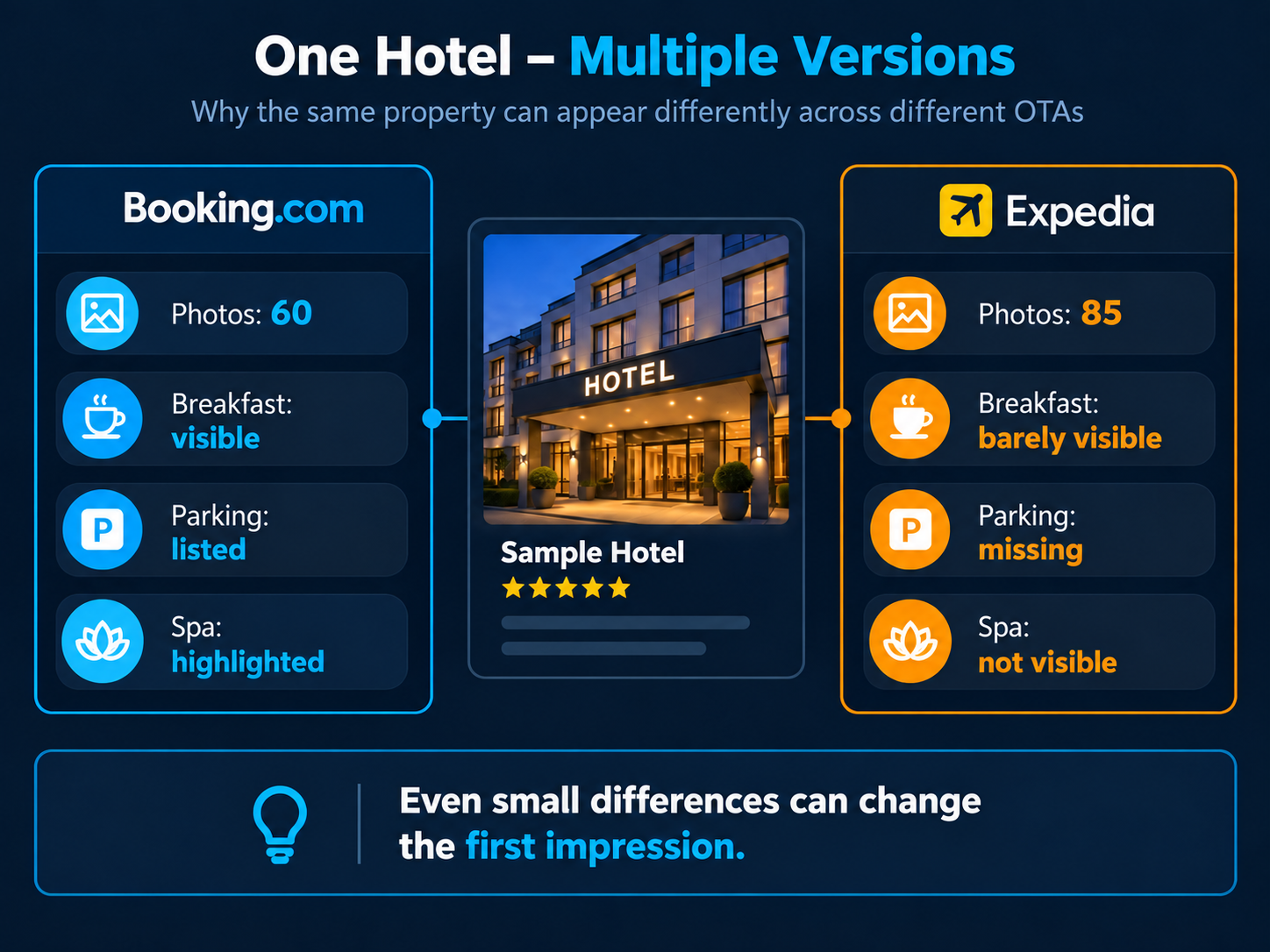
One hotel — but several versions of it
For the hotelier, the property is obviously always the same hotel.
For the guest, that is not necessarily true.
Depending on the booking platform, a property can appear surprisingly different. One OTA may put the rooms front and centre, while another focuses more heavily on food and beverage. One platform may show dozens more photographs than another. Bathrooms may look bright and appealing in one gallery but barely appear elsewhere.
Important services can also be presented differently — or may not be visible at all.
This is exactly where Toprak’s analysis begins.
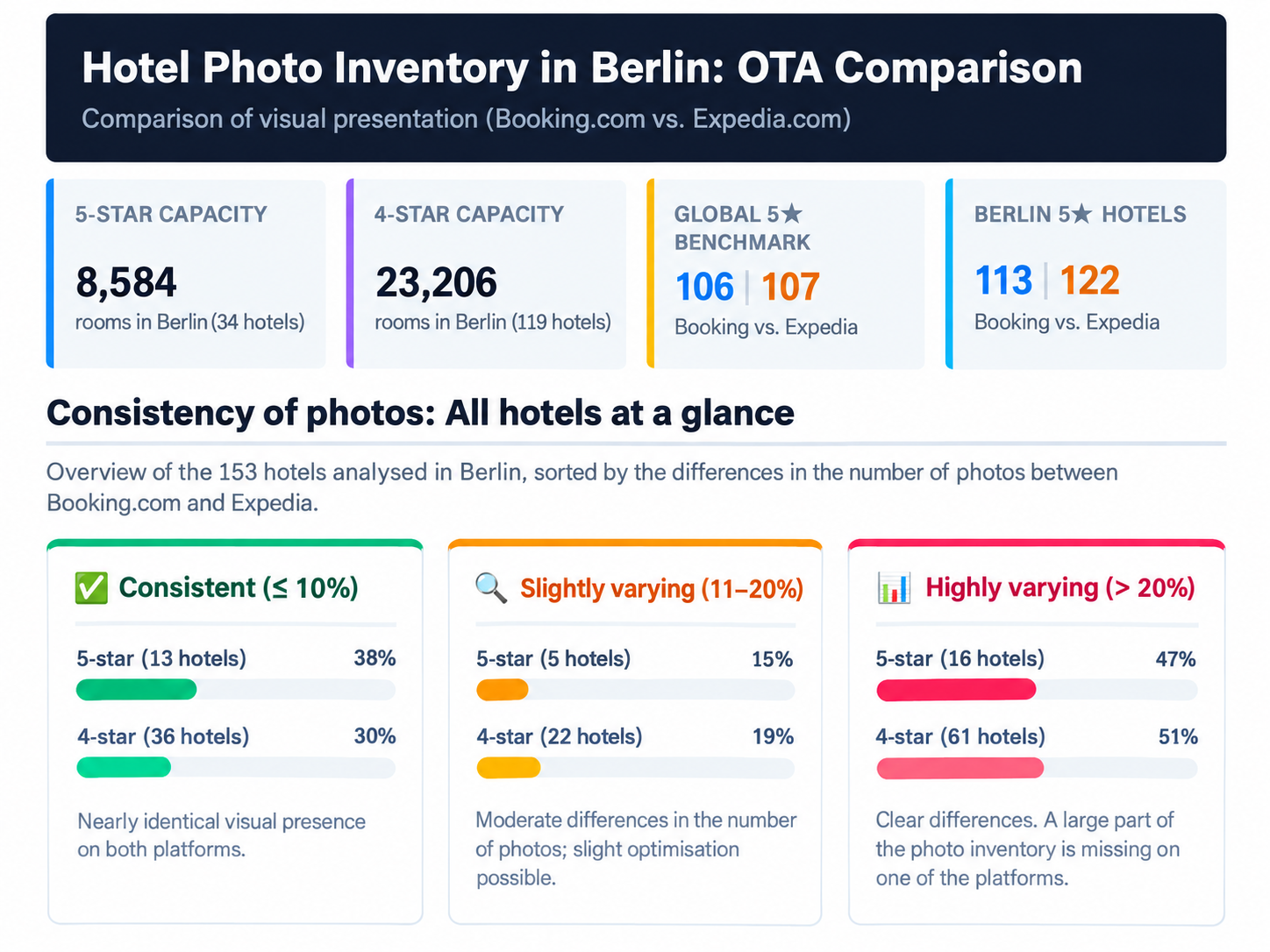
For a recent study, the photo inventories of 153 four- and five-star hotels in Berlin were compared between Booking.com and Expedia.
The results are striking.
Among Berlin’s five-star hotels, 47 percent showed a difference of more than 20 percent in the number of photos available on the two platforms. Among four-star hotels, the figure was 51 percent.
That does not automatically mean that these hotels are managing their content badly.
Different photo counts are not proof of an error.
But they are a very good reason to take a closer look.
Because what ultimately matters to the guest is not how many photographs a hotel has stored somewhere in its archive.
It is what the guest actually sees.
This is not about overwhelming hoteliers with technical terminology or complicated metrics. The real question is much simpler:
Do guests on Booking.com, Expedia and other platforms actually see the hotel you want them to see?

Why this matters especially for smaller hotels
Many independent and smaller hotels do not have their own e-commerce department, revenue team or dedicated OTA manager.
Managing booking platforms is simply one more task among many — somewhere between reception, guest enquiries, staff schedules and the daily operation of the hotel.
That makes it easy to underestimate.
Toprak believes this is a mistake.
In his view, the countless fields and settings inside OTA extranets should not simply be treated as annoying forms that need to be completed as quickly as possible.
They form part of the hotel’s digital shop window.
Photos, amenities, room information and service descriptions can affect how a hotel is found, how it appears in filtered searches and, most importantly, what guests expect before they arrive.
A guest develops an impression of a hotel long before check-in.
Not at reception.
But while scrolling through photographs, room descriptions, facilities and rates.
If important information is missing or one platform presents the hotel considerably less attractively than another, the effect can be very simple:
The potential guest clicks on the next hotel.
Or perhaps even worse, the guest books with the wrong expectations and arrives disappointed.
The mistakes Toprak sees most often
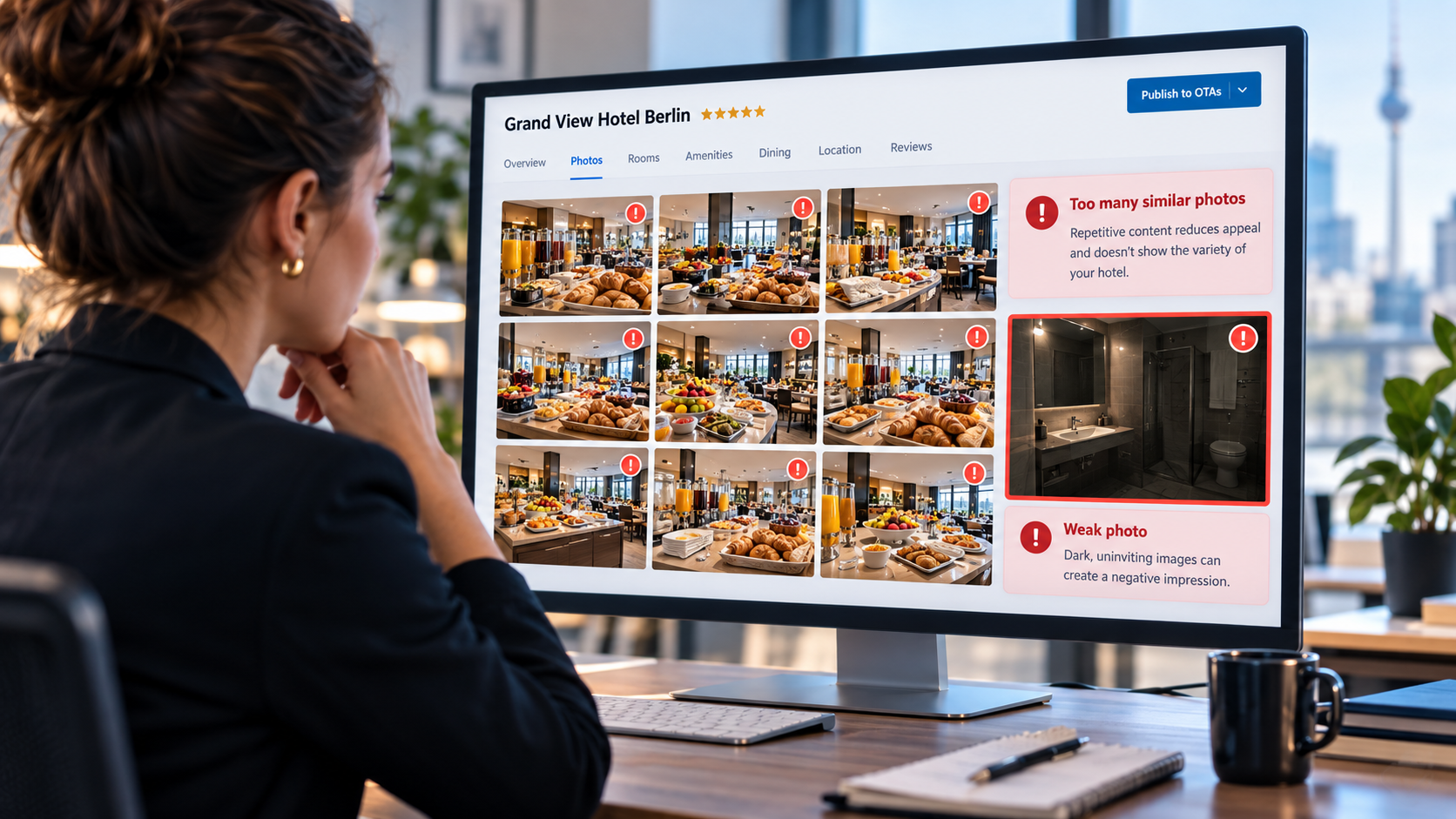
One recurring problem is surprisingly simple: hotel galleries often lack structure.
Instead of carefully selecting and prioritising images, properties sometimes upload almost everything that happens to be available.
That may sound harmless, but quantity does not automatically create desire.
Four almost identical photographs of the breakfast buffet do not necessarily tell the guest more about the hotel. Several near-identical angles of the same room do not make the room more attractive.
They simply make the gallery longer.
Toprak also pays particular attention to bathrooms.
Dark, poorly lit or carelessly composed photographs of bathrooms and toilets can create an immediate feeling of uncertainty. A hotel may have an immaculate bathroom in reality, but if the photograph looks gloomy or dated, the guest can only judge what is shown on the screen.
Then there are the services and amenities.
Is breakfast clearly presented?
Is parking listed correctly?
Can guests immediately see whether the hotel has a restaurant, sauna, family rooms, EV charging or accepts pets?
And are these details consistent across the major platforms?
Sometimes a feature that seems minor to the hotel is exactly the feature a guest is using as a booking filter.
- Too many similar photos: Guests scroll through variations of the same image instead of discovering the full property.
- Dark bathroom images: Poor photographs can quickly create uncertainty or mistrust.
- An unclear short description: The property becomes interchangeable even when it has genuine strengths.
- Missing amenities: Important services may be incomplete or incorrectly listed.
- Different appearances across platforms: Guests receive a different impression of the same hotel depending on the OTA.
Hotel photos are not “just photos”
In everyday hotel operations, OTA content can easily become administrative work.
But it is performing a much bigger job.
It has to create trust.
The main image, the order of the gallery, the quality of the photographs and the information surrounding them all contribute to the first impression.
And that first impression can decide whether curiosity turns into interest — or whether the traveller simply moves on.
This is particularly relevant for hotels that have invested heavily in renovations, redesigned their breakfast offering, upgraded rooms or added new services.
If none of that is clearly visible on the booking platforms, part of the investment is effectively hidden from potential guests.
Toprak therefore recommends a simple change of perspective.
Hoteliers should occasionally stop looking at their property as operators who already know every corner of the building.
Instead, they should look at it as someone discovering it for the first time.
Not:
“I know what our hotel offers.”
But:
“Would I want to book this hotel based solely on what I can see here?”
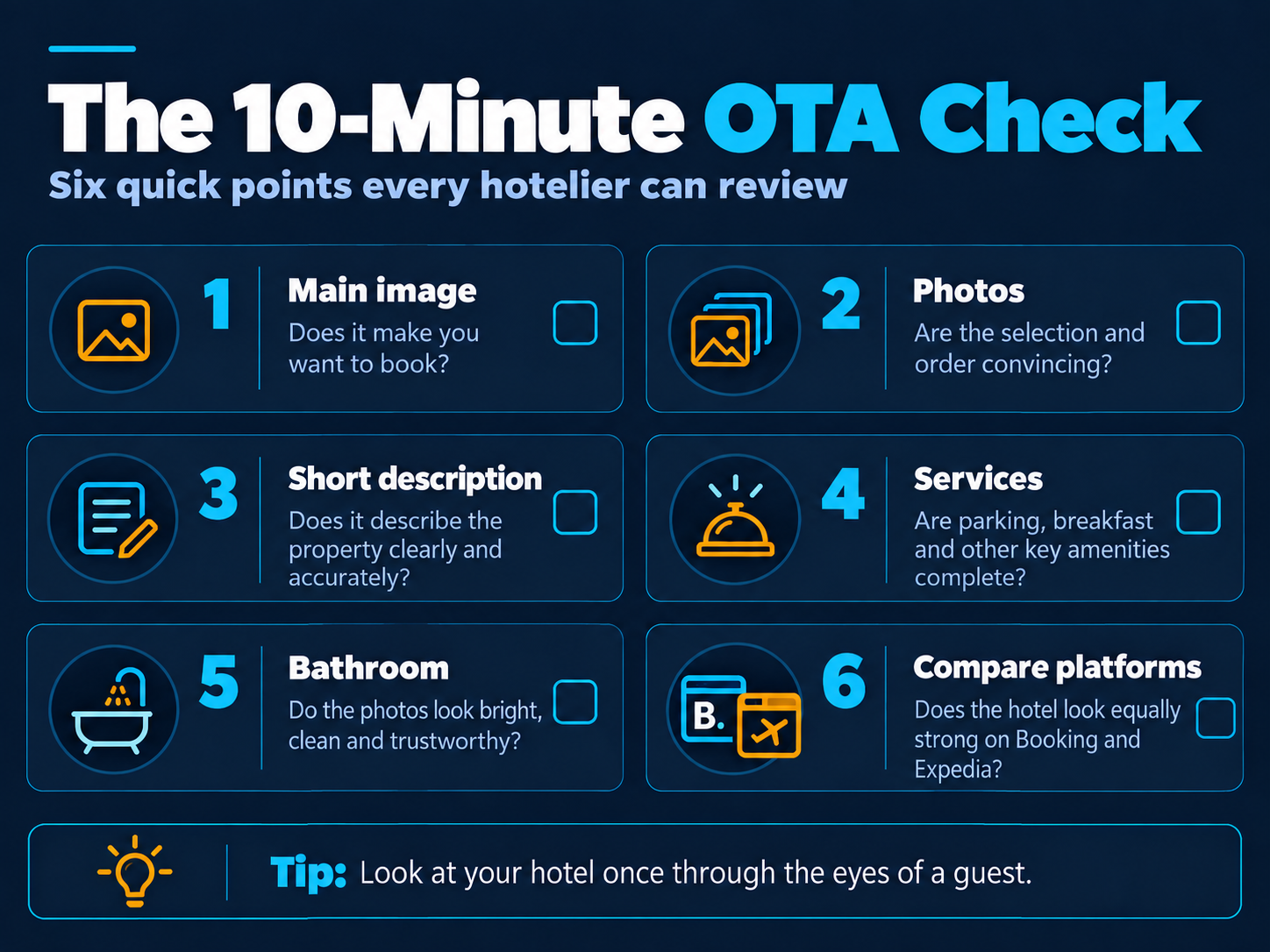
The ten-minute reality check
This leads to one of Toprak’s simplest recommendations — and one that virtually every hotel can implement without new software or outside consultants.
Spend ten minutes looking at your own hotel online.
Forget what you already know about the property.
Open the profiles as if you were a guest seeing the hotel for the very first time.
Then look closely.
- Review your photos: Does the gallery show your property at its best — or simply as many images as possible?
- Question the main image: Is it strong enough to make someone want to continue looking?
- Read the short description: Does it describe the property clearly, authentically and accurately?
- Check your services: Are important amenities and services completely and correctly listed?
- Compare platforms: Does your hotel feel like the same property on Booking.com and Expedia?
- Look closely at bathrooms: Do the images appear bright, clean and trustworthy?
- Check for completeness: Are renovated areas, new services or important recent changes missing?
What the Berlin data tells us
Toprak’s current Berlin analysis makes the scale of the issue visible.
The dataset covers 34 five-star hotels with 8,584 rooms and 119 four-star hotels with 23,206 rooms. Infografik - Berlin 5&4 Star Ho…
Among the five-star properties, only 38 percent had photo counts on Booking.com and Expedia that differed by no more than ten percent. For four-star hotels, that figure was 30 percent.
At the other end of the scale, almost half of the five-star hotels and slightly more than half of the four-star hotels showed differences of more than 20 percent. Infografik - Berlin 5&4 Star Ho…
Again, the number of photos alone does not tell us whether one listing is better than another.
It does, however, show how easily two booking platforms can end up presenting substantially different visual inventories for the same property.
Toprak’s wider international work points in the same general direction. His 2025 benchmark examined 2,500 five-star hotels across 50 major travel destinations, covering Booking.com, Expedia, Agoda and Trip.com. Global OTA Search Report Q3 20…
That research found that the average numbers of photographs on Booking.com and Expedia could look remarkably similar at market level while individual hotels still showed considerable differences between the platforms. Global OTA Search Report Q3 20…
That distinction matters.
A market average can look perfectly balanced.
An individual hotel may not be.

From content to pricing — an interesting but still open question
Toprak’s work now goes beyond photographs and descriptions.
He is also investigating whether hotels with less consistent content management are more likely to show irregularities in their pricing and rate management.
The theory is understandable.
If a property loses control of its digital content across different sales channels, it is reasonable to ask whether similar inconsistencies might appear elsewhere in its online distribution.
But this is an important distinction:
It is currently a research question, not a proven causal relationship.
Different photo inventories do not prove poor revenue management.
And poor content does not automatically mean poor pricing.
Toprak is developing his model precisely to investigate whether measurable patterns exist between the two.
For hoteliers, however, there is already a much simpler takeaway.
Before spending hours watching competitors change their rates, it may be worth spending ten minutes checking whether their own digital shop window is actually in order.
No data science required — just an honest look
Perhaps that is the most useful aspect of Toprak’s work for the wider hotel industry.
The subject can quickly become technical: content scores, pricing behaviour, channel management, rate strategies and large datasets.
But the first lesson is not technical at all.
Booking platforms are not just administrative systems.
They are sales environments.
And they deserve the same attention as the reception desk, breakfast room or guest rooms themselves.
Finding the first problem may therefore require neither an algorithm nor an advanced revenue-management system.
Sometimes all it takes is ten minutes, two browser windows and the willingness to look at your own hotel through the eyes of a guest.
Almost every hotel can do that today.
And it may be the most useful place to start.
This article is based on editorial interviews as well as data and background material provided by Ananas OTA Consulting.
-
Sahin Toprak / Ananas OTA Consulting
www.ananasotaconsulting.com
Hotel Photo Inventory in Berlin: OTA Comparison.
Analysis comparing the visual presentation of 153 four- and five-star hotels in Berlin on Booking.com and Expedia.com, 2026. -
Ananas OTA Insights (2025)
Q3 2025 Global Multi-OTA Benchmark Report.
Analysis of 2,500 five-star hotels across 50 major global travel destinations, examining content, guest feedback and promotional strategies across major OTAs.