


Key points
- Vienna raised its local tax on overnight stays from 3.2 to 5 per cent in July 2026; from July 2027, the rate is set to be 8 per cent.
- Overnight stays are rising, but revenue per available room is falling. The Chamber of Commerce and ÖHV want the second step suspended.
- WIFO economist Oliver Fritz: the more price-sensitive the guests, the more the hotel bears itself. He expects no marked drop in visitors to Vienna.
- Vienna Tourist Board CEO Norbert Kettner points to the percentage-based calculation. The revenue goes into the city budget without being earmarked.
Vienna continues to attract guests from all over the world. The number of overnight stays is rising and demand is stable. For the hotel industry, however, the picture is less clear-cut: revenue per available room is falling, while staff, energy and food remain expensive. It is precisely in this situation that the city is raising its local tax – and the next step has already been set.
Since July 2026, Vienna’s local tax on overnight stays (Ortstaxe) has been five per cent instead of the previous 3.2 per cent. From July 2027, the rate is set to rise to eight per cent.¹ The Vienna Chamber of Commerce and the Austrian Hotel Association (ÖHV) are calling for this second step to be suspended.² The city is sticking to the agreed model.³
What does this mean for hotels and their guests? For the eingecheckt® magazine, Dr. Oliver Fritz of the Austrian Institute of Economic Research (WIFO) and Norbert Kettner, CEO of the Vienna Tourist Board, assessed the economic consequences and the differing interests involved.
- Until 30 June 2026: 3.2 per cent of the previous assessment basis.
- Since 1 July 2026: 5 per cent.
- From 1 July 2027: legally scheduled increase to 8 per cent.
- Calculation: A percentage of the accommodation charge, excluding VAT and breakfast. The previous flat-rate deduction of 11 per cent no longer applies.
- Use: The revenue goes into the City of Vienna’s central budget without being earmarked.
More overnight stays, but less revenue per room
The figures explain why the city and the hotel industry view the development differently.
In September 2026, Vienna recorded around 1.8 million overnight stays, four per cent more than in the same month last year. From January to September, the total was almost 14.9 million, also an increase of four per cent.
“We are seeing stable demand for Vienna this year,” says Norbert Kettner.

Hotels, on the other hand, point to their financial indicators. According to an STR benchmark published by the Vienna Chamber of Commerce, revenue per available room (RevPAR) fell by 2.8 per cent in August. From January to August, it was 2.1 per cent below the previous year.²
September brought no turnaround either: according to the industry association, RevPAR in Vienna fell by 2.7 per cent. On average across the Austrian cities covered, by contrast, it rose by four per cent – including Vienna.⁴
However, overnight stays, room revenue and total turnover describe different developments. According to the Vienna Tourist Board, Vienna’s total net accommodation revenue rose by one per cent from January to August, even though it fell by five per cent in August alone. At the same time, the number of beds available is growing.⁵

More guests therefore do not automatically mean higher revenue per available room. And the data published so far does not show what share of the development can be attributed to the local tax.
Who really pays the higher local tax?

For Dr. Oliver Fritz, Senior Economist at WIFO, the effect of a visitor levy depends largely on which travellers a destination attracts.
Business travellers and high-income guests often react less sensitively to price changes than families or holidaymakers on a tight budget. Economists call this the price elasticity of demand.
This has a direct impact on businesses.
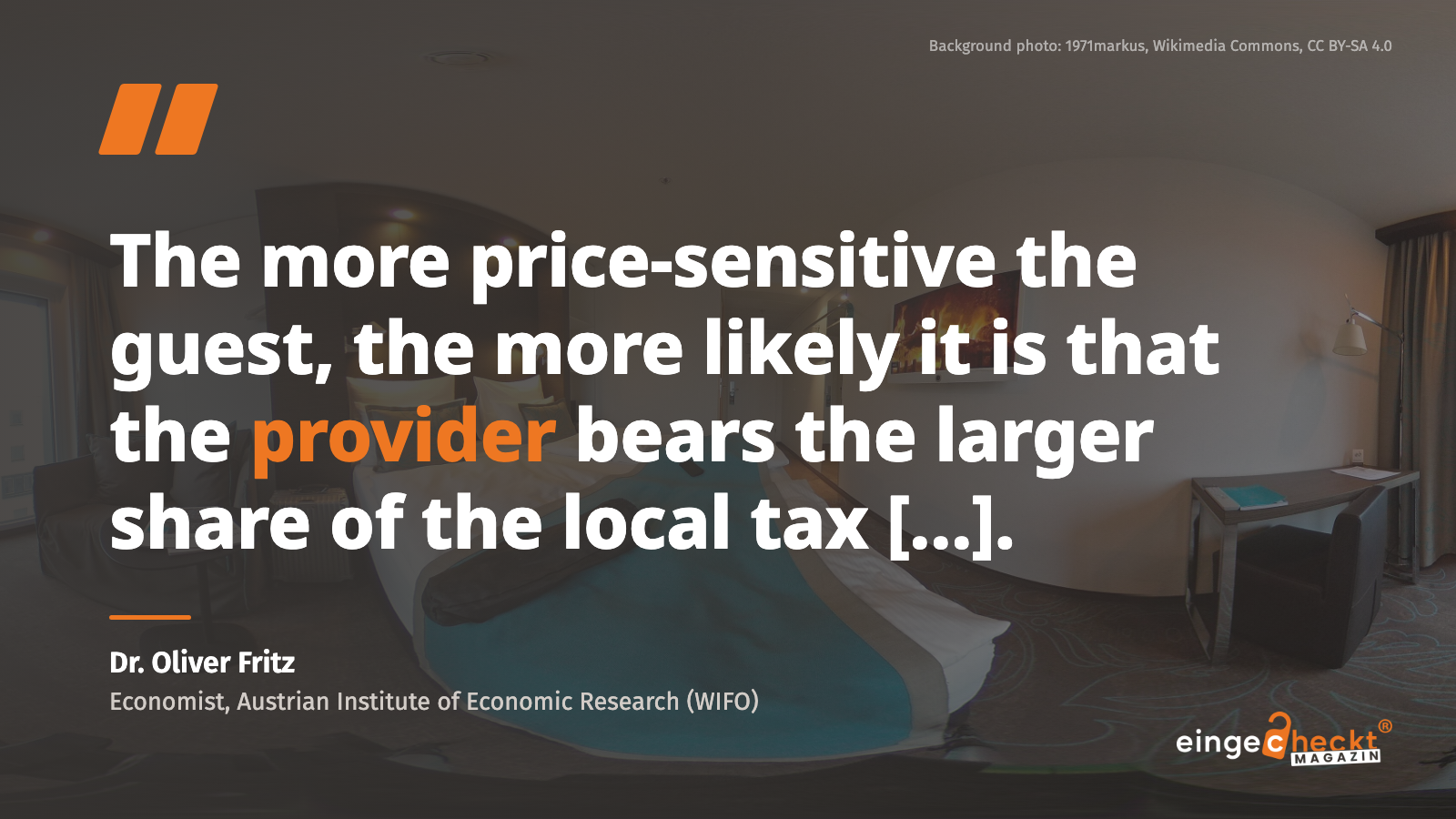
“The more price-sensitive the guest, the more likely it is that the provider bears the larger share of the local tax (or of an increase in it) – and vice versa, of course.”
A hotel cannot therefore necessarily pass the additional burden on to its guests in full. If it charges a higher total price, it may risk losing bookings. If the final price remains unchanged, part of the burden may come out of its own margin.
Fritz points out that such effects are usually shared between both sides of the market. Especially in view of higher operating costs, this could become a problem for hoteliers.
He sees different conditions for a business hotel or an upscale property than for a holiday apartment that mainly appeals to budget-conscious families.
The Viennese model relies on a percentage-based levy

Many municipalities charge a fixed amount per night. Vienna, by contrast, calculates its local tax as a percentage of the room rate – the more expensive the room, the higher the levy. Norbert Kettner sees precisely this as an important advantage of the Viennese model.
“Proportionality is key: the local tax is linked to the room rate as a percentage. Those who stay more cheaply therefore also pay less.”
He refers to research by Prof. Matthias Firgo of Munich University of Applied Sciences. The study on tourism levies in German municipalities, published in 2025, does indeed conclude that percentage-based levies can be less economically distorting than fixed amounts per night.⁶
It examined 49 German municipalities outside Bavaria that introduced new tourism taxes or levies between 2008 and 2019. The analysis also shows that cities with major cultural attractions and significant business travel tend to be less vulnerable to demand-related disadvantages from additional levies.

However, the study stresses that its results are of limited transferability. It is no proof that a particular level of tax will have no consequences for Vienna.
Kettner nevertheless sees the Austrian capital in a strong position thanks to its cultural offering, its infrastructure and its international appeal.
Where the additional revenue goes
For the City of Vienna, the local tax is also a means of financing public services. It was raised as part of the city’s budget consolidation.³
“The revenue from the local tax goes directly into the City of Vienna’s central budget and is not earmarked,” explains Kettner.
He points out that investment in infrastructure and quality of life benefits residents and guests alike. After all, hotels also benefit from a well-functioning city.
The industry association, on the other hand, would like to see more of the money used for tourism purposes, for example to help hotels and restaurants adapt to climate change.²
Fritz considers earmarking particularly sensible when there is a recognisable link between the levy and the services it finances. This could concern tourism infrastructure, but equally measures to reduce the negative effects of tourism on residents.
So the issue is not only how high a visitor levy is, but also what benefit guests, businesses and residents derive from it.
What other cities can learn from Vienna
Amsterdam shows that visitor levies can also be used to manage tourist demand. There, the tourist tax currently amounts to 12.5 per cent of the room price excluding VAT.⁷
Fritz cites the Dutch capital as an example of a city that also wants to influence visitor growth with such instruments. However, this only works if travellers react sensitively enough to the higher price.
For Vienna, the economist does not expect the higher local tax to cause a significant drop in visitor numbers. What matters, he says, are the international guest structure and the destination’s particular strengths.
German cities are also facing similar questions.
Winter as the next test

In Vienna, attention is now turning to the Christmas season. In December 2025, the city recorded around 2.2 million overnight stays. According to the Vienna Tourist Board, average room occupancy was around 90 per cent.
Kettner also expects high demand for December 2026.
“According to current forecasts, occupancy in December is likely to be at the high level of the previous year.”
At the same time, he says, bookings are increasingly being made at short notice. January and February, by contrast, are traditionally quieter months for travel, when targeted reasons to visit become particularly important.
The debate about the local tax is therefore unlikely to end with the Christmas season.
For Vienna shows that two developments can happen at the same time: a city can be successful in tourism while individual hotels are under economic pressure. A higher visitor levy can help finance public services without being equally easy for every business to absorb.
For other cities, the key lesson therefore lies less in a particular percentage. What matters more is looking at local demand, the economic situation of accommodation providers and the use of the revenue together.
This article is based on information from the City of Vienna, industry and tourism statistics, a study on tourism levies and original written interviews. As of 29 October 2026.
-
City of Vienna (2026)
Ortstaxe
Information page, accessed on 29 October 2026. Tax rates and assessment basis until 30 June 2026, from 1 July 2026 and from 1 July 2027. Original publication in German. -
Vienna Chamber of Commerce (2026)
Wiener Hotellerie fordert Aussetzen der Ortstaxen-Erhöhung
Article dated 30 September 2026. STR hotel benchmark for August and demands by the Vienna Chamber of Commerce and ÖHV. Original publication in German. -
ORF Wien (2026)
Diskussion über Ortstaxen-Erhöhung
Article dated 30 September 2026. Phased increase of the local tax, budget consolidation and the city’s position. Original publication in German. -
Tageskarte (2026)
Nach Ortstaxenerhöhung: Österreichs Stadthotels gewinnen, nur Wien verliert
Article dated 25 October 2026. RevPAR trends in Vienna and on average across Austrian cities in September. Original publication in German. -
Vienna Tourist Board (2026)
Tourismuskennzahlen auf einen Blick
Statistics page, accessed on 29 October 2026. Overnight stays, accommodation revenue and hotel capacity in Vienna. Original publication in German. -
Bavarian Centre for Tourism / Munich University of Applied Sciences (2025)
Erwartbare Auswirkungen eines abgabenfinanzierten Tourismus auf bayerische Destinationen
Project report published in January 2025. Empirical analysis of new tourism levies in 49 German municipalities (project lead Prof. Dr. Matthias Firgo). Original publication in German. -
City of Amsterdam (2026)
Tourist tax
Information page, accessed on 29 October 2026. Rate and assessment basis of Amsterdam’s tourist tax on overnight stays.


