


Key points
- The German Hotel Association warns that hotels are receiving more warning letters over music in their Instagram, Facebook and TikTok posts.
- According to media law expert Thomas Hoeren, the music the apps offer is not automatically licensed for hotel advertising.
- The Frankfurt Regional Court rejected a claim for 95,750 euros but confirmed that the music had been used unlawfully.
- Hotels should review and document older posts and use music cleared for commercial use in new Reels.
A quick look inside the hotel suite, a camera pan across the breakfast buffet or a few seconds of sunset on the terrace. Add a matching song from Instagram’s music library and the next Reel is ready. This has long been part of everyday hotel marketing, but it can have copyright consequences. The German Hotel Association is currently warning of a growing number of warning letters. eingecheckt® asked media law expert Prof. Dr. Thomas Hoeren of the University of Münster what lies behind the claims and how hotels can put their social media posts on a safer legal footing.
More warning letters, but no new ban
At the end of October 2026, the German Hotel Association (IHA) published a warning that is particularly relevant to smaller hotels. In it, lawyer Mathias Iking describes how hotels are increasingly receiving warning letters over music in their social media posts. The complaints concern posts on Instagram, Facebook and TikTok, in some cases including posts that are several years old. The letters demand cease-and-desist declarations, damages and reimbursement of costs. According to the association, the amounts claimed are in some cases in the mid to high four-figure range.¹
For Prof. Dr. Thomas Hoeren, Director of the Institute for Information, Telecommunication and Media Law at the University of Münster, this is not the result of stricter legislation. “The hotel association’s warning concerns stepped-up enforcement. There is no new general ban on music behind it.”
So the problem is not new. What has changed above all is that rights holders, or the companies they commission, appear to be taking action against such posts more often. For hoteliers, this does not mean they have to give up videos with music. But they should pay closer attention to where the music comes from and what usage rights come with it.
A song in the app is not a licence
The misunderstanding often starts in the app itself. Instagram and TikTok make it extremely easy to add popular songs to videos. A few taps are enough to combine a clip with a song and publish it.
Hoeren sees this as a key cause of the problem: “What Instagram or TikTok technically offer for selection is not automatically licensed for hotel advertising.”
Instagram’s standard music library is generally intended for personal, non-commercial use. TikTok also distinguishes between private and business use. In addition, a piece of music can involve different rights: the copyright in the composition and, where applicable, the lyrics, as well as rights in the specific recording.²
Existing licence agreements between GEMA, the German music rights society, and the platforms do not settle every question either. Combining music with a video for commercial purposes may require additional rights that have to be obtained directly from the rights holders.³
For hotels, the crucial point is therefore not only whether a song is available in the app, but whether its use is actually permitted for the specific business purpose.
Hotel advertising or a private post?
A business post does not have to be a classic advert. Simply showcasing a room, a restaurant or the spa can serve to market the hotel. A booking link or paid advertising is not required.
DEHOGA Baden-Württemberg, the regional hospitality association, warned against the commercial use of Instagram’s standard music library as early as July 2025. The association pointed in particular to business profiles that publicly promote their services.⁴ However, there is no fixed threshold based on follower numbers or the account label.
“What matters is the purpose of the post, not just the label of the account,” Hoeren explains.
This also applies to posts by employees. If a member of staff shares a personal impression of her workplace, that can be a private post. If, on the other hand, she produces a promotional video on the hotel’s behalf, its purpose remains commercial even on her private profile. Conversely, simply working at a hotel does not automatically turn every private post into advertising.
14 seconds of music and a claim for 95,750 euros
A judgment by the Frankfurt am Main Regional Court of 9 September 2026 shows how far apart views on appropriate damages can be.
A company had picked the song “Freed from Desire” from TikTok’s standard music library for a 14-second promotional video. The rights agency that brought the claim then demanded 95,750 euros in damages, based on 250 euros per day of use, extrapolated over 383 days.⁵
The court found that the use had been unlawful and negligent. The defendant was not entitled to assume that, because TikTok offered the track, its commercial use was also permitted.
Nevertheless, the court dismissed the claim in full. The claimant had not presented any reliable licensing practice or other sufficient basis on which the fee demanded could be determined in a comprehensible way. The judgment is not yet final.
For Hoeren, this is the key message for hotels affected: “Even a justified complaint does not justify every invoice.”
No generally appropriate amount per Reel can be derived from this, he says. What counts is the objective licence value and the specific circumstances of use, such as the extent, duration and economic significance of the use.
Other individual cases show that considerably lower claims can also be a burden for small businesses. Händlerbund, a German retail association, reported a demand for a retrospective licence fee of 5,300 euros for an Instagram video.⁶ A travel agency in Kassel paid a total of 2,600 euros including legal fees after its lawyer negotiated.⁷ These cases are no basis for a general price range.
A lawsuit filed by Sony Music against Marriott in the US in 2024 showed that the issue also affects large hotel companies. Sony challenged 931 allegedly unauthorised uses of music in social media posts. In October 2024, the case was dismissed with prejudice; whether an out-of-court settlement was reached has not been publicly confirmed. The US legal situation cannot be transferred directly to German hotels.⁸
Cleaning up old Reels without deleting everything
So what should hoteliers do with their existing Instagram and TikTok posts? Hoeren advises a structured approach rather than hasty deletions.
“I would start with a structured review: which posts contain which music, and what proof of licences is there?”
Before making any changes, the posts concerned should be documented internally, including dates and available reach figures. Where rights are missing or cannot be clarified quickly, Hoeren recommends removing the music, replacing it with suitably licensed music or taking the post out of public view for the time being.
- Take stock: Check older Reels, Stories and other videos on Instagram, Facebook and TikTok for the music used.
- Document the use: Save the track, post, publication date, available reach figures and any proof of licences.
- Defuse problematic posts: Remove the music, replace it with suitably licensed tracks or temporarily take the post out of public view.
- Protect new posts: Only use music whose clearance covers the commercial purpose, the platform in question and the specific type of use.
- Have warning letters checked: Note deadlines immediately, do not ignore the letter, and neither pay nor sign a cease-and-desist declaration without having it checked.
The distinction in time matters: hiding a problematic Reel or removing the music can stop further use. It does not make possible claims for the past go away.
Safe alternatives for Instagram and TikTok
The choice of legally suitable music is by no means limited to a handful of unknown tracks. Both Meta and TikTok offer their own libraries for commercial content. The key is not to carry a clearance over to other platforms.
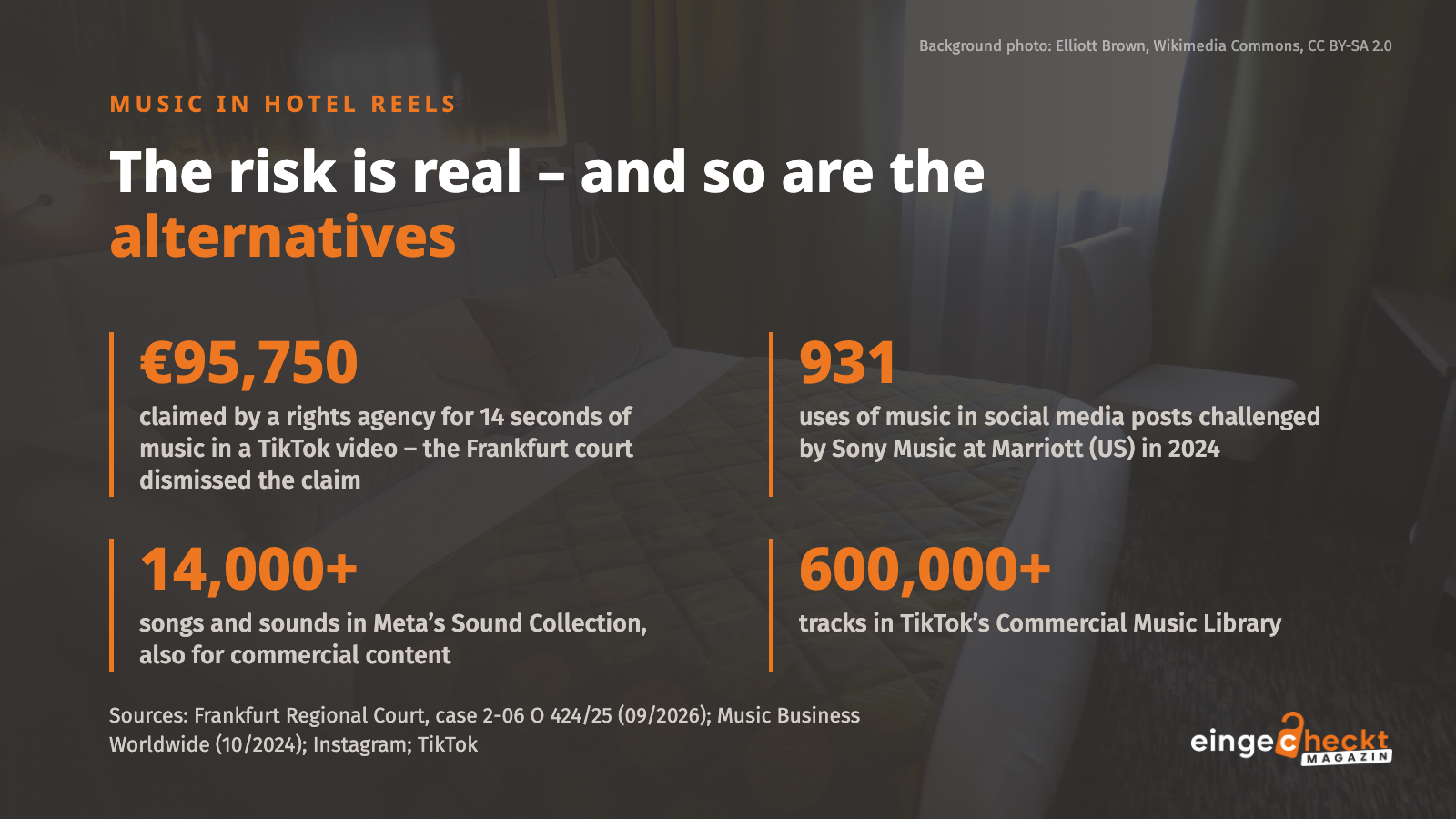
Meta Sound Collection: According to Instagram, more than 14,000 royalty-free tracks and sounds, also for commercial content. For use within Instagram and Facebook, not automatically on TikTok.⁹
TikTok Commercial Music Library: According to TikTok, more than 600,000 tracks for commercial content, for organic posts and advertising. The clearance applies within TikTok’s licence terms; in the app, the library is available to business accounts.¹⁰
External music libraries: Suitable if commercial use is expressly licensed, including the planned platforms, durations, advertising and, where relevant, client work.
Your own music and recordings: An option if all the necessary rights actually lie with the hotel. Your own recording of someone else’s song, however, is not automatically free to use.
Three common questions from everyday hotel life
Do all old posts have to be deleted?
No. According to Hoeren’s advice, deleting everything is not necessary. The first step is to check the rights and document the posts. Where the legal situation is unclear, it may be enough to take the post out of public view until things have been clarified.
Does the problem also apply to Instagram Stories?
Yes. The distinction between private and commercial use of music also applies to Stories. The fact that they are usually only visible for a short time does not automatically make unauthorised use permissible.²
What if an agency or influencer created the Reel?
Hotels should check the music rights in this case too. What matters is whether the licences obtained cover the specific use, in particular publication on the hotel’s channels or additional use as advertising. Who is responsible for a possible infringement in an individual case depends on the circumstances and agreements.
Music is still possible – with the right rights
For small hotels, the current wave of warning letters does not have to become a complicated legal project. Clear documentation, defined responsibilities for social media and a conscious choice of music cleared for commercial use can already make a significant difference.
Hoeren sums up the real difficulty aptly: “The user interface gives the impression that you may use anything you can add with a single click.” Precisely because Reels are so easy to produce, the legal limits are easily overlooked.
Hotels that review their existing posts and pay attention to suitable music sources in future can significantly reduce this risk without giving up social media marketing with music.
This article by eingecheckt® provides a general overview of music use on social media and does not replace legal advice in individual cases.
This article is based on industry reports, guidance from GEMA and the platforms, reports on court decisions and an original written interview. Research as of 27 October 2026.
-
Hotel vor9 (2026)
Hotelverband warnt vor Abmahnungen für Hotelposts mit Musik
Report dated 26 October 2026. Warning from the German Hotel Association based on a guest article by lawyer Mathias Iking, claims and recommendations. Original publication in German. -
GEMA (2026)
Für eine Story/ein Reel auf Instagram möchte ich Instagrams Musikbibliothek nutzen. Was muss ich dabei beachten?
Help page, accessed 27 October 2026. Private and commercial use of Instagram’s music library in Stories and Reels, synchronisation rights. Original publication in German. -
GEMA (2024)
Musik auf Instagram: Das ist erlaubt
Article dated 25 June 2024. Scope of the GEMA licence for Instagram and further rights in music recordings. Original publication in German. -
Tageskarte (2025)
Achtung Abmahnung – Musikbibliothek auf Instagram nicht für gewerbliche Zwecke nutzen
Report dated 21 July 2025. Guidance from DEHOGA Baden-Württemberg on business accounts and Meta’s Sound Collection. Original publication in German. -
Händlerbund (2026)
Fast 100.000 Euro für TikTok-Musik? Gericht weist Riesenforderung ab
Report dated 24 September 2026. Judgment of the Frankfurt am Main Regional Court of 9 September 2026, case no. 2-06 O 424/25. Original publication in German. -
Händlerbund (2026)
5.300 Euro wegen eines Reels: Musiknutzung auf Social Media bleibt teures Pflaster
Report dated 31 July 2026. Warning letter demanding a retrospective licence fee for an Instagram Reel. Original publication in German. -
touristik aktuell (2025)
Abmahnung wegen Instagram-Reel: Reisebüro zahlt 2.600 Euro
Report dated 30 October 2025. Case of a travel agency in Kassel. Original publication in German. -
Music Business Worldwide (2024)
Sony Music settles lawsuit against Marriott Hotels over alleged ‘rampant’ infringement in social media posts
Report dated 9 October 2024. Sony Music’s lawsuit against Marriott and the dismissal of the case. -
pressure magazine (2026)
Abmahnung wegen Musik in Reels: Was jetzt gilt
Report dated 24 October 2026. Instagram’s figures on the size of Meta’s Sound Collection. Original publication in German. -
TikTok for Business (2026)
Explore royalty-free music in our Commercial Music Library
Article, accessed 27 October 2026. Size and use of the Commercial Music Library.


