


Key points
- Relative to the number of businesses, insolvencies in German hospitality were over 60 per cent above the average from January to August 2026.
- Only transport and storage was higher. At the same time, 4.5% more larger businesses were founded in Germany.
- According to IWH researcher Steffen Müller, hospitality has always ranked high, partly because so many businesses start up in it.
- The IWH’s leading indicators have recently declined. There is, however, no separate forecast for hospitality.
Germany’s hospitality sector remains among the industries with the highest insolvency rates. Yet across the wider economy, business start-ups are also increasing. Behind these seemingly contradictory developments lies a combination of longstanding structural risks, economic pressures and the legacy of earlier crises. Insolvency researcher Professor Steffen Müller explains what the figures really tell us – and why there may be grounds for cautious optimism towards the end of 2026.
An industry under considerable pressure
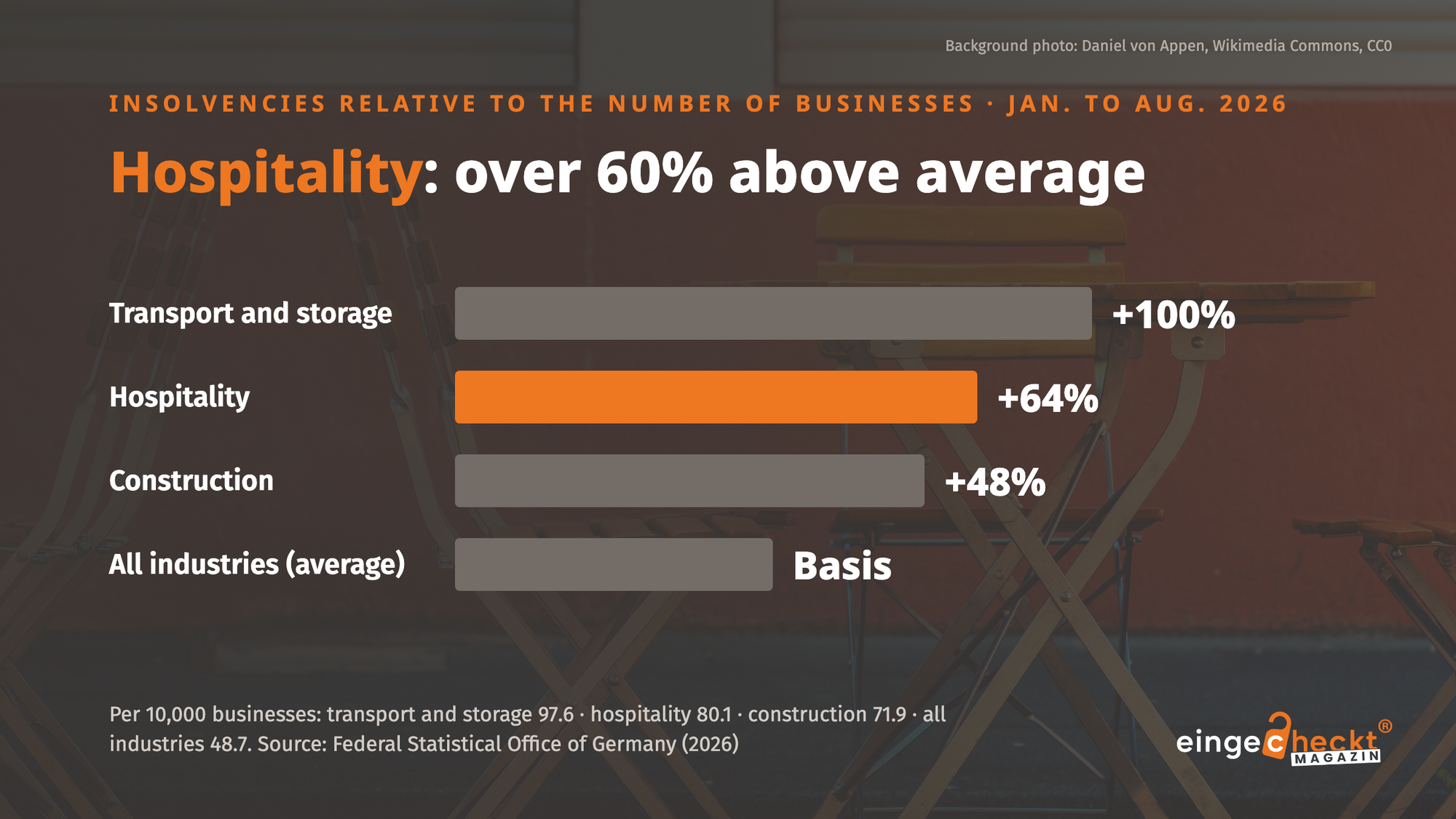
The latest figures from Germany’s Federal Statistical Office paint a striking picture. During the first eight months of 2026, German courts recorded 17,252 corporate insolvency filings, an increase of 6.6% compared with the same period a year earlier. August alone accounted for 2,067 cases, up 4.4% year on year. Particularly noteworthy is the position of hospitality: relative to the number of businesses, its insolvency rate was over 60 per cent above the average across all industries – 80.1 compared with 48.7 cases per 10,000 businesses.¹
Only transport and storage recorded a higher rate, at 97.6 insolvencies per 10,000 businesses, while construction followed hospitality with 71.9. These figures cover January to August 2026 and take the number of businesses in each industry into account, making them more meaningful for comparison than absolute case numbers. However, the published data do not establish how much the insolvency rate in hospitality itself has changed compared with the previous year.
Another detail illustrates why headline figures deserve closer examination. Although the number of insolvencies has risen, creditors’ reported claims have fallen, from approximately €37.2 billion during the first eight months of 2025 to €25.9 billion in the corresponding period of 2026. According to the Federal Statistical Office, this reflects the greater number of economically significant companies entering insolvency proceedings in the previous year. The number of cases alone therefore reveals relatively little about their overall financial impact.¹
Businesses are failing – but others are being created
Alongside the insolvency statistics, the Federal Statistical Office published new business formation figures on 13 November. They reveal another side of the German economy. During the first three quarters of 2026, around 103,700 businesses classified as being of greater economic significance were established, representing an increase of 4.5% year on year. Meanwhile, the number of complete closures within this category fell by 2.4% to approximately 72,500. Across all categories, around 525,100 new businesses were registered, up 7.7% from the previous year.²
These figures relate to the economy as a whole and cannot be interpreted as evidence of an equivalent rise in new hotels or restaurants. They do, however, demonstrate that increasing insolvencies do not necessarily coincide with declining entrepreneurial activity. Business closures and insolvencies are also different measures: not every company that ceases trading does so because it is unable to pay its debts. Equally, the number of new businesses established says little about how many will survive in the longer term.
Why hospitality has always been a high-risk industry
For Professor Steffen Müller, Head of the Labour Markets Department and of insolvency research at the Halle Institute for Economic Research (IWH), hospitality’s position near the top of the insolvency rankings is nothing new. In a written interview with eingecheckt®, he explains: “Hospitality has traditionally been one of the industries with the highest probability of insolvency, regardless of the current crisis.”
One important reason, he argues, is the substantial number of businesses regularly entering the market. Newly established companies generally face a higher risk of insolvency than their more established counterparts, and this is by no means unique to hospitality. Nevertheless, the pattern is particularly relevant when examining the sector’s long-term insolvency record.
This distinction matters. A high industry-wide insolvency rate may partly reflect the composition of a market in which new businesses are constantly being established. Hospitality’s second-place ranking does not automatically mean that the financial position of an individual hotel which has been operating successfully for years has deteriorated to a comparable degree.
Are hotels and restaurants affected differently?
Official German statistics group accommodation and food-service businesses together within the hospitality sector. Yet for hoteliers, the distinction between the two would be particularly valuable. Are restaurants and hotels experiencing similar pressures, or are their insolvency patterns substantially different?
Here, the researcher is careful not to draw conclusions beyond the available evidence. He does not have figures that would allow him to distinguish reliably between hotels and restaurants. He does, however, consider the explanation involving frequent new business formation more relevant to restaurants than to hotels. That observation should not be interpreted as proof that hotels are inherently safer businesses. Rather, it highlights why more detailed figures would be valuable when assessing the different parts of the hospitality industry.
The lasting effects of earlier economic conditions
The causes of today’s elevated insolvency figures reach back several years. According to the researcher, there were indeed delayed effects from the coronavirus pandemic, although these were concentrated primarily between 2022 and 2024 or 2025. Some businesses that had been able to continue operating during the pandemic subsequently faced renewed financial difficulties.
The prolonged period of low interest rates also played a part. Cheap financing had made it easier for heavily indebted companies to remain in business. When the European Central Bank began raising interest rates in 2022 in response to inflation, that environment changed. Borrowing costs increased rapidly, placing further pressure on companies already carrying substantial debt. Some of the insolvencies recorded today therefore reflect financial circumstances that developed well before 2026.
For hospitality, the economist identifies another potential factor: Germany’s substantial increase in the statutory minimum wage in October 2022, when it rose to €12 gross per hour.³ In his assessment, this change is likely to have had a particularly noticeable impact on the sector. It remains his economic interpretation, however, rather than a statistically established measure of how much that increase contributed to the current number of insolvencies.
A cautious sign of improvement
There is still little justification for declaring that the situation has improved. The IWH Insolvency Trend published on 5 November recorded 1,683 insolvencies among partnerships and corporations in October 2026. This represented an increase of 9% compared with October 2025 and an 83% rise against the average October figure for the years 2016 to 2019. Across the largest 10% of insolvent companies, approximately 16,800 jobs were affected, according to the institute’s calculations.⁴
Despite these figures, the IWH has identified early indications of a possible shift. Its leading indicators, which typically precede actual insolvencies by two to three months, have declined recently.⁴ “We see that pre-insolvency activity has decreased slightly in recent months,” Steffen Müller tells eingecheckt®. He therefore expects a modest reduction in the number of actual insolvencies as well.
Crucially, this is not yet a specific forecast for hospitality. The IWH has not broken down its expected decline by industry. Whether hotels and restaurants will benefit from any broader improvement therefore remains uncertain.
What the figures show – and what they don’t
The latest statistics describe an industry with a longstanding exposure to insolvency risk, whose businesses have also had to contend with significant changes in the economic environment. These pressures do not affect every company simultaneously or to the same extent. Reducing the current situation to a single explanation – whether the pandemic, rising financing costs or higher wages – would overlook that complexity.
For hotel operators, the distinction between long-term industry characteristics and more recent economic pressures is particularly important. Hospitality’s high insolvency rate is a serious finding, but it is not a verdict on the prospects of every individual hotel. Whether the early positive signals towards the end of 2026 mark the beginning of a more sustained improvement will become clearer in the months ahead.
This article draws on official German statistics, economic research publications and an original written interview.
-
Federal Statistical Office of Germany (Destatis) (2026)
Unternehmensinsolvenzen im August 2026: +4,4 % gegenüber August 2025 (Business insolvencies in August 2026: up 4.4% on August 2025)
Press release No. 398, 13 November 2026. Insolvencies from January to August 2026, insolvency rates by industry and creditors’ claims. Original publication in German. -
Federal Statistical Office of Germany (Destatis) (2026)
4,5 % mehr Gründungen größerer Betriebe im 1. bis 3. Quartal 2026 (4.5% more start-ups of larger businesses in the first three quarters of 2026)
Press release No. 399, 13 November 2026. Business start-ups and closures in the first three quarters of 2026. Original publication in German. -
Federal Ministry of Labour and Social Affairs (2022)
Gute Arbeit verdient mehr. 12 Euro Mindestlohn. (Good work deserves more. A minimum wage of 12 euros.)
Article, 1 October 2022. Increase of the statutory minimum wage to 12 euros from 1 October 2022. Original publication in German. -
Halle Institute for Economic Research (IWH) (2026)
IWH-Insolvenztrend: Firmenpleiten verharren im Oktober auf hohem Niveau, Lichtblick zum Jahresende (Insolvencies remain high in October, a glimmer of hope for the end of the year)
Press release, 5 November 2026. Insolvencies in October 2026, jobs affected and leading indicators. Original publication in German.


