


Key points
- At the end of September, Patrizia bought the B&B Hotel Berlin Tiergarten, a young property with 186 rooms and a long-term lease.
- According to Christie & Co, average room rates and RevPAR reached record highs in September. Even so, over half of the operators surveyed report falling margins.
- Buyers are looking for well-located properties with development potential and sound operators. Smaller hotels with an investment backlog are struggling.
- Christie & Co advises private hoteliers to seek early, realistic advice on a sale or succession.
At the end of September, a hotel in Berlin changes hands. Art-Invest Real Estate is selling the B&B Hotel Berlin Tiergarten to the real estate investor Patrizia. The property has 186 rooms, is centrally located in Charlottenburg and was only completed in 2016. It is a hotel property with a long-term lease – B&B Hotels remains on board as the operator. The parties have agreed not to disclose the purchase price.¹
The sale comes at a time when the economic news from the hotel industry is far from consistently positive. Many operators are grappling with rising costs, higher leases and margins that are coming under pressure despite decent room revenue. At the same time, investors are still looking for attractive hotel properties. What sounds contradictory at first reflects two different economic perspectives: while operators have to earn their money in day-to-day hotel business, real estate investors are primarily interested in sustainable income, reliable contractual partners and the long-term development of a property.
For the eingecheckt® magazine, we asked two experts from the real estate consultancy Christie & Co: Alexander Apitzsch, Senior Consultant Advisory & Valuation Services, and Robin Barth, Associate Director Investment & Letting. Both observe the German hotel market from different angles – one with a focus on valuation and advisory, the other on hotel transactions.
When higher room rates are no longer enough
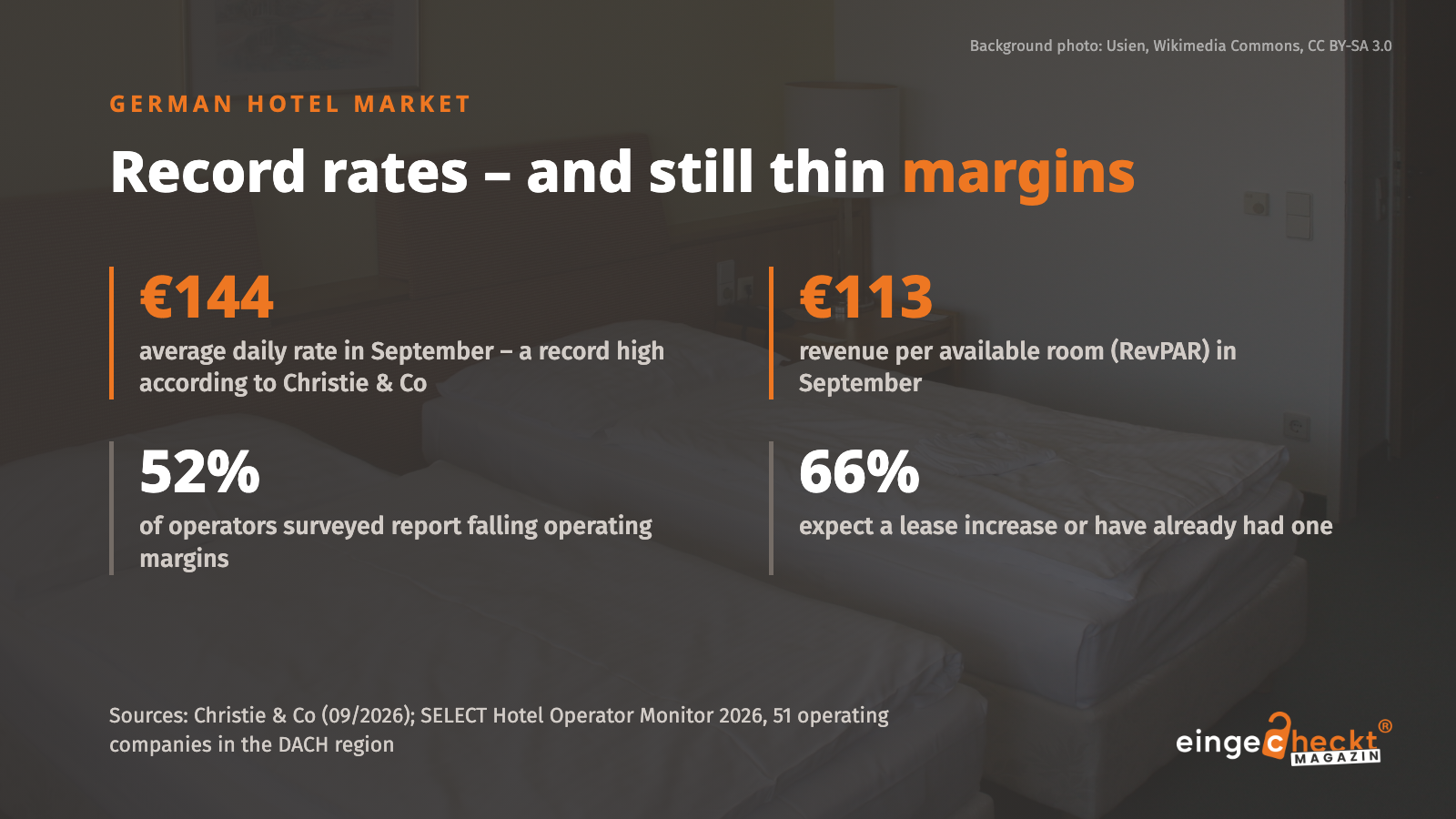
The SELECT Hotel Operator Monitor 2026 shows just how strained the economic situation of many operators has become. For the study, 51 hotel operating companies from Germany, Austria and Switzerland were surveyed in the spring. 52 per cent of the companies that responded reported falling operating margins, and 46 per cent saw their operating cash flow decline. At the same time, 66 per cent expect their lease to increase or have already been notified of or experienced such an increase.²
The study mainly covers larger hotel operating companies and is therefore not a representative picture of every individual hotel. But it does show how far revenue trends and actual profitability can now drift apart. After all, a higher room rate does not automatically improve operating profit if staff, energy, financing and leases become more expensive at the same time.

Alexander Apitzsch has observed an interesting development. According to him, the German hotel market reached an average daily rate of around 144 euros and revenue per available room (RevPAR) of around 113 euros in September. He describes both figures as historic highs. Operating business has picked up momentum again since the summer, he says, supported in part by the slower growth in hotel supply in recent years.
However, this does not yet mean a thorough easing of the situation. Apitzsch points to the significantly higher cost base that many businesses now have to carry. His conclusion: “The market is therefore gaining operational momentum this autumn, but given the higher cost base, a broad-based recovery in margins cannot yet be derived from this.”
The Treugast Rating 2026, published in early October, comes to a similar conclusion. Even established hotel companies lost around two per cent of their rating points on average compared with the previous year. Motel One and B&B Hotels nevertheless held on to their top positions with the highest rating, AAA.³ The rating assesses the economic strength and operator quality of hotel companies, not the quality of individual properties from the guest’s point of view.
Why some hotels remain in demand
The Berlin sale shows what investors may be looking for in this market environment. The B&B Hotel Berlin Tiergarten is in a central city location, is comparatively new and has a long-term contract with an established hotel group. This gives the property several features that can be attractive to buyers. Whether, and on what terms, the investment actually pays off for Patrizia cannot be judged without knowing the purchase price, however.

Robin Barth observes that buyers now distinguish very carefully between different hotel properties. Particularly in demand, he says, are operator-free properties in good locations where additional value can be created through modernisation, repositioning or working with a new operator. But hotels that are already leased also find buyers, provided the operator is financially sound, the income appears sustainable and the asking price is in line with the market.
The situation is much more difficult for smaller hotel properties with a considerable investment backlog, he says. Anyone who takes over such a property may have to finance extensive modernisation, technical upgrades or energy-efficiency measures in addition to the purchase price. These additional investments – known in the real estate industry as CapEx – can make a transaction considerably more difficult.
Market figures also show that investors are by no means buying hotels indiscriminately. According to Cushman & Wakefield, the transaction volume for German hotel properties in the first half of 2026 was around 600 million euros, compared with around 1.1 billion euros in the same period of the previous year.⁴ So the market as a whole has not entered a new buying frenzy. Rather, demand is focusing more strongly on properties whose location, condition and economic prospects are convincing.
The lease becomes a shared question of risk
One particularly sensitive issue is now the relationship between hotel owners and operators. Many hotels are not run by their owners themselves but are leased to hotel companies on a long-term basis. For the investor, this promises regular income; for the operator, it means a fixed financial obligation – regardless of how well business is going in any given month.
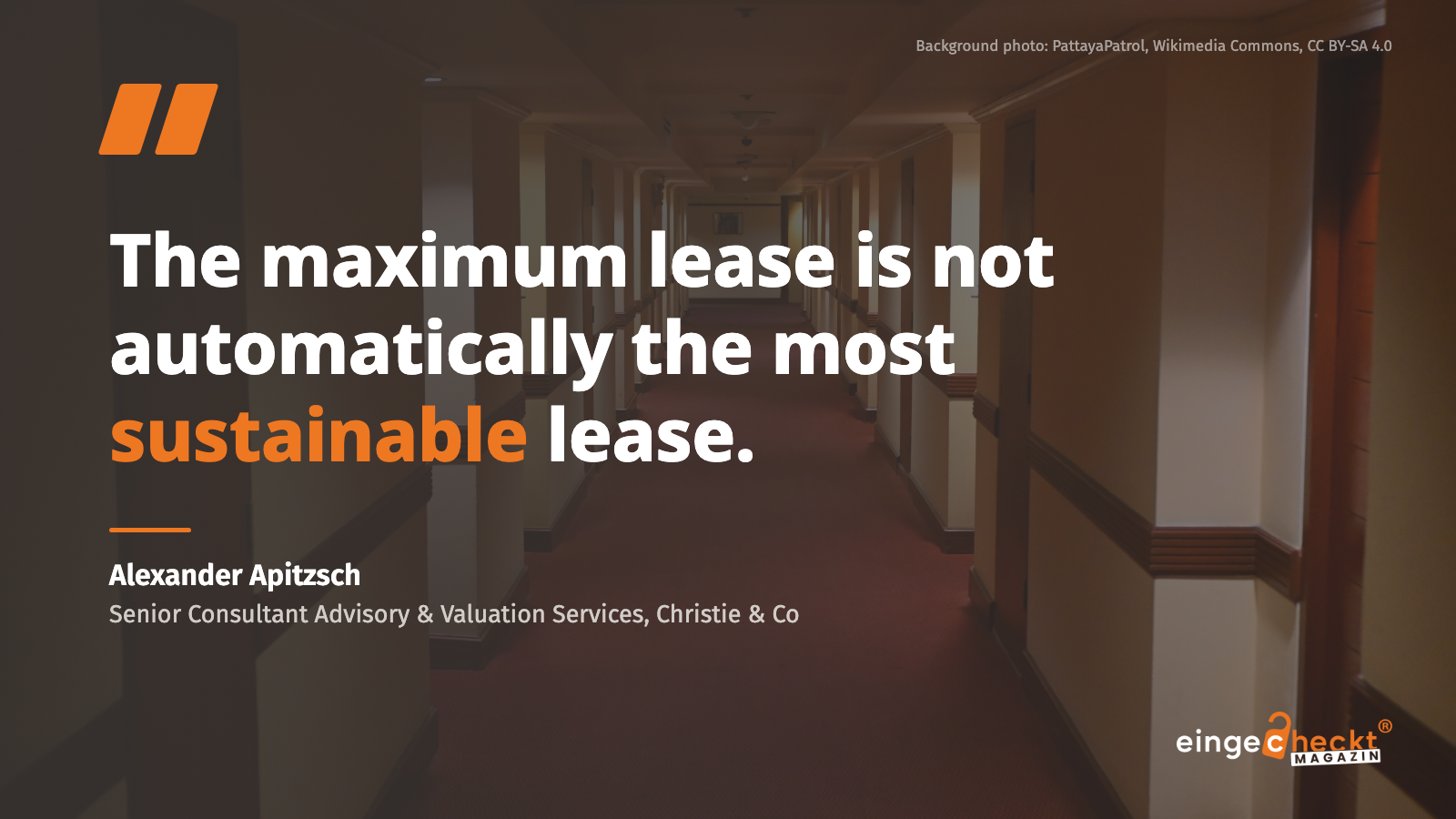
“The maximum lease is not automatically the most sustainable lease,” says Alexander Apitzsch. If costs and contractually agreed lease increases grow faster than the hotel’s earning power, the operator comes under pressure first, he explains. In the long term, however, this also becomes a problem for the owner. Investments could be postponed, renegotiations become more likely and the financial stability of the contractual partner could suffer.
Apitzsch therefore sees more flexible contract models gaining in importance. These include hybrid leases, which combine fixed components with components linked to revenue or earnings, as well as contractual caps on certain lease increases. Such agreements can help to share economic risks differently between owner and operator.
At the same time, in his view, cost pressure is changing hotel concepts themselves. More efficient limited-service hotels, serviced apartments and hostels are gaining in importance because their operating models can in part be organised with lower staffing and costs.
For other hotel concepts, this does not automatically mean that they are economically inferior. What matters is whether the operating structure, achievable revenue and contractual obligations fit together.
What this means for private hoteliers
For owners of smaller and family-run hotels, the situation is different again. Property, hotel business and personal life planning are often closely intertwined. Anyone who has built up a hotel over decades does not judge its value solely on the basis of balance sheets and future income. For a potential buyer, however, it is precisely these factors that play a decisive role.
Robin Barth therefore advises private hoteliers to look into the economic options for a sale or succession early on. “My advice to private hoteliers is to seek early, realistic advice on the prices achievable on the market and on the opportunities and risks of a sale or succession solution.”

The first step, he says, is to assess the value of the property, the economic condition of the hotel business and possible development potential as objectively as possible. A structured sales process with suitable groups of buyers can then improve the chances of a successful deal.
Barth considers early preparation to be crucial. Anyone who only starts thinking about a sale when major investments can no longer be postponed or an unresolved succession becomes a burden may have less room to negotiate.
A market in which reliability matters more
This autumn’s developments do not paint a picture of a hotel market in which everything is getting worse. Rather, they show an industry in which economic differences are becoming more pronounced. While some operators are growing despite rising costs and convincing investors of their long-term stability, others are coming under increasing pressure from high leases, modernisation needs and low financial reserves.
For owners of smaller hotels, the Berlin sale is not a success model that can be transferred directly. But it makes clear what buyers look for today and why the economic condition of a hotel business matters far beyond its daily room revenue.
After all, whether a hotel is of interest to an investor no longer depends solely on how many guests stay there. It increasingly also depends on how reliably those stays can generate income over the long term.
This article is based on current industry analyses, publications on the hotel investment market and original written interviews. As of 30 October 2026.
-
Art-Invest Real Estate (2026)
Art-Invest Real Estate verkauft B&B Hotel Berlin Tiergarten an PATRIZIA
Press release dated 30 September 2026. Sale of the B&B Hotel Berlin Tiergarten (186 rooms, completed in 2016) with a long-term lease. Original publication in German. -
Tageskarte (2026)
Trotz steigender Preise bleiben Margen der Hotels unter Druck
Article dated 15 September 2026. Results of the SELECT Hotel Operator Monitor 2026 (51 hotel operating companies in the DACH region) on margins, cash flow and leases. Original publication in German. -
Hotel vor9 (2026)
Treugast-Rating zeigt wachsenden Druck auf Betreiber
Article dated 6 October 2026. Results of the Treugast Rating 2026 on the operator quality of German hotel companies. Original publication in German. -
Cushman & Wakefield (2026)
Hospitality MarketBeat Germany H1 2026
Market report, accessed on 30 October 2026. Transaction volume in the German hotel investment market in the first half of 2026 and the same period of the previous year.


