


Key points
- 521 projects have applied to the “NaturMomente” competition run by Airbnb and the German Tourism Association for one million euros in rural tourism funding.
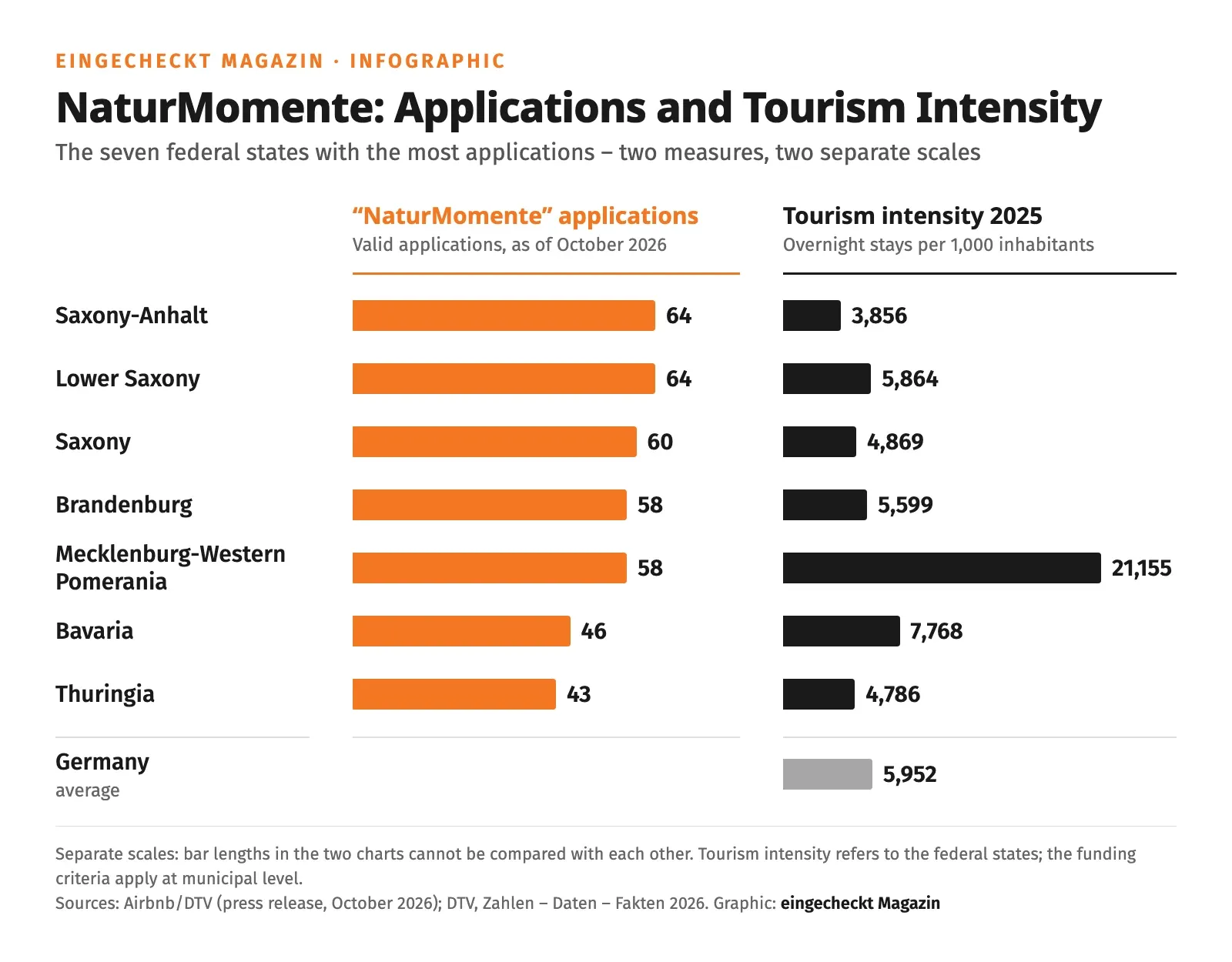
- 283 applications, or 54.3 per cent, come from the five eastern German states; Saxony-Anhalt shares first place with Lower Saxony at 64 each.
- Only 10 to 40 projects can be funded. The winners are due to be announced at the end of November 2026.
- Whether hotels and guesthouses benefit depends, according to the association, on linking new attractions with local businesses.
Saxony-Anhalt has one of the lowest levels of tourism intensity in Germany. Yet in a nationwide funding competition for rural tourism, it shares first place with Lower Saxony. In total, 521 projects have applied for one million euros, more than half of them from eastern Germany. Behind these figures lie questions that reach far beyond the competition run by Airbnb and the German Tourism Association: why is interest so strong in the east in particular, who benefits from new tourism offerings – and what role do existing hotels and guesthouses play?
In 2025, Saxony-Anhalt recorded around 3,856 overnight stays per 1,000 inhabitants. That is one of the lowest figures among Germany's federal states and well below the national average of 5,952.¹ And yet this very state produced one of the largest groups of applicants for the “NaturMomente” project competition. 64 projects were submitted, exactly as many as from Lower Saxony. They are followed by Saxony with 60 and by Brandenburg and Mecklenburg-Western Pomerania with 58 applications each.²
The joint competition run by Airbnb and the German Tourism Association (DTV) is intended to support tourism initiatives in rural regions that have so far benefited comparatively little from tourism. Airbnb is providing one million euros for this purpose. A total of 521 valid applications were received, 283 of them from the five eastern German non-city states. That corresponds to 54.3 per cent of all submissions.²
The geographical distribution raises questions that the application figures alone cannot answer. We therefore asked the German Tourism Association and compared the results with regional tourism statistics and the competition's participation conditions.
Why eastern Germany?
The figures become even more meaningful when the population of each federal state is taken into account. With around eight million inhabitants, Lower Saxony has almost four times as many people as Saxony-Anhalt with around 2.12 million. Nevertheless, 64 projects applied from each of the two states. Per million inhabitants, that equates to around eight applications in Lower Saxony compared with just over 30 in Saxony-Anhalt.³
The comparison between Mecklenburg-Western Pomerania and Bavaria is even more striking. While Bavaria, with around 13.25 million inhabitants, submitted 46 applications, Mecklenburg-Western Pomerania, with only around 1.57 million inhabitants, submitted 58. Relative to population, the application rate in Mecklenburg-Western Pomerania is therefore around 10.6 times as high as in Bavaria.³
This calculation shows above-average participation, but does not yet explain its causes.
In his written answers, Olaf Bentlage, press spokesperson for the German Tourism Association, points to the many rural regions in eastern Germany that have tourism potential but are not yet among the established destinations. The competition, he says, appears to have met a particular need for support there.
So far, however, there is no scientifically sound explanation for the regional distribution. “However, we have not examined the precise causes of the regional distribution,” says Bentlage.
A possible explanation can nevertheless be derived from the participation conditions. The competition is aimed at relatively sparsely populated municipalities with comparatively low tourism activity. Both characteristics could apply to numerous rural regions in eastern Germany. Whether the five eastern German non-city states actually have an above-average number of eligible municipalities, however, cannot be determined from the information published so far.
That would require an additional analysis: how many municipalities meet the funding criteria in each individual federal state? Only with this information would it be possible to judge whether the high number of applicants can be explained by the structure of the eligible regions or whether eastern German initiatives have in fact taken part at an above-average rate.
Mecklenburg-Western Pomerania shows why state averages can be misleading
Mecklenburg-Western Pomerania is a particularly revealing example. With 21,155 overnight stays per 1,000 inhabitants, the state recorded a considerably higher tourism intensity in 2025 than the German average. Saxony-Anhalt, by contrast, reached only 3,856, Thuringia 4,786 and Saxony 4,869.¹
The fact that Mecklenburg-Western Pomerania reaches such a high figure is likely to be closely linked to its established holiday regions on the Baltic Sea. This does not, however, mean that tourism is equally well developed throughout the entire state. Away from well-known resorts, the conditions for tourism can differ considerably.
This is precisely where the “NaturMomente” funding conditions come in. What counts is not the average of a federal state but the situation of the individual municipality. The participation conditions define sparsely populated regions with a maximum of 150 inhabitants per square kilometre as the target area and exclude highly developed tourist municipalities with more than 4.5 overnight stays per inhabitant.⁴
The current press release gives a threshold of 4.5 overnight stays per 1,000 inhabitants. This unit, however, contradicts the official participation conditions. For assessing the competition, the threshold set out there – 4.5 overnight stays per inhabitant at municipal level – is therefore decisive. The press release refers the selection to the year 2024.² ⁴
For Mecklenburg-Western Pomerania, this means that a busy coastal municipality may be excluded from funding, while a sparsely populated municipality inland may well meet the requirements. The high state average alone says nothing about this.
One million euros for a maximum of 40 projects
The competition was launched on 16 June 2026 under the patronage of Federal Minister of Agriculture Alois Rainer. Those eligible to apply included municipalities, tourism organisations, small and medium-sized enterprises, farms, associations and private individuals.⁵
The 521 projects submitted fall into four thematic areas. Culture and tradition is the most strongly represented, with 161 applications. This is followed by nature and environmental protection and by community-led tourism projects, with 144 submissions each. A further 72 projects deal with regional agriculture.²
In response to our enquiry, the DTV was not yet able to say which specific ideas occur particularly frequently within these categories. This would first require a more detailed analysis.
What is certain, however, is that only a small proportion of applicants can receive funding. The possible amounts are €25,000, €50,000 or €100,000. With a total budget of one million euros, the money is mathematically sufficient for 10 to 40 projects, provided the budget is fully used and awarded exclusively in these tiers. That corresponds to only around two to eight per cent of the 521 valid applications.⁴
The selection takes place in several stages. First, an internal expert team from Airbnb and the DTV and a specialist commission review the submitted projects. A seven-member jury then decides on the selection and the level of funding.
According to the published participation conditions, the jury comprises Professor Julian Reif of the German Institute for Tourism Research, Member of the Bundestag Dr Franziska Kersten, Jens Spanjer of Schlösser und Gärten in Deutschland, Birgit Grauvogel of Tourismus Zentrale Saarland and Franziska Schmieg of the Federal Association for Farm Holidays and Rural Tourism. They are joined by DTV Managing Director Norbert Kunz and, as Airbnb's representative, Kathrin Anselm. The current October press release, however, names Ellen Madeker instead of Anselm. Which of the two Airbnb representatives will actually take part in the final jury meeting has therefore not yet been clearly established.² ⁴
The assessment is based on seven criteria: environment and nature, quality of the visitor experience, economic added value, involvement of the local community, public-benefit orientation, innovation and transferability. Environment and nature carries the greatest weight at 25 per cent. The remaining criteria each count for between five and 15 per cent.⁴
The aim is therefore not to assess only how attractive an idea is for tourism. Its economic viability and its benefit for local people also play a role.
What Airbnb gains from the funding
For Airbnb, supporting rural tourism is not merely a matter of social engagement. At the same time, the company is moving into a market that matters for its further business development.
According to the company, almost two thirds of the overnight stays booked within Germany by German guests via Airbnb in 2025 were in destinations outside cities. The company also reports growth of 65 per cent for cabins and 45 per cent for farms between 2023 and 2025. The press release does not, however, specify which metric these two growth rates refer to.²
Airbnb co-founder Nathan Blecharczyk had already told the German Press Agency in March 2026 that Airbnb was deliberately focusing on rural areas. According to him, around 60 per cent of all Airbnb stays in Europe now take place outside urban regions. In many rural areas, he said, there are still only a few hotels or other places to stay. Airbnb had already launched similar funding initiatives in Spain, France and the United Kingdom.⁶
The funding can therefore serve two interests at once: rural regions receive support in developing new tourism offerings, while Airbnb could benefit from growing tourism demand away from the cities. Whether, and to what extent, the funded projects will actually generate additional bookings on the platform remains open for now.
Airbnb not only finances the funding budget but is also involved in the preselection and holds a seat on the jury. In addition, the participation conditions provide for limited veto rights for Airbnb and the DTV, for example in the event of legal violations or significant compliance problems.⁴
A comparison with an earlier funding competition shows why it is also worth looking at the contractual terms. For an Airbnb fund for unique accommodation planned in 2020, winners were to be required to offer their completed accommodation exclusively via Airbnb for at least twelve months. That earlier competition was initially suspended because of the coronavirus pandemic.⁷
No comparable exclusivity obligation can be found in the published participation conditions for “NaturMomente”. Instead, the requirements include interim reports and proof of how funds were used, a two-page final report and mention of Airbnb and the DTV in project-related communications. Reasonable participation in public relations activities may also be requested.⁴
However, the winners are still required to sign a separate project agreement before payment. Whether this contains additional marketing conditions cannot be determined from the documents publicly available so far.
New guests for the region – but where will they stay?
For existing hotels and guesthouses, a different question arises: who benefits economically from the newly created tourism offerings?
Olaf Bentlage certainly sees opportunities for smaller accommodation businesses. New nature, cultural and regional experiences could create additional reasons to travel, make lesser-known regions more attractive and possibly lead to longer stays.
The decisive factor, however, is cooperation with existing businesses. “What matters is that new offerings are connected with the existing businesses on the ground,” says Bentlage in the written interview.
For the hotel industry, this assessment is significant. A new cycle path, an agricultural experience or a cultural event can attract visitors. Whether they then stay in a local hotel, a guesthouse or a privately let holiday flat, however, depends on other factors.
A look at the official accommodation statistics at least shows that the various types of accommodation have recently developed differently. According to provisional data from the Federal Statistical Office, overnight stays in hotels, inns and guesthouses fell by 0.4 per cent in 2025. Holiday accommodation, by contrast, recorded a slight increase of 0.2 per cent, while campsites grew by 4.2 per cent.⁸
These figures do not, however, indicate any competitive advantage for private holiday lets over hotels. In principle, the statistics only cover accommodation establishments with at least ten beds or campsites with at least ten pitches. Smaller private holiday flats, such as those also offered on Airbnb, therefore remain largely outside this survey.
Whether growing tourism demand in rural areas will benefit traditional accommodation businesses or private providers more cannot, therefore, be answered with these data.
Without infrastructure, tourism potential remains limited
New offerings alone will not solve the structural challenges facing many rural regions. Even if they succeed in attracting additional visitors, those visitors need functioning tourism infrastructure.
In the written interview, Bentlage cites in particular accessibility by public transport, attractive cycling and hiking trails and reliable digital infrastructure. Added to this are the shortage of skilled workers and a lack of investment funds.
The strained financial situation of many municipalities is particularly problematic, he says. They have to provide and maintain a considerable share of the tourism infrastructure, but increasingly lack the financial means to do so.
These difficulties also affect existing accommodation businesses. A family-run hotel can modernise its rooms, improve its service and develop new offerings. Missing bus connections, poorly developed paths or inadequate public infrastructure, on the other hand, can hardly be remedied single-handedly.
For Bentlage, one key approach therefore lies in cooperation between municipalities, hotels, restaurants, regional producers and other tourism stakeholders. If such partners are involved at an early stage, new tourism offerings could create additional demand from which as many businesses in the region as possible benefit.
At the same time, he says, tourism development must take into account not only economic value creation but also the quality of life of the local population.
The end of November will show which projects get a chance
According to the current press release, the winners of the competition are to be announced at the end of November 2026. Which regions and concepts will actually be selected therefore remains to be seen.²
From the hotel industry's perspective, the practical implementation is likely to be particularly revealing afterwards. The decisive question is not only whether a funded project attracts new visitors, but whether it leads to long-term cooperation with existing businesses.
The German Tourism Association has already indicated to us that, once the winners have been announced, it will look into putting us in touch with a suitable project from Saxony or Thuringia. This could provide an opportunity to follow one of the funded initiatives journalistically beyond its application.
The 521 applications show how many people and organisations are engaged with the tourism development of their regions. How many of these ideas will actually be realised, and what economic impact they will have, remains to be seen.
For smaller hotels and guesthouses in particular, however, it would be an important success if the funded offerings did not emerge in isolation but became part of a tourism development in which the existing local hosts are also involved.
This article is based on official press releases, official statistics, the participation conditions of the project competition and original editorial sources.
-
German Tourism Association (2026)
Facts and Figures 2026 (Zahlen – Daten – Fakten 2026).
A review of the 2025 tourism year. Tourism intensity of the federal states, overnight stays per 1,000 inhabitants. Original publication in German. -
Airbnb / German Tourism Association (2026)
More than 500 applications for NaturMomente.
Joint press release of 7/8 October 2026. Application figures, regional distribution, project categories and platform data. Original publication in German. -
Federal Statistical Office (2026)
Population by nationality and federal state.
Population as at 31 December 2025. Basis of the editorial calculations of applications per inhabitant. Original publication in German. -
Airbnb / German Tourism Association (2026)
NaturMomente – Official participation conditions.
Eligibility requirements, population density, tourism intensity, selection procedure, jury composition, assessment criteria, project obligations and transfer of rights. Original publication in German. -
German Tourism Association / Airbnb (2026)
One million euros for rural tourism.
Press release on the launch of the competition of 16 June 2026. Original publication in German. -
dpa-AFX (2026)
Airbnb and tourism association plan fund for rural areas.
News report of 4 March 2026. Statements by Airbnb co-founder Nathan Blecharczyk on rural travel markets and comparable European funding initiatives. Original publication in German. -
Airbnb (2020)
Official rules of the fund for unique accommodation.
Historical comparison of the funding conditions, including the planned exclusive marketing via Airbnb. Original publication in German. -
Federal Statistical Office (2026)
Tourism in Germany in 2025: another record for overnight stays.
Press release no. 046 of 11 February 2026. Provisional overnight stays by type of establishment and methodological coverage thresholds. Original publication in German.


