


Key points
- New collective agreements bring hospitality employees higher pay – in Brandenburg, for example, three increases of 3.5 per cent each through July 2028.
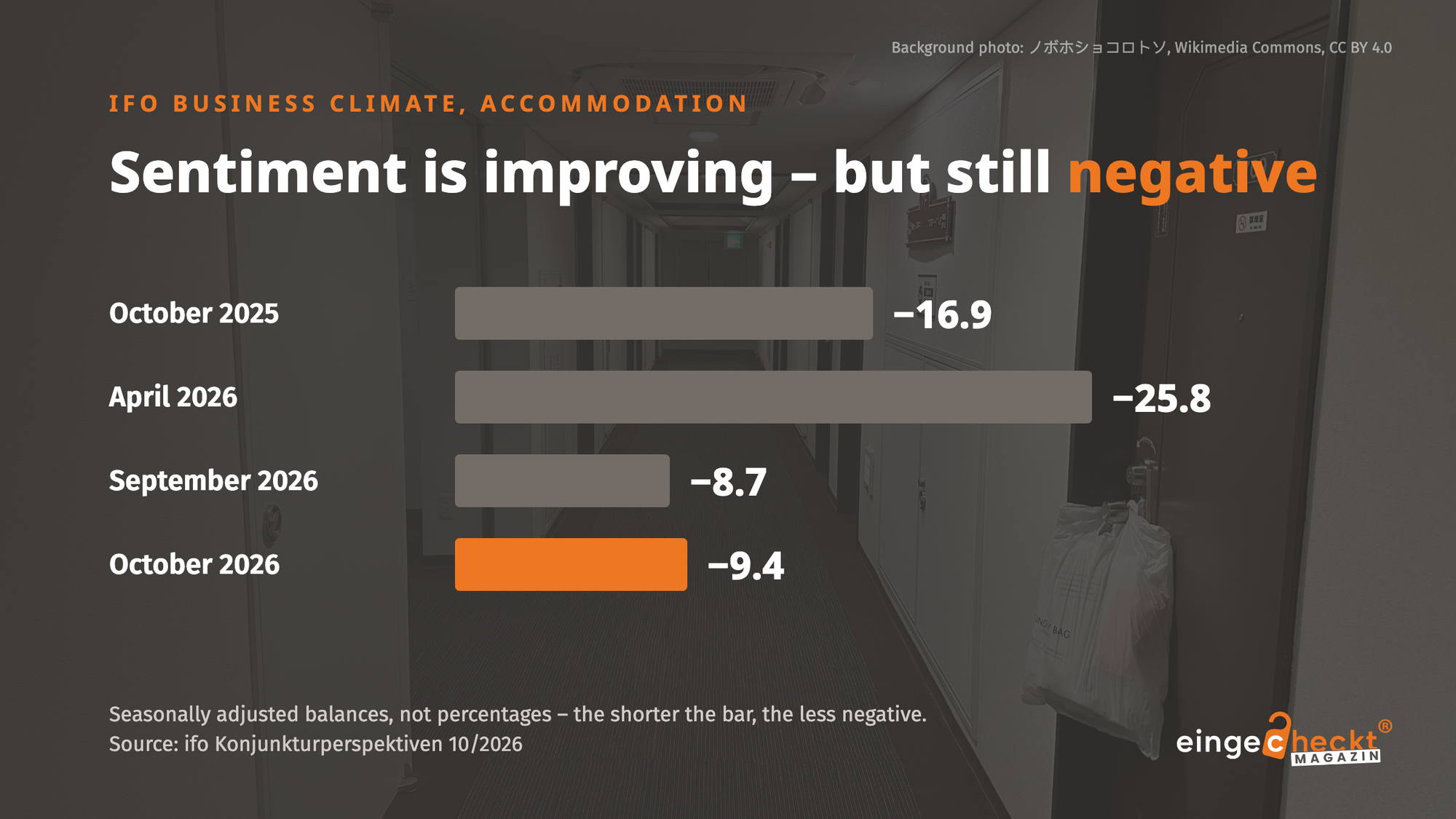
- The ifo business climate for accommodation stood at minus 9.4 points in October 2026 – much better than in the spring, but still negative.
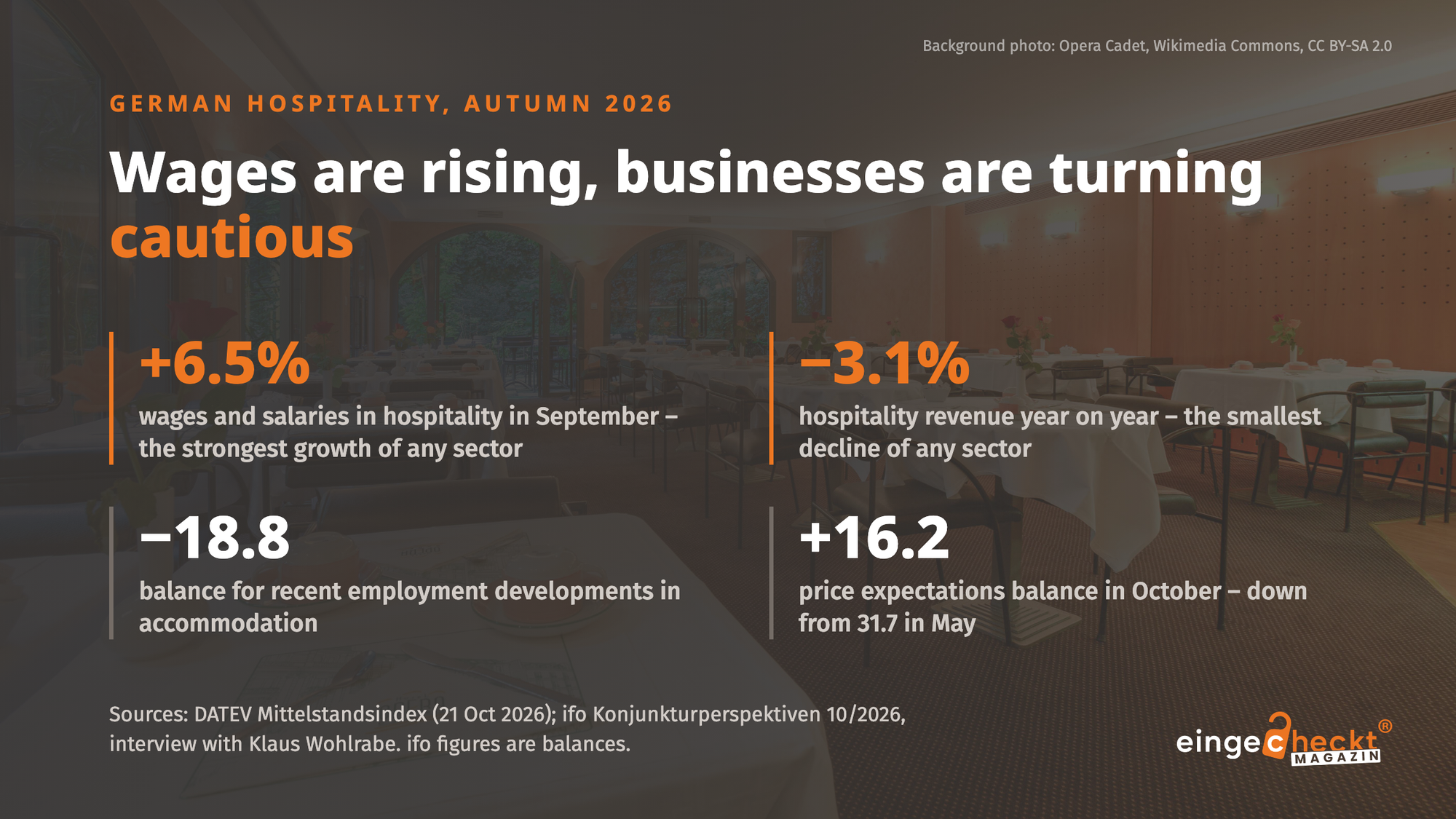
- Many hotels are cautious about staffing: the balance for recent employment developments fell to minus 18.8 points.
- Higher room rates cannot absorb every cost increase. For 2027, Klaus Wohlrabe expects stabilisation at a relatively low level.
New collective pay agreements are bringing better earnings to hospitality employees. But how much financial flexibility do businesses still have? The latest ifo Institute figures reveal a hotel industry that is gradually recovering, while remaining cautious about the coming winter and the outlook for 2027.
In Brandenburg, the pay increases awaiting many hospitality employees over the next two years have already been agreed. Higher collectively negotiated wages came into effect in October 2026, with further increases scheduled for July 2027 and July 2028. The Food, Beverages and Catering Union (NGG) and the regional hotel and restaurant association DEHOGA Brandenburg have agreed three increases of 3.5 per cent each. According to the union, qualified employees in the relevant pay category will eventually earn a gross monthly salary of €3,007.¹
For employees, this is welcome progress. In an industry that has struggled for years to recruit qualified staff, better pay is an important part of making hospitality careers more attractive. For hoteliers, however, every new pay agreement also means revisiting their financial calculations. Higher staffing expenditure has to be covered by operating income, and not every additional euro can simply be recovered through higher room rates.
Brandenburg is far from an isolated case. In Lower Saxony, collectively agreed wages rose by 3.0 per cent in May 2026, with a further 2.9 per cent increase scheduled for May 2027.² North Rhine-Westphalia has agreed three increases through January 2028, amounting to approximately seven per cent in total.³ In Hesse, a four per cent rise took effect on 1 November 2026, with another increase of the same size following one year later.⁴ Although the regional agreements differ, they point in the same direction: Hospitality pay is improving, while many businesses are still waiting for a convincing economic recovery.
Sentiment has improved, but confidence remains fragile
How are hotels actually performing against this backdrop? The Munich-based ifo Institute offers some insight. For the eingecheckt® magazine, we asked Dr Klaus Wohlrabe, Head of Surveys at the institute, about current business sentiment in German accommodation businesses and what hotel operators can expect in the months ahead.
His assessment is more nuanced than some headlines might suggest. The accommodation sector’s business climate balance stood at minus 9.4 points in October 2026, slightly weaker than September’s minus 8.7. Nevertheless, sentiment has improved considerably since the spring. In April, the figure had fallen to minus 25.8 points. The latest result also compares favourably with October 2025, when the balance stood at minus 16.9.⁵
“Sentiment in the hotel industry remains subdued, but it has improved over the course of the year,” he told us in a written interview.
What makes the figures particularly interesting is the contrast between current conditions and expectations. Hotel operators assessed their present business situation less favourably than they had in September, yet they became less pessimistic about the following six months. They appear unlikely to anticipate a rapid return to stronger trading conditions, but neither are they as concerned about the future as they were earlier in the year.
For operators, that distinction matters. Better business sentiment does not necessarily mean that everyday trading has become easier. It suggests, first and foremost, that businesses are becoming somewhat more confident about what lies ahead.
Employees remain valuable, but vacancies are being left unfilled
The conversation becomes particularly revealing when Klaus Wohlrabe turns to employment. While collective agreements provide for higher wages, the ifo findings indicate that hotels have become increasingly cautious about staffing.
The balance measuring recent employment developments fell to minus 18.8 points in October, its lowest level in more than a year. In his assessment, many hotels have either reduced their workforce or chosen not to replace employees who have left.
It is a striking development in an industry where recruitment difficulties have long dominated discussions about staffing. It does not, however, mean that qualified workers have suddenly become plentiful. A hotel may urgently need skilled employees and still decide against filling a vacancy if its current income leaves insufficient financial room to do so.
The outlook for the coming months offers some reassurance. The employment expectations balance stood at minus 6.2 points in October. More businesses therefore still expect to reduce staffing than increase it, but the anticipated contraction is less pronounced than before.⁵
The ifo survey does not establish a direct causal relationship between higher collectively agreed wages and staffing decisions. It does not specifically ask about labour costs. Nevertheless, the economist interprets the cautious employment figures as an indication of how hotels are responding to financial pressures.
Hospitality outperforms other sectors on revenue, but faces the strongest wage growth
The growing tension between income and expenditure is also reflected in the DATEV Mittelstandsindex, which tracks economic developments among German small and medium-sized businesses.
Figures released on 21 October 2026 cover the month of September and reveal an initially surprising result. Among the sectors examined, hospitality recorded the smallest year-on-year decline in revenue, at 3.1 per cent.
At the same time, wages and salaries in hospitality increased by 6.5 per cent, the strongest growth of any sector included in the analysis. Across the wider SME economy, seasonally and calendar-adjusted wage growth was 5.5 per cent.⁶
These figures help explain why even hotels that continue to sell rooms successfully may face difficult financial conditions. Relatively stable revenue does not automatically translate into stronger earnings. As staffing, energy, food and other operating expenses become more expensive, a greater proportion of income is needed simply to keep the business running.
The DATEV figures are not a profit-and-loss statement for the hotel industry. They cover hospitality as a whole and cannot establish the actual margins of individual hotels. What they do demonstrate is that income and wages are currently moving at very different rates.
Why higher room rates cannot absorb every cost increase
Passing rising operating expenses on to guests might appear to be the obvious solution. According to the ifo figures, more accommodation businesses still expect to raise prices than reduce them. The corresponding balance stood at plus 16.2 points in October. Earlier in the year, however, the willingness to increase prices was considerably stronger. In May, the figure reached 31.7 points.⁵
Klaus Wohlrabe believes this illustrates the limits of the industry’s pricing power. He also points out that price increases actually implemented by businesses have recently been substantially weaker than their long-term average.
For hotel operators, this creates a delicate balancing act. On one hand, salaries need to remain competitive to attract good employees and encourage them to stay. On the other, guests may respond to higher accommodation prices by shortening their stays, choosing less expensive room categories or booking elsewhere.
The room for manoeuvre varies considerably between properties. A popular leisure resort may be in a very different position from a small city hotel experiencing fluctuating occupancy. Simply increasing rates across the board is therefore unlikely to work equally well for every business.
A winter of stability rather than strong growth
Looking ahead, the ifo economist remains cautious. The revenue expectations balance for accommodation businesses stood at minus 0.6 points in October, suggesting an almost even split between optimistic and pessimistic assessments. General business expectations were still negative, however, at minus 11.9 points.⁵
He therefore anticipates neither a sharp downturn nor a strong recovery over the winter. One potentially important factor will be changes in travel behaviour. If higher petrol prices and airfares influence holiday decisions, two opposing developments are conceivable. More German residents might choose to holiday within their own country, while higher travel costs could discourage international visitors. At present, it is impossible to determine which effect might prove stronger.
Klaus Wohlrabe also expects no rapid turnaround in 2027. A period of stabilisation at a relatively low level appears more likely, with businesses continuing to manage high operating costs and restricted margins.
There is nevertheless an opportunity for forward-looking management. The pay increases already agreed give many hotels greater certainty about their future staffing expenditure. The challenge will be to incorporate those commitments into financial planning early, organise working arrangements efficiently and maintain the quality of the guest experience despite limited resources.
The coming months will therefore be about more than the number of rooms sold. For many businesses, what remains of that revenue after operating costs have been paid will matter just as much – along with how successfully they support their employees through a financially demanding period.
- Business climate: −9.4
- Current business situation: −6.9
- Business expectations: −11.9
- Revenue expectations: −0.6
- Price expectations: +16.2
- Employment expectations: −6.2
- Recent employment developments (interview): −18.8
Accommodation sector, October 2026, seasonally adjusted survey balances. Note: These figures are balances derived from business surveys, not percentage changes in revenue, prices or employment. A negative balance indicates that negative assessments or declining developments outweigh positive ones. Source: ifo Konjunkturperspektiven 10/2026, supplemented by the written interview with Klaus Wohlrabe. Original statements translated from German.
This article draws on collective bargaining information, DATEV economic data, publications from the ifo Institute and an original editorial interview.
-
Food, Beverages and Catering Union (NGG), Eastern Region (2026)
Mehr Geld für Beschäftigte im Brandenburger Gastgewerbe
News item of 17 October 2026. Collective pay agreement with DEHOGA Brandenburg: three increases of 3.5 per cent each, pay for qualified employees through 2028. Original publication in German. -
DEHOGA Lower Saxony (2026)
Tarifeinigung für das niedersächsische Gastgewerbe erzielt
Press release of 26 March 2026. Pay increases from 1 May 2026 and 1 May 2027. Original publication in German. -
DEHOGA North Rhine-Westphalia (2026)
Tarifabschluss im Gastgewerbe NRW
News item of 23 September 2026. Three pay increases on 1 October 2026, 1 January 2027 and 1 January 2028. Original publication in German. -
DEHOGA Hesse (2026)
Tarifabschluss verbindet Lohnplus mit Arbeitsplatzsicherung
News item of 8 October 2026. Increases of 4 per cent each on 1 November 2026 and 1 November 2027. Original publication in German. -
ifo Institute (2026)
ifo Konjunkturperspektiven 10/2026
October 2026 issue. Seasonally adjusted ifo survey balances for the accommodation sector, page 38. Original publication in German. -
DATEV (2026)
DATEV Mittelstandsindex Oktober 2026
Press release of 21 October 2026. Revenue, wage and employment developments among German SMEs in September 2026. Original publication in German.


