


Key points
- At the end of October 2026, unemployment in Austria’s accommodation and food services sector was 1.7% lower than a year earlier, while overall unemployment rose by 1.3%.
- According to Statistics Austria, vacancies in the sector remained relatively stable at around 13,000 from the first to the third quarter of 2026.
- Tourism researcher Mario Situm sees a positive signal, but not yet a lasting improvement.
- He advises hoteliers to offer reliable rotas, proper onboarding, genuine prospects and technology that eases employees’ workloads.
Fewer unemployed hospitality workers, declining job vacancies and slightly more optimistic employers: Austria’s labour market is showing early signs of improvement ahead of the 2026/27 winter season. Yet finding and retaining skilled staff remains a considerable challenge. What do the latest figures actually tell us, and why might the way hotels manage their people matter more than the number of applications they receive?
As Austria prepares for another winter season, hotels face a familiar question: will there be enough staff to deliver the experience their guests expect? From reception and housekeeping to kitchens and restaurants, schedules must be organised, new colleagues trained and potential absences accounted for. For businesses operating in destinations with pronounced seasonal peaks, assembling a reliable team remains one of the most demanding parts of running a hotel.
This autumn, however, there are reasons for cautious optimism. The latest employment figures suggest that accommodation and food services are performing slightly better than the Austrian labour market as a whole. At the same time, thousands of vacancies remain unfilled. Understanding this apparent contradiction is important for hoteliers preparing their businesses for the months ahead.
Hospitality moves against the wider labour market trend
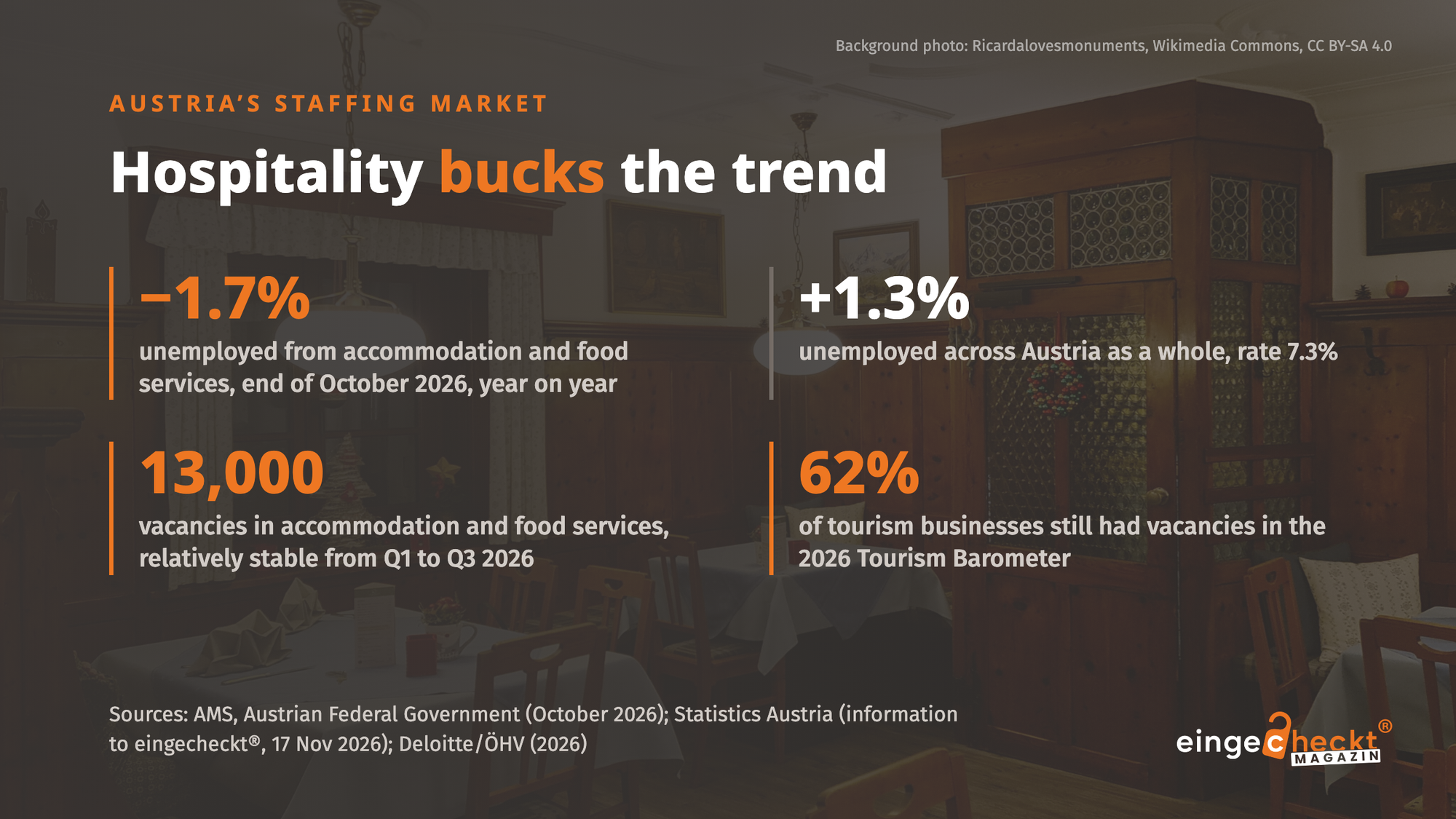
According to Austria’s Public Employment Service (AMS), 40,993 people whose previous employment was in accommodation or food services were registered as unemployed at the end of October 2026, down 1.7% on the same month last year. Including participants in AMS training programmes, the figure stood at 47,152, a year-on-year decline of 1.9%.¹ Across Austria, unemployment moved in the opposite direction, rising by 1.3% to 314,499 people. The national unemployment rate stood at 7.3%.²
Recruitment demand is also changing. At the end of October, the AMS recorded 73,733 immediately available vacancies nationwide, a decrease of 3.4% compared with the previous year.² Statistics Austria provides a broader picture: its vacancy survey identified an average of 121,900 unfilled positions across the economy during the third quarter of 2026, down 11.8% year on year. In accommodation and food services, however, vacancies remained relatively stable at around 13,000 throughout the first three quarters of the year, according to information provided by Statistics Austria directly to our editorial team.³
These figures measure different aspects of the labour market. The AMS records vacancies registered with its service, while Statistics Austria conducts a representative survey of businesses. Their monthly and quarterly totals should therefore not be treated as directly comparable.
AMS unemployment figures classify people according to the industry in which they last worked. They do not establish whether those individuals have the qualifications needed for a particular role or are available in the required location. Seasonal employment patterns can also cause substantial fluctuations between summer and winter.
A decline in unemployment does not necessarily make recruiting an experienced chef, receptionist or housekeeper any easier.
Tyrol illustrates the mixed picture
In Tyrol, where winter tourism plays a major economic role, the latest numbers tell a similarly nuanced story. Unemployment in accommodation and food services fell by 0.9% year on year in October, while immediately available vacancies in the sector declined by 5.4%. Employment, meanwhile, had increased by 1.2% in September compared with the same month in 2025.⁴
Employers themselves are reporting a modest improvement. The 2026 Tourism Barometer, produced by Deloitte and the Austrian Hotel Association (ÖHV), found that businesses rated staff availability at 3.0 on Austria’s five-point school grading scale, compared with 3.3 the previous year. Nevertheless, 62% of the businesses surveyed still had vacancies to fill at the time.⁵ Recruitment may have become easier for some employers, but the wider staffing challenge has certainly not disappeared.
The real challenge begins after recruitment
Prof. (FH) DDr. Mario Situm of Kufstein Tirol University of Applied Sciences, who leads the Interreg research project “Resilienter Tourismus” (Resilient Tourism), welcomes the encouraging labour market signals but urges caution. In written comments to eingecheckt®, he explains that the latest figures should not be interpreted prematurely as evidence of a lasting improvement.

For him, the central issue extends well beyond filling vacancies. Seasonal employment, irregular working hours and competition from other industries remain structural challenges for hospitality businesses. Even when employers receive more applications, suitable candidates may still be difficult to find. What ultimately matters is whether hotels can attract qualified people and persuade them to stay.
Through the Resilient Tourism project, he is exploring how tourism businesses and destinations can become more resilient over the long term. Drawing on wider research into employee retention, he highlights several factors beyond pay: working conditions, leadership quality, career development opportunities and a healthy balance between professional and personal life. His central message is clear: “Staffing must not become a strategic priority only when skilled workers are in short supply.”
Smaller, family-run hotels may have an advantage
Independent and family-run properties have characteristics that could help them build lasting relationships with employees. Smaller teams often allow closer contact between staff and management, quicker decisions and greater flexibility in responding to individual circumstances. Employees who feel that their contributions are recognised and their ideas genuinely influence the business may have stronger reasons to remain.
Yet a welcoming, family-like atmosphere cannot compensate for unreliable schedules, limited career prospects or persistently excessive workloads. Mario Situm therefore believes that smaller businesses are most likely to benefit from their personal approach when it is supported by attractive employment conditions and a commitment to staff development. He deliberately avoids singling out individual hotels as examples without sufficient empirical evidence.
Five priorities for hoteliers this winter
Rather than concentrating exclusively on the immediate winter season, the researcher encourages hotels to plan for longer-term employee retention. The objective should be to turn seasonal recruitment into a more sustainable relationship wherever possible. His recommendations translate into five practical priorities.
- Make rotas more predictable: Communicate working hours and rest periods early, and minimise unnecessary last-minute changes.
- Communicate openly: Keep employees informed early about processes, changes and decisions.
- Give new employees a proper introduction: Establish clear responsibilities, provide designated contacts and allow sufficient time for training before peak demand begins.
- Offer meaningful development opportunities: Discuss future responsibilities, further training and potential career paths with employees.
- Use technology to support employees: Identify administrative tasks that can be simplified, allowing staff to concentrate on their professional responsibilities and guest service.
Hotels recruiting seasonal employees from outside the European Union may also benefit from Austria’s new seasonal employment quota, which takes effect on 1 December 2026. It provides 6,250 places for seasonal workers from third countries, including a dedicated allocation for nationals of the Western Balkan countries. The regulation will remain in force until the end of November 2028, giving employers a more predictable framework for workforce planning.⁶
A successful winter should lead to a stronger team
Whether Austria’s improving staffing indicators develop into a lasting trend will become clearer over the coming months. For hoteliers, however, the most important measure of success may lie within their own businesses. Recruiting enough people to get through a busy winter is one achievement; creating the conditions that make them want to return is another.
This is also where Mario Situm sees a valuable role for digitalisation. Technology should not be regarded primarily as a way to reduce headcount, he argues, but as an opportunity to ease administrative workloads and improve working conditions.
When the winter season draws to a close and the last guests check out, a hotel’s staffing strategy will have faced its real test. Beyond occupancy levels and operational performance, one particularly valuable result would be a team whose members are already looking forward to returning next winter.
This article draws on official Austrian labour market statistics, an industry study, information from Statistics Austria and an original written interview.
-
Austrian Public Employment Service (AMS) (2026)
Übersicht über den Arbeitsmarkt (Labour market overview)
Monthly report for October 2026, published 2 November 2026. Unemployment in accommodation and food services, including training participants. Original publication in German. -
Austrian Federal Government (2026)
Arbeitsmarktlage im Monat Oktober 2026 (Labour market situation in October 2026)
Report to the Council of Ministers, November 2026. Total unemployment, unemployment rate and immediately available vacancies. Original publication in German. -
Statistics Austria (2026)
Weniger offene Stellen im 3. Quartal 2026 (Fewer vacancies in the third quarter of 2026)
Press release, 5 November 2026. Job vacancy survey; additional written information to our editorial team on 17 November 2026 about accommodation and food services. Original publication in German. -
AMS Tirol (2026)
Robuster Arbeitsmarkt in Tirol (A robust labour market in Tyrol)
News item, 2 November 2026. Unemployment, vacancies and employment in accommodation and food services in Tyrol. Original publication in German. -
Deloitte and the Austrian Hotel Association (ÖHV) (2026)
Deloitte und ÖHV-Tourismusbarometer 2026 (Tourism Barometer 2026)
Study, published 3 June 2026. Staff availability and vacancies in tourism businesses. Original publication in German. -
Austrian Federal Ministry for Economic Affairs, Energy and Tourism (2026)
Zehetner: Saisonkontingente für zwei Jahre fixiert (Seasonal quotas fixed for two years)
Press release, 9 November 2026. Seasonal quota of 6,250 places from 1 December 2026 to 30 November 2028, including 2,000 for workers from the Western Balkans. Original publication in German.


