


Key points
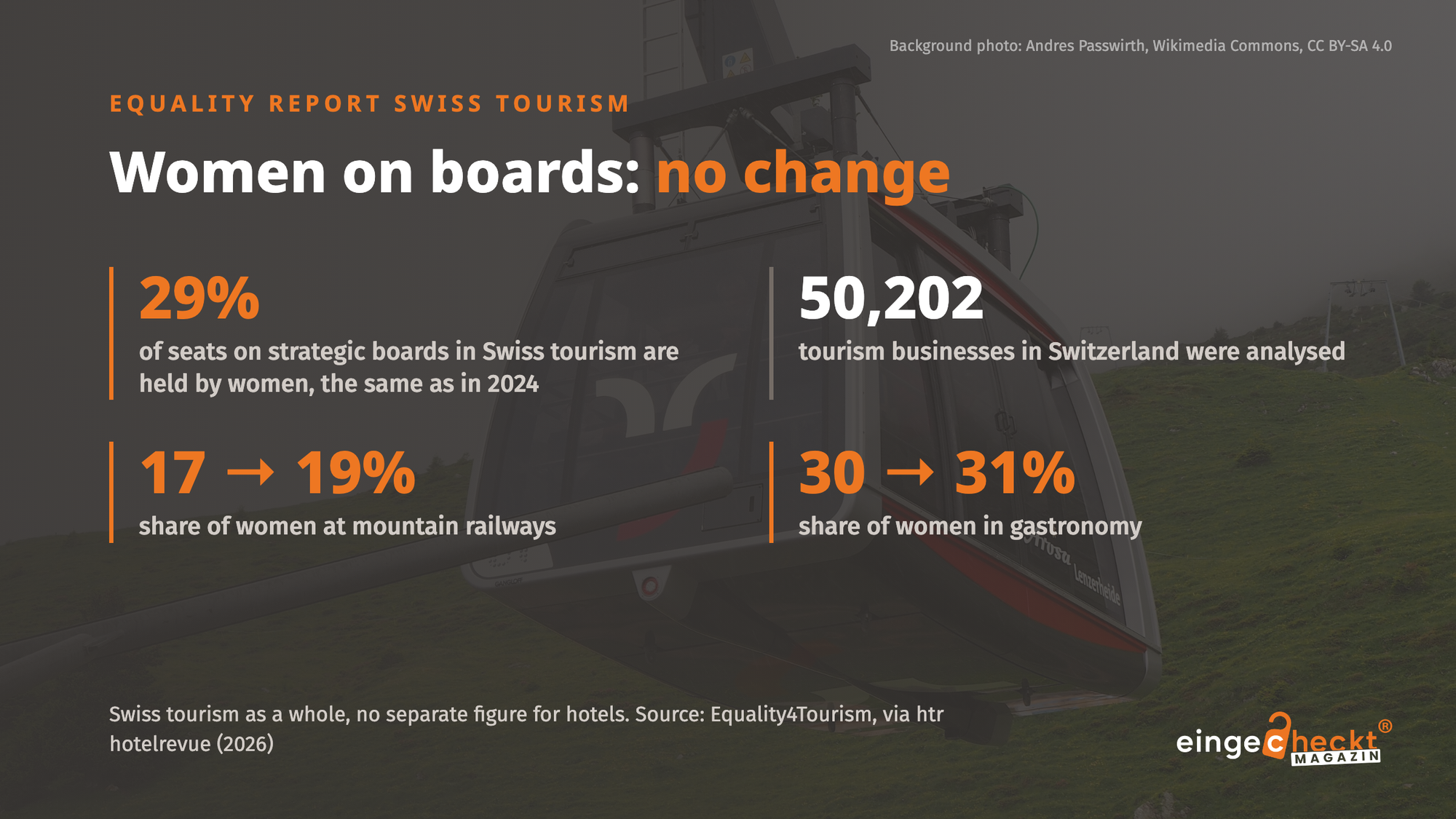
- According to the second Equality Report Swiss Tourism, women hold 29 per cent of seats on the strategic boards of Swiss tourism businesses, the same as in 2024.
- According to Equality4Tourism, the figure for accommodation is also 29 per cent, even though more than half of those working in the sector are women.
- Women are less likely to receive their first promotion into leadership; so are people working less than 80 per cent of full time.
- Janine Bunte of Equality4Tourism advises every hotel to start by collecting its own figures, approach talented staff directly, plan rotas together and share leadership roles.
- For family-run hotels, Ines Hartmann recommends three steps: look beyond familiar contacts, give women real influence and plan succession openly.
Women manage hotel departments, lead teams and take responsibility for daily operations. Yet they remain considerably less visible in the bodies that make long-term strategic decisions across Swiss tourism. New figures reveal how little has changed. Together with Equality4Tourism, the association behind the study, and researcher Ines Hartmann from the University of St. Gallen, we explore what holds women back from senior leadership – and why family-run hotels have an opportunity to rethink succession.
When a family-run hotel considers appointing someone to its board, a few familiar names may come to mind. Perhaps a family member, a long-standing business partner or a trusted professional contact. It is an understandable approach when important decisions and personal trust are involved. But relying on established relationships can also mean overlooking qualified people who have never been part of the usual circle.
The second Equality Report Swiss Tourism, whose first findings are already available and which is expected to be published in early December 2026, brings this question into focus. Published by Equality4Tourism, the study examined 50,202 tourism businesses in Switzerland and found that women hold just 29 per cent of seats on their strategic governing bodies. According to the report’s authors, the overall figure remains unchanged from the 2024 study. Five tourism subsectors recorded modest improvements, including mountain railways, where female representation rose from 17 to 19 per cent, and gastronomy, where it increased from 30 to 31 per cent.¹
These figures cover Swiss tourism as a whole. They raise a question that matters particularly to hotel owners: how does someone progress from managing day-to-day operations to helping shape the long-term direction of a business?
Not a pipeline problem, but a progression problem
So where does the hotel industry stand? According to Janine Bunte, President of the association Equality4Tourism, accommodation sits exactly at the average: here too, women hold 29 per cent of seats on strategic boards. Within tourism, the range extends from 12 per cent in passenger transport to 35 per cent in food retail, with gastronomy, at 31 per cent, slightly ahead of hotels. Across all Swiss public limited companies, she says, women hold only 20 per cent of board seats, so tourism does not compare badly. How much such comparisons depend on which companies are included becomes clear from the figures for Switzerland’s largest employers below.
She finds the comparison with the workforce more revealing. More than half of those employed in accommodation are women.
“When it comes to women, the hotel industry does not have a pipeline problem, but a progression problem.”
She is not surprised that the share on boards is moving slowly. Mandates run for several years and successions are planned well in advance, so major leaps within two years were never expected. Then there are the particular features of the industry: many small businesses, shift work, seasonality and a high proportion of women working part-time.
What gives her most pause for thought is the association’s survey of senior figures at tourism organisations. Almost all of them value mixed teams, and hardly anyone believes there is a shortage of suitable women. “So it is not a question of conviction, but of implementation, and that does not happen by itself,” she says.
Boards and executive teams compared
We also spoke with Dr Ines Hartmann, Co-Director of the Competence Center for Diversity, Disability and Inclusion (CCDI) at the University of St. Gallen. Her research examines equal opportunities, career progression and how organisations can make better use of the talent available to them.
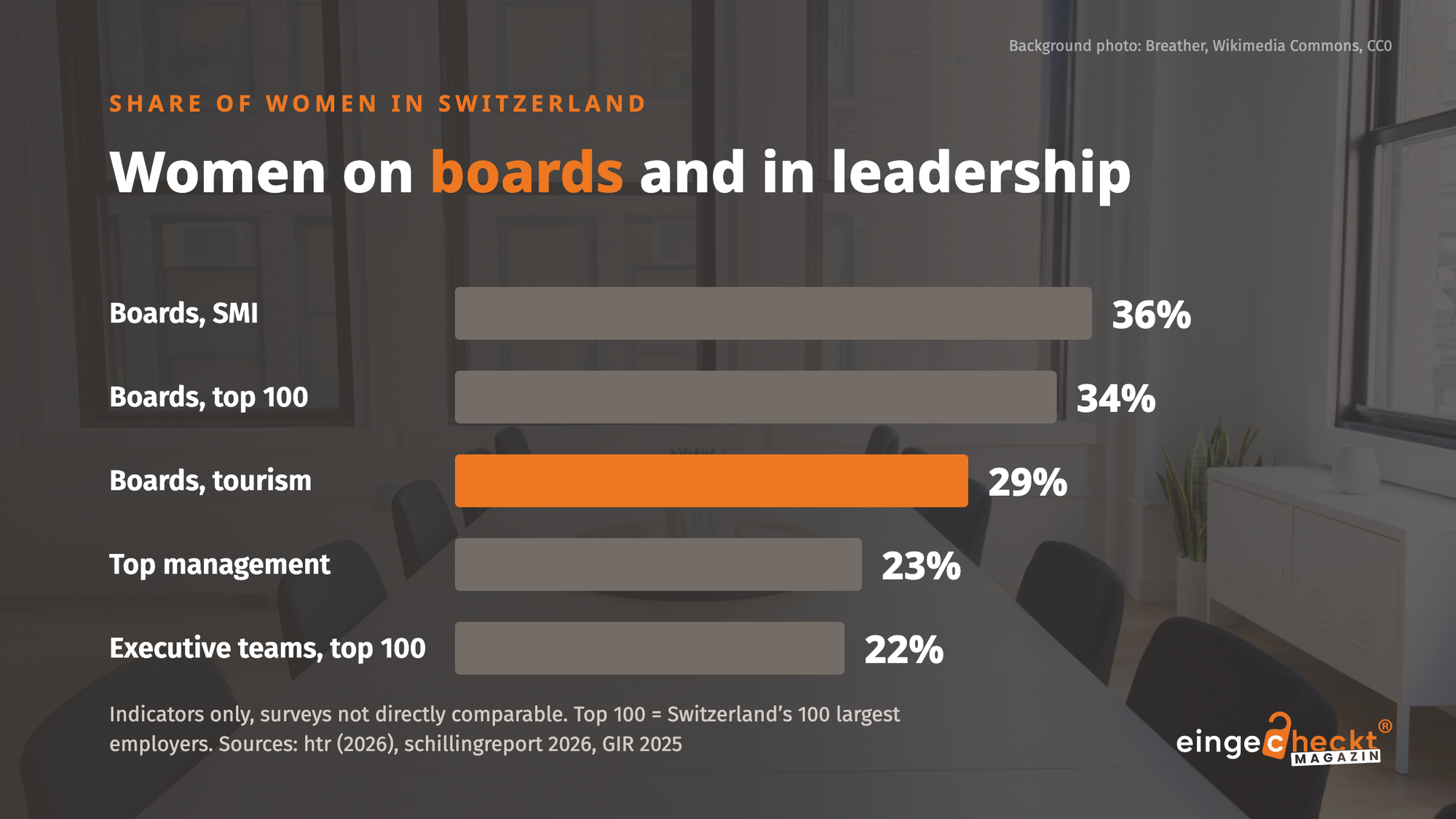
She points to the 2026 schillingreport for context. Women account for 34 per cent of board members at Switzerland’s 100 largest employers and 36 per cent at the 20 companies listed in the Swiss Market Index (SMI). Their representation on executive management teams, however, stands at 22 per cent.² The 2025 Gender Intelligence Report, published jointly by the CCDI and Advance, puts female representation in top management at 23 per cent.³
These figures cannot simply be arranged into a league table. The studies examine different groups of companies and, in some cases, different levels of leadership. Boards of directors and executive management teams also serve distinct purposes. For her, the comparisons are therefore useful indicators rather than a definitive ranking.
Her concern extends beyond achieving a statistically balanced boardroom. Ideally, women and men should be represented in leadership in proportion to their presence in the workforce. Businesses also stand to benefit from making full use of the skills and experience they already have. The people involved in strategic decisions help determine which perspectives shape an organisation’s response to future challenges.
Why the first promotion can make all the difference
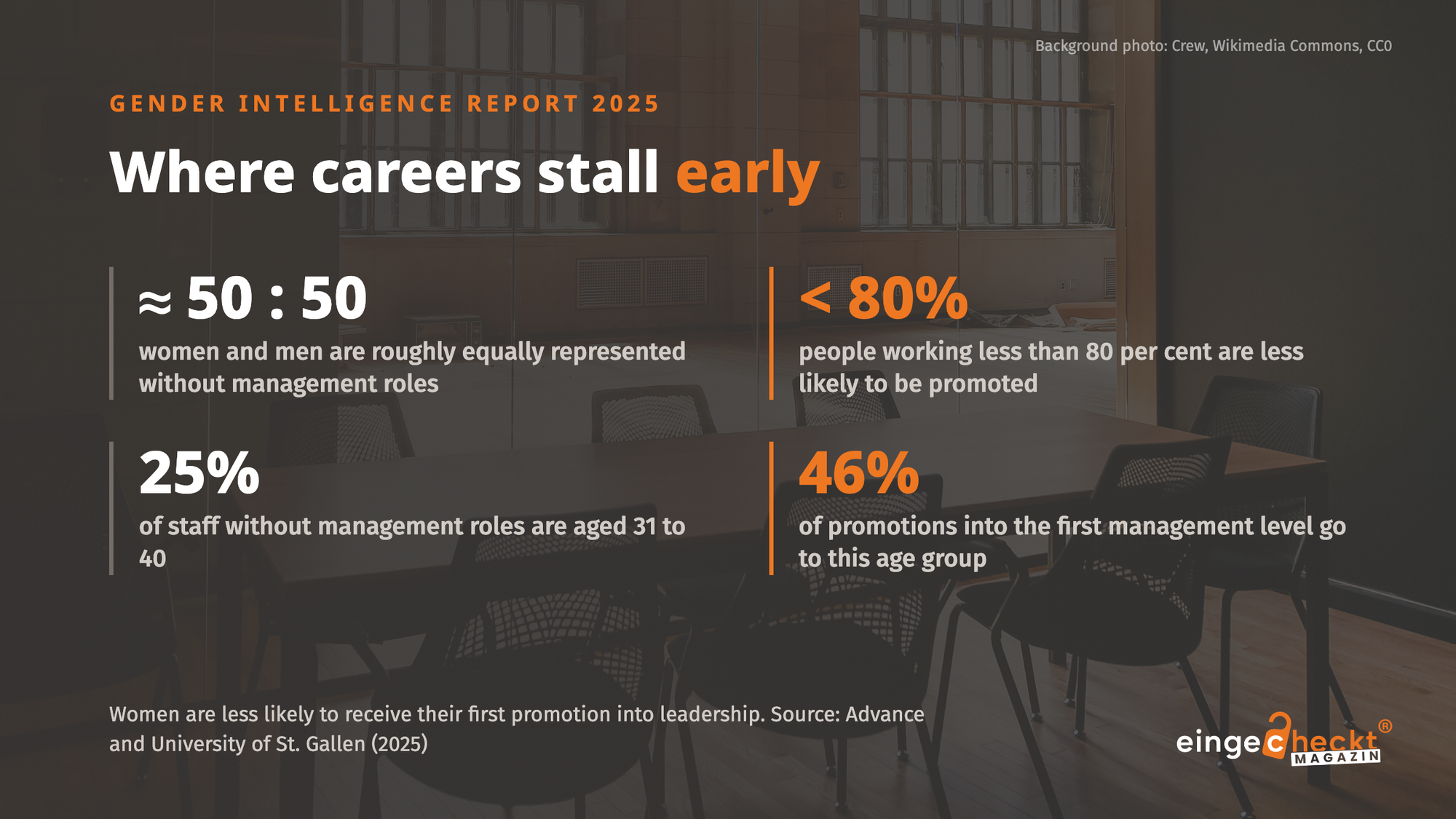
One of the most revealing findings of the Gender Intelligence Report concerns the beginning of a management career rather than the boardroom itself. Although women and men are represented in roughly equal numbers among employees without management responsibilities, women are already less likely to receive their first promotion into leadership.³
That imbalance matters long before a senior appointment is considered. Employees who are not given opportunities to lead teams, manage important projects or develop strategic experience may find themselves at a disadvantage when more senior positions become available. Traditional expectations about what a leader should look like can make the problem worse.
Working hours are particularly significant. The report finds that people working less than 80 per cent of a full-time position are less likely to be promoted.³ Ines Hartmann believes this often reflects an unspoken assumption that leadership requires an almost constant presence at work. Such expectations deserve particular scrutiny in hospitality, where variable shifts and seasonal demands can already make career planning difficult.
Timing adds another complication. According to the Gender Intelligence Report, employees aged 31 to 40 account for 46 per cent of promotions into the first management level, despite representing only 25 per cent of staff without management responsibilities.³ This is also a stage of life when many people start families or adjust their working hours. If women are assumed to be less interested in career progression for these reasons, they may miss opportunities that are difficult to recover later.
Developing leaders before a vacancy arises
So what can businesses do differently? Ines Hartmann advocates identifying potential leaders early and giving them meaningful opportunities to develop. Mentoring, active support from influential senior colleagues and responsibility for strategically important projects all have a role to play. Someone who has already managed a significant operational change can demonstrate experience that may prove valuable when a leadership position becomes available.
Transparent appointment procedures are equally important. Which competencies does a particular role require? Which types of experience are essential, and which can be developed? These questions should be addressed before a vacancy creates pressure to make a quick decision. Clear criteria can help ensure that personal familiarity and traditional expectations do not outweigh professional suitability.
She also encourages businesses to consider more flexible approaches to management. Job-sharing and top-sharing, where two people share responsibility for a leadership role, can create additional routes into senior positions. Such arrangements will not suit every organisation. But they encourage employers to examine whether a particular role genuinely demands permanent full-time presence or whether responsibility could be organised differently.
Three practical steps for family-run hotels
For smaller family-owned properties, Ines Hartmann sees opportunities to make progress without introducing extensive HR programmes or creating new administrative structures.
1. Look beyond familiar contacts when filling a board position
Before making an appointment, consider which skills the hotel will need in the years ahead. Alongside hospitality experience, expertise in digital transformation, finance, people management, sustainability or marketing may be valuable. A clear set of requirements can reveal suitable candidates beyond the family and its established professional network.
2. Give women genuine influence, not just a seat
Appointing a woman to a board should also mean involving her meaningfully in strategic decisions. This could include responsibility for a major business priority or even chairing the board. The objective is active participation in shaping the hotel’s direction, rather than improving the composition of the board on paper alone.
3. Treat succession as a long-term strategic responsibility
Even a small family business can identify people within the organisation or its wider network who have the potential to take on greater responsibility. Important leadership roles need not automatically pass to family members. Looking ahead and defining clear selection criteria can help ensure that appointments are based on suitability, regardless of gender.
What every hotel can do tomorrow
Janine Bunte also favours deliberate management over leaving things to chance. In her experience, equality works where it is treated like any other leadership task, with key figures, targets and clear responsibility. For individual businesses, she suggests four steps that require little effort.
“A diverse mix is no accident, but the result of conscious decisions.”
Count. Record the share of women at each level of the hierarchy, the proportion of part-time staff and any pay gaps. Anyone who knows their own figures can see immediately where the problems lie.
Approach talent directly. Point out promising positions to female employees and support them as they move into a new role, for example with mentoring from experienced colleagues.
Let staff help shape rotas. Being able to submit preferences early and swap shifts makes it easier to balance work and private life, and the whole team benefits.
Share leadership. Make job-sharing and part-time work possible in management roles too.
None of this costs much, she stresses, and it pays off: happy employees make for happy guests. Equality4Tourism has made that its motto: “Happy Host – Happy Guest”.
When tradition becomes a conscious choice
Personal relationships and established structures are often among the greatest strengths of a family-run hotel. They provide continuity, efficient decision-making and a detailed understanding of the business. Broadening the approach to leadership appointments does not mean abandoning those qualities. It creates an opportunity to complement them with the expertise needed for the property’s next stage of development.
Ines Hartmann sums up the responsibility carried by smaller governing bodies in a single observation:
“On a small board of directors, every individual member has a significant influence.”
The next succession decision may therefore be an opportunity to consider people who have not previously been part of the conversation. A hotel’s future depends not only on the experience its leadership already possesses, but also on its willingness to bring new capabilities into the room.
This article draws on Swiss tourism research, published leadership studies and original editorial interviews.
-
htr hotelrevue (2026)
Frauen führen – doch wer bestimmt die Strategie?
Article, 2 November 2026. Findings of the second Equality Report Swiss Tourism by Equality4Tourism. Original publication in German. -
schillingreport (2026)
schillingreport 2026 – Transparenz an der Spitze
Report, May 2026. Female representation on Swiss boards of directors and executive management teams. Original publication in German. -
Advance and University of St. Gallen (2025)
Gender Intelligence Report 2025: Why Meritocracy Needs Inclusion
Executive report, 18 September 2025. Research on career development, promotions and part-time employment.


