


Key points
- Hotels in Krefeld, Neumarkt and Rheine announced new brand partnerships within a few days. In Krefeld, Dorint is returning as a franchise brand.
- Under a franchise, a legally independent partner uses a system’s brand and concept in return for fees and complies with its standards.
- Antje Katrin Piel of the German Franchise Association advises checking fit, costs, freedom and exit terms before signing, and talking to existing partners.
- Whether a partnership works shows in everyday operations. That also means bringing the team along through the change.
Dorint is returning to Krefeld, while a Park Inn in Bavaria is preparing to become a Best Western Plus. Several recent announcements highlight how hotel brands are expanding through partnerships with independent operators. Yet changing the name above the entrance involves much more than replacing a sign. Franchise agreements can bring access to international distribution networks, but they also create long-term commitments. What should hoteliers consider before joining a brand?
In Krefeld-Traar, a familiar hotel name is preparing to make a comeback. The current Mercure Tagungs- & Landhotel was originally built and operated under the Dorint brand in the 1990s, and from 1 January 2027 it is due to carry that name once again. DHO Deutsche Hotel Operations will take over the 155-room property under a 20-year lease agreement. The entire workforce, including General Manager Walter Sosul, will remain. For employees, the change will therefore introduce a new business structure without dismantling the established team.¹
Another hotel is preparing for a different kind of transition. In early December, the 105-room Park Inn by Radisson in Neumarkt, Bavaria, will become the Best Western Plus Hotel Neumarkt. Unlike in Krefeld, its operating company, Neumarkt Hotel Betriebs GmbH, will remain unchanged.² Meanwhile, Germany’s first Fairfield by Marriott is taking shape in Rheine. Signo Hospitality will run the 120-room hotel once it is completed, which is planned for summer 2027. This is a new-build project rather than a conversion of an existing hotel.³
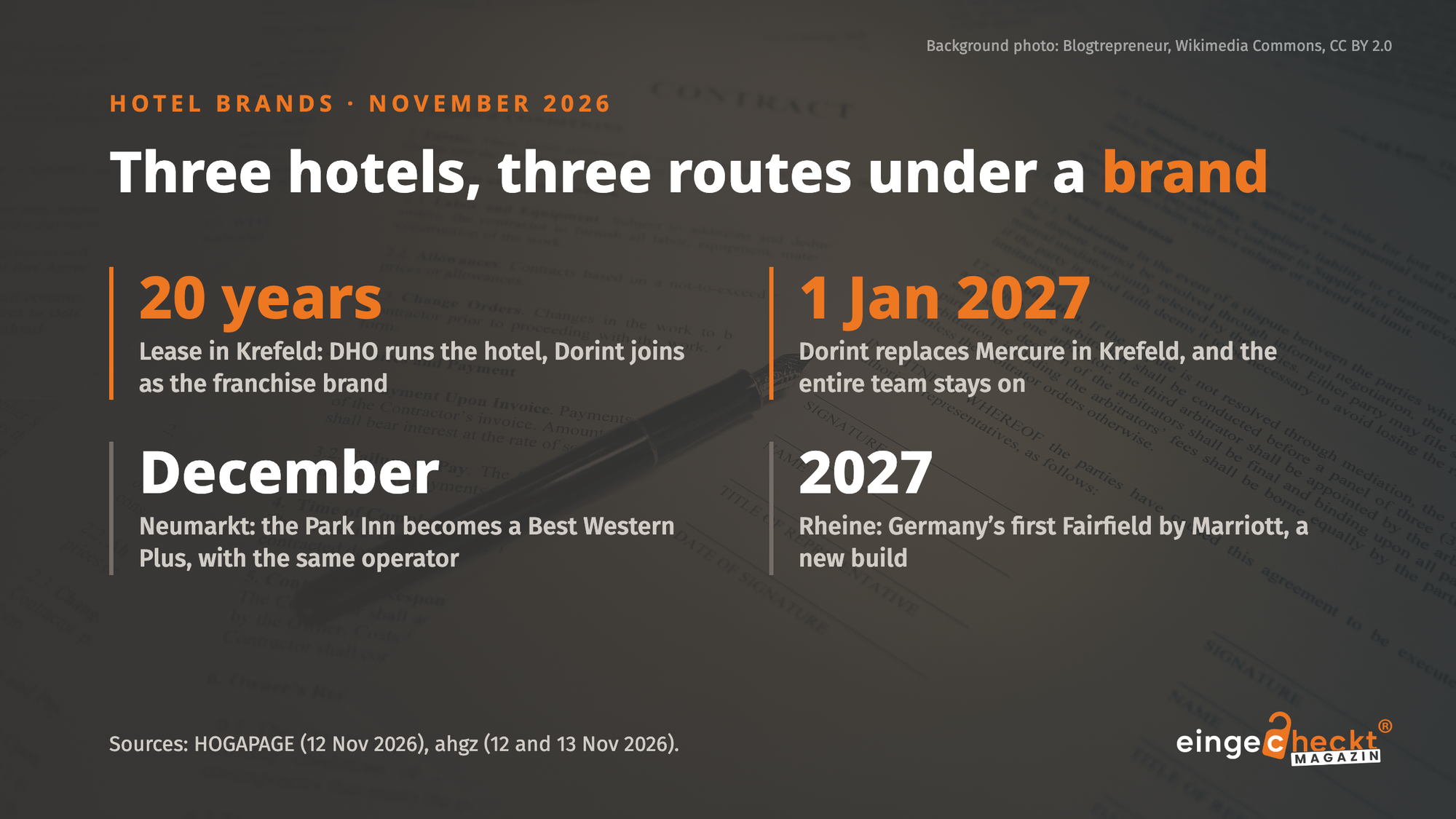
Together, these developments illustrate the different ways hotel groups establish a presence in new markets. An existing property may adopt another brand, an operator may change alongside the name, or a franchise brand may be selected while a hotel is still under construction. The common thread is a business model that allows hotel groups and independent operators to work together: franchising.
Behind the brand there is often an independent business
A familiar name above a hotel entrance reveals surprisingly little about who actually runs the property. Staying at a Dorint, Mercure or Marriott does not necessarily mean staying in a hotel operated directly by the company behind that brand. Day-to-day responsibility may rest with a separate hotel business.
Under a franchise agreement, the franchisor grants an independent operator the right to use its brand and business concept in return for agreed fees. The franchisee remains a legally independent business but must comply with contractual standards. These may cover the hotel’s appearance, service quality, facilities and operating procedures. The precise obligations and the support provided by the brand depend on the individual agreement.⁴
- Lease: The property owner grants a business the right to operate the premises under a lease. In Krefeld, DHO has entered into a 20-year agreement with property owner K/S Krefeld.
- Operator: The operating company manages the hotel’s day-to-day business. DHO will assume this responsibility in Krefeld.
- Franchise: The hotel brand provides its name and agreed brand system. The Krefeld property will operate under the Dorint franchise brand.
Both sides bring something to the table
For an existing hotel, joining an established brand can create commercial opportunities that might otherwise be difficult to develop independently. International booking networks, shared distribution channels and an established reputation can help the property reach new audiences. The hotel may also benefit from the experience and expertise accumulated across the wider network.
Antje Katrin Piel, Head of Communications at the German Franchise Association in Berlin and Editor-in-Chief of FRANCHISEconnect, sees this combination as a central strength of the model. In a written interview with eingecheckt®, she explains that franchising brings together entrepreneurial independence and the advantages of belonging to a larger organisation. An existing hotel contributes something a corporate headquarters cannot simply recreate: its individual character, established guest relationships and an experienced local team.
The franchisor also has something to gain. While the brand brings its identity and systems to the partnership, the local operator understands the destination and its guests. Antje Katrin Piel describes such partners as “local heroes”, whose knowledge of regional demand and customer expectations complements the reach of a larger company.
The forthcoming change in Neumarkt offers an example of how an existing business relationship can develop further. The Provent group, associated with the hotel’s operator, already works with Worldhotels Central Europe at other locations. The new branding agreement extends that relationship, although the published announcement does not establish the specific commercial reasons behind the decision.²
The strength of a major brand comes at a price
The potential benefits of a franchise are relatively straightforward to describe. Establishing whether they justify the cost is considerably more complicated.
Joining an established system comes with financial and operational obligations. Alongside recurring franchise fees, a hotel may need to invest in changes to meet brand requirements. Owners and operators must also consider how much independence they are prepared to surrender. Decisions previously made entirely in-house may become subject to contractual rules or approval by the franchisor.
Antje Katrin Piel therefore advises hoteliers not to be guided by brand recognition alone. The starting point should be whether the franchise genuinely suits the property and the operator’s business ambitions. She also recommends independent legal and financial advice, together with direct conversations with existing franchisees. Their experiences can reveal how the partnership works in practice, particularly when problems arise.
- Brand suitability: Does the positioning, target market and quality promise fit the hotel?
- Services provided: What support is included for distribution, bookings, marketing, training and daily operations?
- Fees and investment: What recurring charges, initial costs and property upgrades will be required?
- Operational freedom: Which decisions will the hotelier remain free to make independently?
- Contractual commitment: Are the term, renewal provisions and exit conditions clearly defined?
- Independent assessment: Have legal and commercial risks been reviewed by external specialists?
- Existing franchisees: What do current partners say about everyday cooperation and support during difficult periods?
The real test comes after the agreement is signed
Signing a franchise contract establishes a commercial relationship. Building a productive partnership takes much more than that, particularly when the expectations of the brand’s central management differ from those of the operator on the ground.
For Antje Katrin Piel, trust, shared objectives and a willingness to accept responsibility are essential. A good franchisor should listen to its partners, take their local knowledge seriously and involve them in developing the wider system. Franchisees, in turn, must uphold the standards on which the brand’s reputation depends. She believes that an important measure of a healthy relationship is whether partners can openly discuss what is not working.
This balance can be particularly significant for previously independent hotels. Owners accustomed to making decisions entirely on their own may have to adjust to new contacts, operating requirements and shared procedures. The franchise network can provide valuable assistance, but it cannot remove the operator’s responsibility for running the business successfully.
Bringing the team along when the system changes
An example from outside hospitality demonstrates why practical support matters during a transition. Antje Katrin Piel describes a franchise network in the building materials trade that existing independent merchants can join. They retain their entrepreneurial independence while gaining access to shared purchasing arrangements, digital tools and business management support.
According to feedback from one participating business, joining the network improved both its organisation and purchasing conditions. Particularly valuable was the franchisor’s on-site assistance during the transition. The example illustrates why a successful system change must extend beyond the contract and become meaningful in everyday operations.
The same principle applies to hotels. A change of brand may require employees to learn new systems, adjust familiar procedures and deliver service according to different standards. Staff need clear information, appropriate training and reliable contacts throughout the transition.
In Krefeld, retaining the entire workforce offers an important starting point. Experienced employees will continue to contribute their knowledge of the property and its guests. Whether the new franchise arrangement delivers the expected commercial and operational benefits will only become clear after the transition.
A brand can open doors, but it cannot guarantee success
Franchising offers hotel businesses an opportunity to benefit from established brands and distribution networks without necessarily surrendering operational independence. For hotel groups, it provides a way to expand through partners who understand their local markets.
The most important question for a hotelier is therefore not simply which name should appear above the entrance. It is whether the services, obligations and working relationship behind that name make sound commercial sense over the full duration of the agreement.
A hotel sign can be replaced quickly. A successful partnership has to be built over years.
This article draws on recent German hospitality industry reports, information from the German Franchise Association and an original written interview.
-
HOGAPAGE (2026)
Dorint kehrt nach Krefeld zurück (Dorint returns to Krefeld)
Industry news, 12 November 2026. Change of operator and brand at the conference and country hotel in Krefeld-Traar, lease with DHO, entire team retained. Original publication in German. -
ahgz (2026)
Markenwechsel: Neumarkter Park Inn by Radisson wird Best Western Plus (Rebranding: Neumarkt’s Park Inn by Radisson becomes a Best Western Plus)
Industry news, 13 November 2026. Rebranding in Neumarkt and Provent’s cooperation with Worldhotels. Original publication in German. -
ahgz (2026)
Markenpremiere: Signo bringt Fairfield by Marriott nach Deutschland (Brand premiere: Signo brings Fairfield by Marriott to Germany)
Industry news, 12 November 2026. Germany’s first Fairfield by Marriott in Rheine, operated by Signo Hospitality. Original publication in German. -
German Franchise Association (2026)
Franchise Definition: Alles rund um das Thema Franchising (Franchise definition: all about franchising)
Knowledge page, accessed November 2026. Basics of franchising: business concept and brand in return for fees, legally independent partners. Original publication in German.


