
Modern POS systems, digital booking engines, inventory software, staff scheduling apps and now artificial intelligence: hotels and hospitality businesses have more technology at their disposal than ever before. But even the best software is of limited value if a business does not know which numbers it actually needs to understand. The Gastro Piraten were a project partner of GastroDigital Hessen, a programme that carried out 1,200 on-site consultations in more than 280 businesses.¹ Their conclusion is surprisingly down-to-earth: digitalisation does not begin with software – it begins with the right question.
A hotel can have excellent occupancy levels and still perform below its economic potential. It can use a modern property management system, automate reservations, create staff schedules digitally and check daily revenue on a smartphone at any time. And yet it may still be unable to say with confidence what individual services actually cost, which booking channels are truly profitable or whether its hotel restaurant is making money at all.
This is precisely where René Kaplick sees one of the fundamental misunderstandings surrounding digitalisation in hospitality.
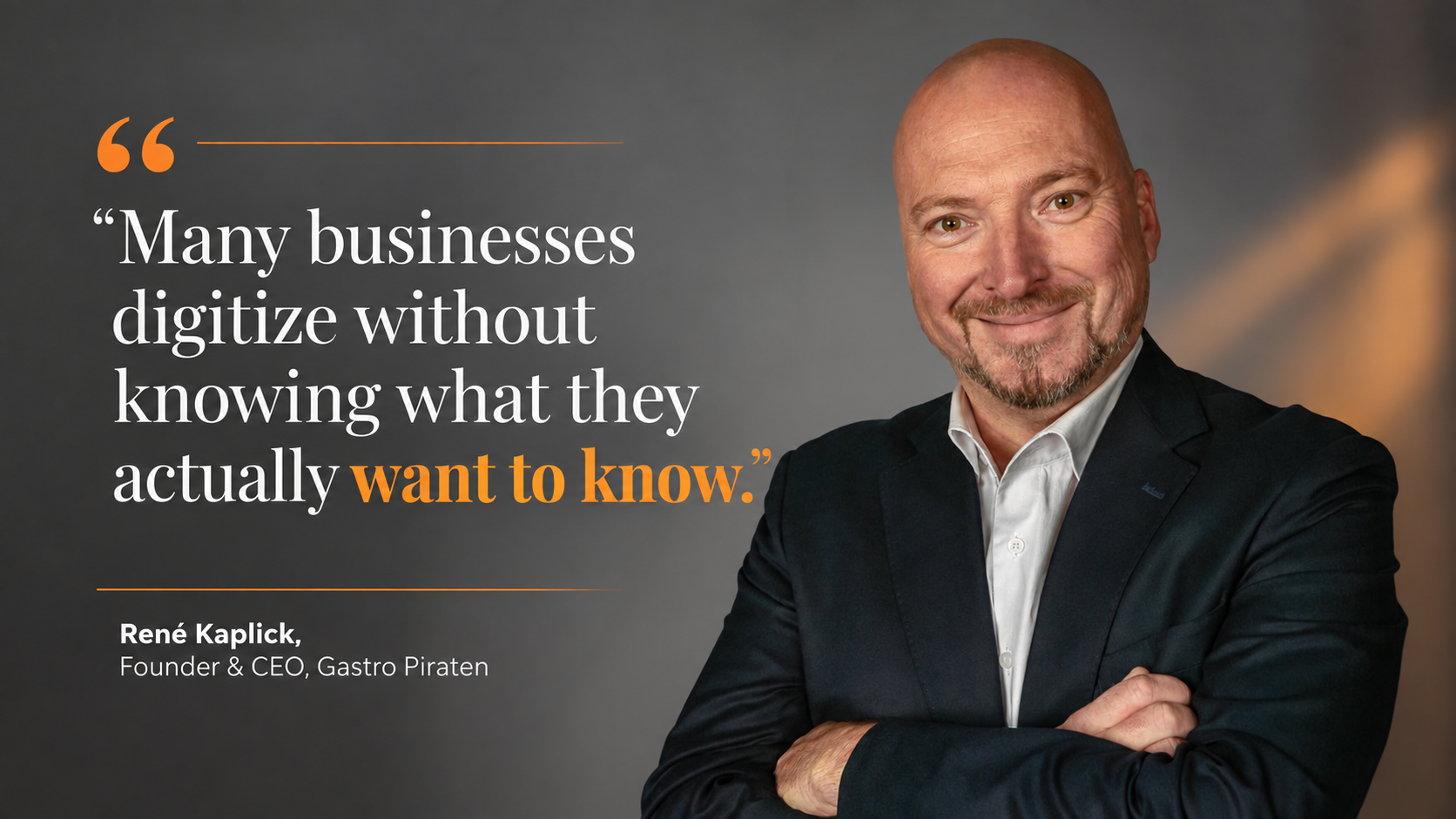
“Many businesses digitalise without knowing what they actually want to know,” says the founder and CEO of consulting firm Gastro Piraten.
Kaplick and his team have been advising businesses in gastronomy and hospitality since 2010. In 2022, they gained an especially broad view of the sector through the publicly funded GastroDigital Hessen project. Between March and November, 1,200 on-site consultations were carried out in over 280 businesses.¹ The project focused on areas including digital guest communication, booking and payment, ordering processes, staff scheduling, workflows and inventory management.
Four years later, the industry has already moved on to the next wave of technology. Hotels are discussing artificial intelligence, automated guest communication, revenue systems, chatbots and increasingly connected software.
But before the next application is purchased, Kaplick asks a much more fundamental question:
Are businesses genuinely better organised today – or are they simply managing the same old chaos digitally?
Digitalisation is not an end in itself. What matters is not how many systems a hotel uses, but whether those systems provide information that leads to better decisions.
If you do not know which question you want answered, even the best software can only take you so far.
The technology has changed – many of the problems have not
Hotels and restaurants have undergone a remarkable digital transformation in recent years. Reservations can be processed automatically, staff rotas created online, purchasing monitored digitally and guest reviews analysed within seconds. Increasingly, artificial intelligence is being added to the list.
At first glance, this should give operators more control over their businesses than ever before.
In practice, however, that is not always the case.
René Kaplick, founder and CEO of the Gastro Piraten, has been advising businesses in the hospitality industry since 2010. His team has worked with more than 5,600 restaurants and hotels on issues ranging from start-ups and digitalisation to operational processes and succession.
One observation keeps recurring:
“Many businesses digitalise without knowing what they actually want to know.”
That may sound almost trivial. But it points to one of the central problems of digitalisation in hospitality: a business can use several modern systems and still have surprisingly little clarity about its own economic situation.
A POS system may know how many schnitzels were sold. A booking system may know how many rooms are occupied. A scheduling tool may know how many employees are working on Friday evening.
But none of these figures automatically answers the questions that ultimately matter:
Where are we actually making money? Where are we losing it? And which decisions should follow from the data?
According to Kaplick, digitalisation therefore has to begin one step earlier.
“Without data, there is no digitalisation.”
Today, he would go one step further. Often, the data is no longer missing.
It is there.
People simply do not look at it.
Almost everyone knows their revenue. After that, things get more difficult.
In Kaplick’s experience, most business owners can quote their monthly or annual revenue fairly accurately. Things become more difficult as soon as the question goes one level deeper.
What is the food cost of an individual dish? What contribution margin does it actually generate? How is the labour cost ratio developing? Which services make money – and which are quietly being subsidised by other areas of the business?One example from a country inn in Hesse has stayed with him.
The menu offered four burgers at exactly the same price: €19.80.
One with beef, one with game and Camembert, one with raclette cheese and one with trout.
The ingredient costs differed significantly.
The selling price did not.
According to Kaplick’s calculations, this simple pricing weakness was costing the business a four-figure amount every year.
The problem was not that the restaurant had no guests or that staff were not working hard.
The weakness remained invisible because nobody was calculating it regularly.
And not every loss appears in conventional accounting in the first place. Kaplick points to missed phone calls on a Saturday evening, no-shows or guests who never came because incorrect opening hours were listed online. Those revenues never appear as losses later, because they were never generated.
That is precisely why they are so easy to underestimate.
When a modern inventory system still does not know what a schnitzel costs
Another example from the Gastro Piraten’s consulting work shows how absurd the situation can become.
A business has a modern POS system and purchased the accompanying inventory-management module at the same time. The licence has been paid for years, all sales are recorded digitally and the owner can see on a smartphone how many schnitzels were sold and how much revenue the day generated.
But the recipes, quantities and purchase prices were never entered into the system.
The software therefore knows how many schnitzels were sold.
It does not know what each schnitzel actually costs the business.
The owner feels well informed while the crucial information is still missing.
Then there are so-called isolated solutions. The POS system, reservation software, staff scheduling, accounting and inventory management come from different providers and barely exchange data. Information is entered twice, exports have to be combined manually and, in the end, the owner is back in front of an Excel spreadsheet despite having invested in expensive software.
That is why the phrase “digitalised – and still flying blind” captures the problem so well.
The technology exists. What is often missing is an understanding of what the technology is actually supposed to tell you.
Revenue per available room: High occupancy alone says little about whether a hotel is selling its available capacity profitably.
Labour cost ratio: Not just once a year when the annual accounts arrive, but regularly throughout the year.
The cost of booking platforms: Do not only know how many bookings come through OTAs – know how much commission is actually paid over the course of a year.
When the software comes before the problem
Kaplick is particularly critical of digitalisation projects where the order is reversed.
Instead of first identifying the operational problem, a system is purchased and only afterwards does the business try to work out what it should be used for.
“Digitalisation tends to start the wrong way round wherever the sales representative arrives before the question,” says Kaplick.
That might mean an expensive agency-built website that looks polished but is rarely updated because every change requires another invoice. It could be a reservation system with a long list of features nobody in the team ever maintains. Or an inventory system whose essential data is never entered.
The most damaging consequence is not always the money wasted on the software itself.
Kaplick says poor experiences can cause owners to lose confidence in digitalisation altogether. He has seen businesses avoid any further digital project for years after a failed implementation.
That is why he believes there is a much more useful question than asking which system is supposedly “the best”:
Which system can this business realistically use and maintain in its day-to-day operation?
Hotels often have different blind spots from restaurants
Kaplick sees an interesting distinction between traditional restaurants and hotels.
In restaurants, the blind spots often sit on the cost side: food cost, pricing and staffing.
In hotels, he more often finds problems on the revenue side.
Occupancy is a good example. Ninety percent occupancy looks excellent at first glance. But if room rates have barely changed for years, that figure says very little about whether the hotel is actually maximising its revenue potential.The same applies to booking platforms. Many hoteliers know exactly what proportion of their reservations comes through Booking.com or other OTAs.
Far fewer have the total annual commission figure immediately in mind.
Once they see how many thousands of euros have flowed out through commissions over twelve months, Kaplick says they often start looking at their own website and direct-booking strategy very differently.
He then asks an even simpler question:
How much money is likely to be in the bank account eight weeks from now?
If a hotelier has no answer at all, the business may have an accounting system – but it is only steering its finances to a limited extent.
A busy hotel restaurant is not automatically a profitable one
Hotels with their own restaurant face another potential blind spot.
Rooms, breakfast, restaurant operations, bar service and events are often tightly connected. Staff may work across several departments, purchasing may be centralised and fixed costs may not be immediately attributable to one area.
The problem arises when nobody analyses which department actually contributes what to the result.
A profitable rooms division can mask losses in the restaurant.
A successful restaurant can just as easily hide weaknesses in the accommodation business.
One of Kaplick’s first questions in a hotel is therefore whether the food-and-beverage operation is evaluated separately, with its own food cost and labour costs.
Without this separation, it can become very difficult to know which part of the business genuinely earns money and which simply “runs alongside” the rest.
For hoteliers, this can be uncomfortable.
A full breakfast room or a busy restaurant instinctively feels like success.
Economically, that is not necessarily the same thing.
And now comes AI
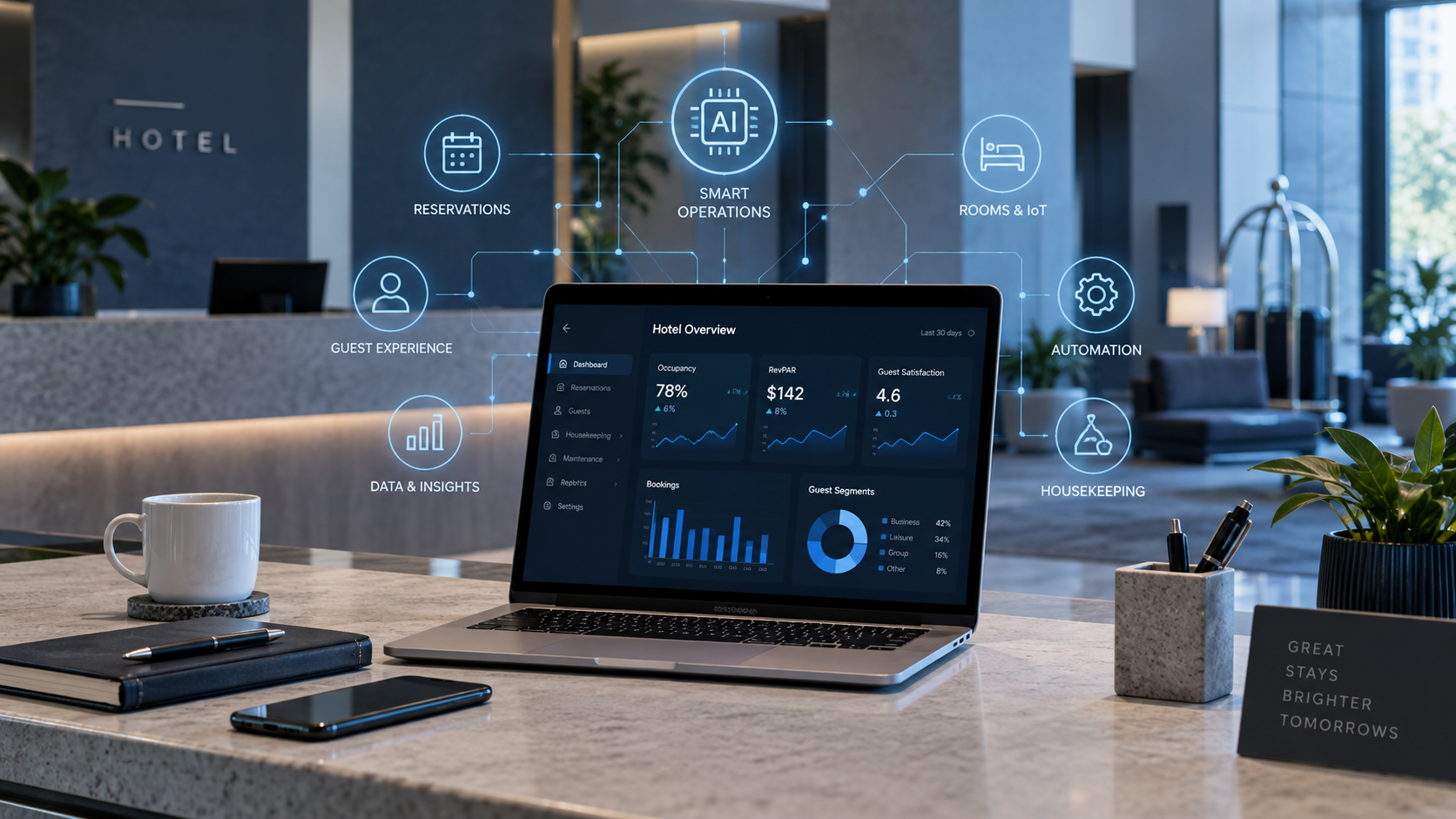
Artificial intelligence is taking the industry into its next technological phase.
Kaplick recognises many familiar patterns.
“AI is being sold in exactly the same way as POS systems and websites were before: first the tool, then the search for the problem.”
This time, the risk may be even greater.
A poorly maintained traditional system often produces obviously incomplete information.
Artificial intelligence can generate answers from poor data that sound convincing and plausible – even when the underlying information is wrong.
That is why Kaplick continues to see the supposedly boring basics as crucial: consistent company data, accurate opening hours, clear information across the relevant platforms, a website with genuine content and answers to the questions guests normally ask by phone or email.
Traditional SEO has not suddenly become irrelevant in the age of AI either.
An analysis by seoClarity found that around 90 percent of the search queries featuring a Google AI Overview showed at least one overlap between the sources used there and the traditional top ten organic search results.⁴
A hotel that does not have its basic digital visibility under control can hardly expect AI to solve the probThe unspectacular measures are often the ones that work
Interestingly, when Kaplick is asked which digital measures have proven particularly effective, he does not name highly complex systems.
His examples sound almost mundane: a properly maintained Google Business Profile, correct opening hours, current photos, responses to reviews, working online reservations or an automatic reminder before a restaurant booking.
At one country inn in the Rheingau region, his team spent less than 40 minutes improving the Google profile. Opening hours were corrected, current images were added and older reviews were answered.
A few months later, the operator reported that new guests had discovered the restaurant through a photo of its Sauerbraten.
In another case, an owner initially thought digitalisation had little to do with her daily business. After online reservations were connected to Google, she suddenly noticed that people she had never seen before were booking tables.
Next to AI and complex hotel platforms, examples like these may sound unimpressive.
That is exactly Kaplick’s point.
Digitalisation does not necessarily have to begin with a major investment project.
Sometimes it begins with making sure your business is accurately represented where potential guests are already looking for it.
Mistakes become expensive more quickly today
Economic weaknesses are also harder for hotels and restaurants to absorb than they were a few years ago.
Staffing, food, energy and many other operating costs have risen significantly. Germany’s statutory minimum wage has stood at €13.90 per hour since January 2026 and will rise to €14.60 in January 2027.⁵
For labour-intensive businesses such as hotels and restaurants, that creates additional pressure to understand workflows and profitability precisely.
A badly calculated dish, unnecessary commission payments, a software licence without real operational value or a room rate that is adjusted far too rarely may not look threatening in isolation.
Over months and years, however, such weaknesses can add up to substantial sums.
The key question is therefore no longer simply whether a hotel works digitally.
What matters is whether digitalisation helps make these losses visible in the first place.
Five things René Kaplick would check first in a hotel
Anyone expecting this to require an extensive corporate audit may be surprised by Kaplick’s approach.
When he enters an owner-operated hotel for the first time, he starts with five relatively simple points. In his experience, they often provide a quick indication of where money and working time may be getting lost.
- Website and Google profile: Check them on a smartphone without using the hotel’s internal Wi-Fi. Can a first-time guest understand within 30 seconds what the hotel offers and how to book a room?
- Booking channels: Where did the reservations of the past twelve months come from – and how much commission was actually paid for them?
- Room rates: When were prices last adjusted? Are seasonality, demand and weekdays being taken into account?
- Dependence on the owner: What happens if the owner is absent for two weeks? Who creates the rota, orders supplies and knows where contracts, procedures and access details are kept?
- Hotel F&B: Are the restaurant and breakfast operation analysed separately, including food costs and labour costs?
According to Kaplick, these five points are often enough to identify within a few hours where a deeper analysis is necessary.
Dependence on the owner is particularly important.
Processes that exist only in one person’s head do not automatically improve just because new software is introduced.
At worst, technology merely digitalises something that was never properly organised in the first place.
Do not start with software
That leaves one question: what should a hotelier do after recognising the problem, but still feeling overwhelmed by the sheer number of systems, providers and options?
Kaplick’s answer is remarkably simple:
“Do not start with software. Start with a sheet of paper.”
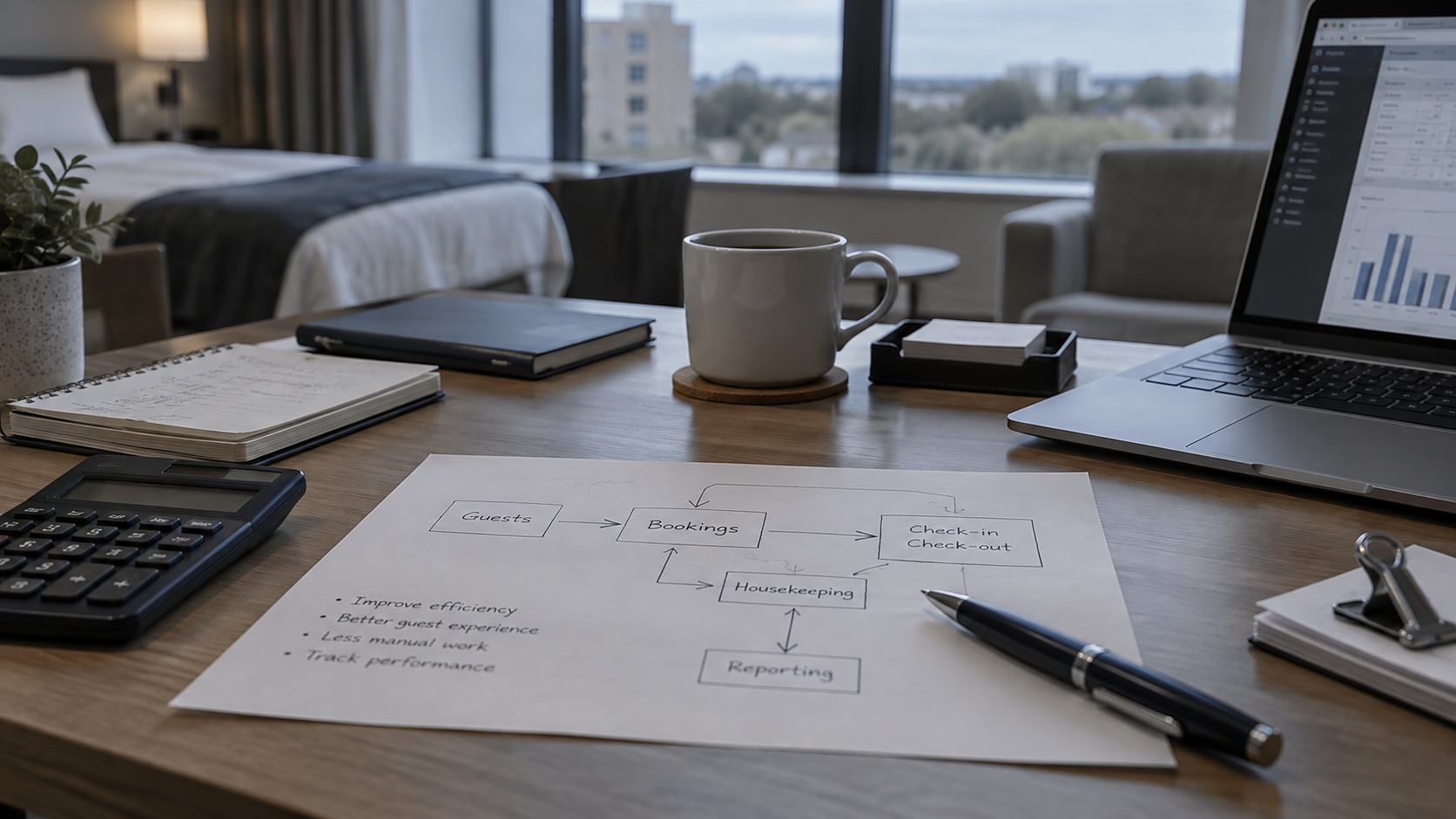
First, write down where time is lost every week and where money is being lost.
Only then decide which problem should be solved first.
Not five at once.
Not a complete digital transformation.
And certainly not whichever system happened to have the most convincing sales presentation.
Twenty minutes every Monday.
Reply to reviews, check the Google profile, add a current photo and review the most important figures from the previous week.
No grand digital strategy – just a routine that actually happens.
Perhaps that is the most important lesson from more than 1,200 on-site consultations carried out as part of GastroDigital Hessen.
A digital business is not automatically the one with the most software.
And a dashboard packed with key performance indicators does not necessarily lead to better decisions.
Digitalisation only becomes economically useful when technology helps answer questions that are genuinely relevant to the business:
Where do we make money? Where do we lose money? Where do we lose time – and why?
Once those answers are clear, a hotel can decide which digital tools will actually help.
If those questions cannot yet be answered, the business may not need another piece of software.
It may simply need a sheet of paper first.

René Kaplick is founder and CEO of Gastro Piraten, a keynote speaker and author. Since 2010, his team has advised more than 5,600 businesses in gastronomy and hospitality, covering topics from start-ups and digitalisation to business succession.
His assessments and practical examples are included in this article as an expert source.
Books by René Kaplick
Practical knowledge for gastronomy and hospitality – from digitalisation and sales to start-ups, succession and franchising.
 Digitalisation
Der digitale Wirt
Digitalisation
Der digitale Wirt
 Sales
Aktiver Verkauf im Restaurant
Sales
Aktiver Verkauf im Restaurant
 Start-ups
Bevor du aufschließt
Start-ups
Bevor du aufschließt
 Succession
Das Lebenswerk übergeben
Succession
Das Lebenswerk übergeben
 Franchising
Dein eigenes Franchise
Franchising
Dein eigenes Franchise
Affiliate notice: The book links are affiliate links. If you purchase through one of these links, we may receive a commission. The price you pay remains unchanged.
This article draws on project documentation, current industry and digitalisation data, and a written interview with René Kaplick.
-
GastroDigital Hessen – Final Report on Digitalisation Consulting for the Hospitality Sector in Hesse 2021–2022
Official final report of the GastroDigital Hessen project. From March to November 2022, 1,200 on-site consultations took place, and more than 280 businesses were advised. Gastro Piraten are listed in the report as a project partner. -
SE Ranking (2025): AI Overviews in Germany – Analysis of 100,000 Keywords
Analysis of 99,964 keywords targeting the German market across 20 topic areas. Google AI Overviews appeared for 27.86 percent of the analysed search queries. Data was collected from 21 to 23 May 2025. -
Bitkom (2025): Internet Search Is Changing – Half Already Use AI Chats
Representative telephone survey of 1,156 people aged 16 and over in Germany, including 1,030 internet users. Fifty percent of internet users said they at least occasionally use AI chats instead of traditional search engines. -
seoClarity (2025): The Overlap Between AI Overviews and Organic Rankings
Analysis of 362,000 keywords with Google AI Overviews. For 90 percent of the analysed queries, at least one source cited in the AI Overview also appeared among the top 10 organic search results. -
German Federal Government (2026): Minimum Wage Now at €13.90
Germany's statutory minimum wage has been €13.90 gross per hour since 1 January 2026. It will increase to €14.60 on 1 January 2027.