


Key points
- According to Bitkom, 19 per cent of German holidaymakers have already had AI recommend accommodation, and a further 44 per cent can imagine doing so.
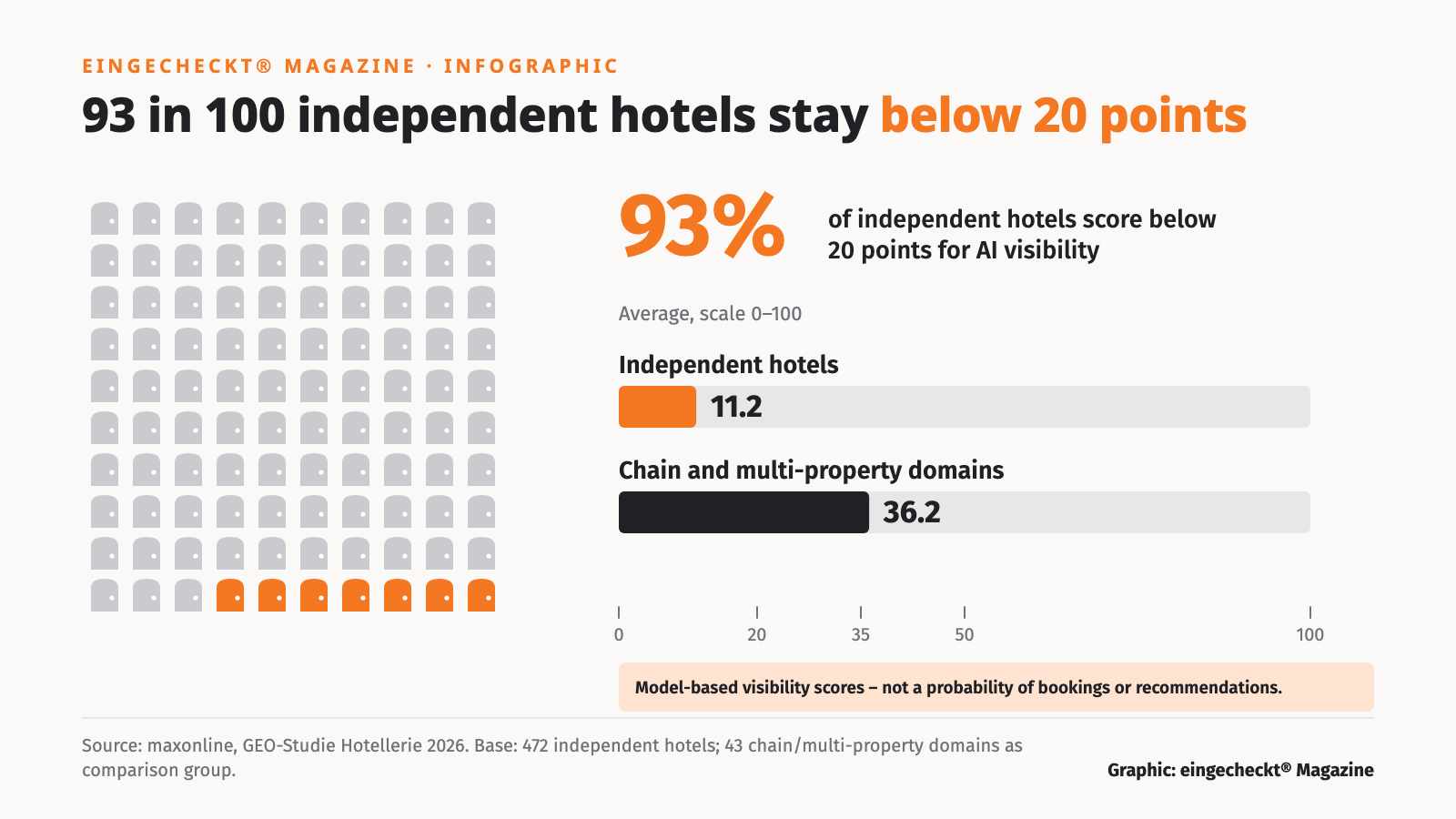
- In maxonline’s GEO study, independent hotels score an average of 11.2 out of 100 points, and 93 per cent score below 20.
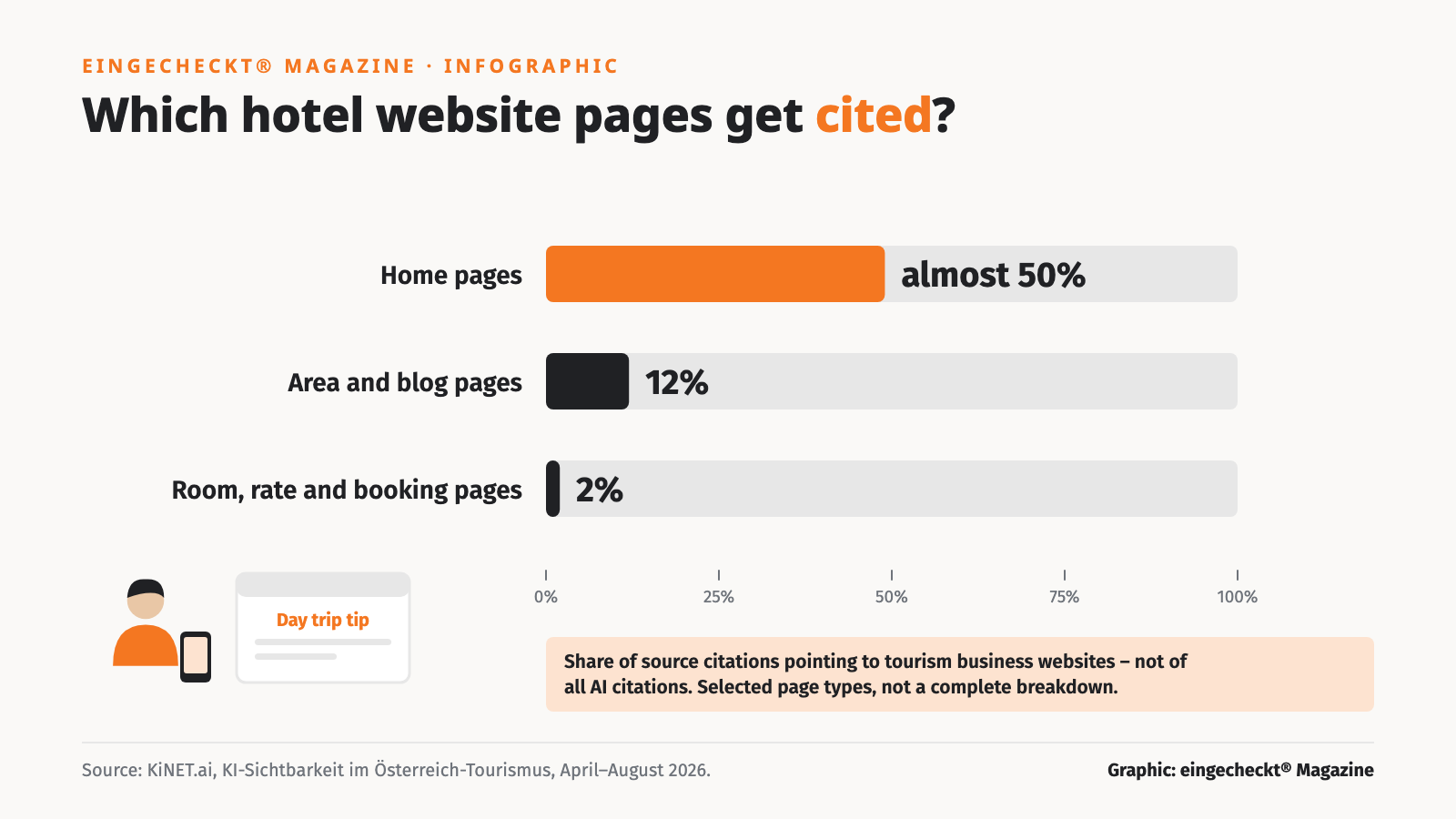
- According to KiNET.ai, almost half of the source citations pointing to tourism business websites went to the home page; room, rate and booking pages accounted for two per cent.
- As a starting point, Manuela Machner recommends five good pages. The Google Business Profile and the listing with the tourism board also deserve attention.
More and more travellers are letting artificial intelligence recommend hotels. Yet many properties barely appear in the answers. Three experts explain why – and why smaller hotels in particular now have an opportunity.
All Manuela Machner really wanted was a nice piece of text about snowshoeing. It was 2022, artificial intelligence was still in its infancy, and the then managing director of the Murtal tourism region in Austria was experimenting with the writing tool Neuroflash. Her instruction could hardly have been simpler: “We are in Hohentauern in the Murtal, write me an image text about snowshoeing.”
The result wasn’t bad at all. It just had one crucial flaw: the information about her region that Manuela Machner had painstakingly put online in the preceding weeks was missing. The AI wrote about snowshoeing but apparently knew little about what actually made the region special.
For Manuela Machner, this was the start of a question that still occupies her today: where do such systems actually get their knowledge from? The former tourism manager is now a tourism AI coach and the founder of KiNET.ai in Leoben. Rather than judging individual texts, she now examines which websites ChatGPT, Google and other AI systems actually draw on for travel questions.

What she has found is likely to surprise many hoteliers. Even an excellent property with outstanding service and first-class reviews can find itself rather lonely in the digital hotel search.
AI has a rather short guest list
Imagine a family planning their next holiday. Two children, a dog, and perhaps the grandparents are coming too. They want a pool, good hiking and, ideally, a hotel where nobody goes stir-crazy after three hours of rain.
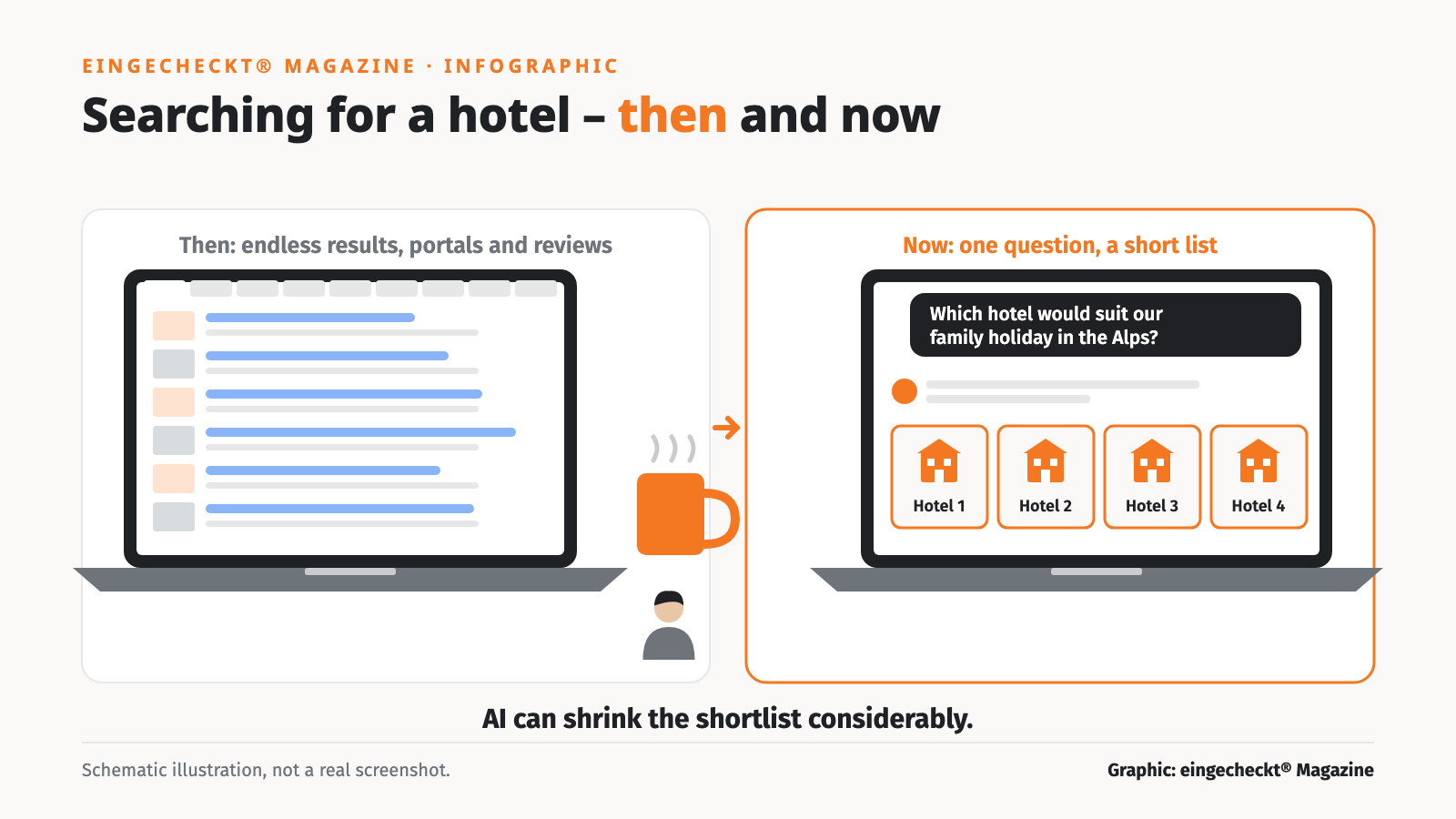
In the past, they would have typed several search terms into Google, trawled through hotel portals and worked their way through countless reviews. Today, a single question to ChatGPT may be enough: “Which hotel would suit our family holiday in the Alps?”
The system provides a selection, explains the advantages and names suitable accommodation. Sometimes there are only three to five hotels. For the properties named, that is an interesting opportunity. For all the others, the guest’s digital journey could be over before they have even seen their website.
That such situations are no longer a thing of the future is shown by a Bitkom survey from August 2026: 19 per cent of German holidaymakers have already had artificial intelligence recommend accommodation. A further 44 per cent can imagine doing so in future.¹
93 in 100 hotels stay under the radar
How big the challenge is was revealed in July 2026 by a study from the Austrian GEO agency maxonline. Harald Fischl, Head of SEO & GEO and managing partner of the agency, had the AI visibility of a total of 515 four- and five-star hotels from Germany, Austria and Switzerland analysed. They included 472 independent hotels and 43 chain or multi-property domains.²

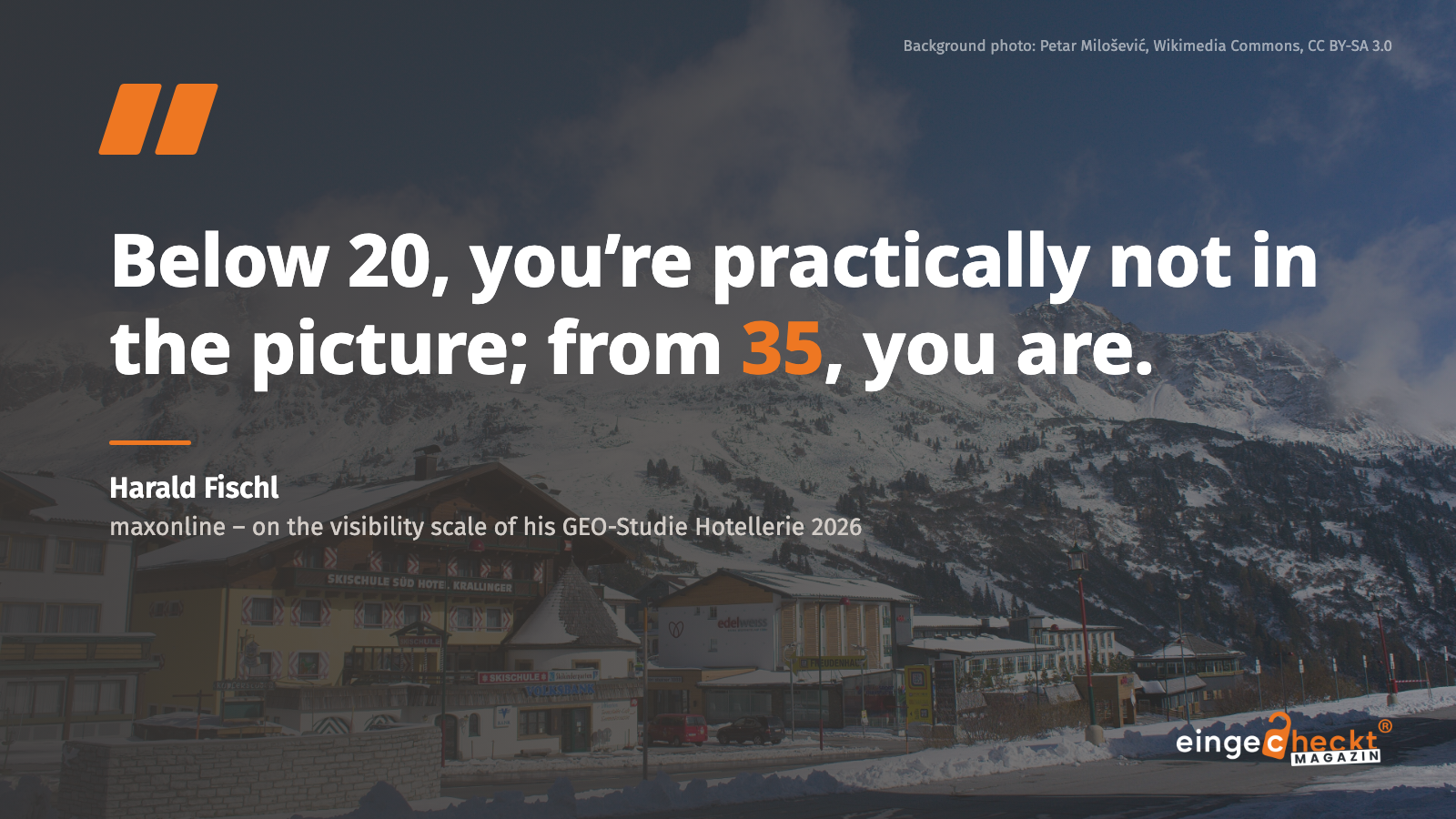
The result: on a model-based visibility scale from 0 to 100, independent hotels achieve an average of just 11.2 points. For 93 per cent of the properties, the score is below 20. Chain and multi-property domains perform considerably better, with an average of 36.2 points.
It is important to understand what these figures mean. A hotel with eleven points is not recommended in eleven per cent of all questions. Rather, the score describes how broadly and how regularly a property appears in the AI systems studied when people ask relevant hotel questions without brand names. So it is neither a booking rate nor a school grade for the hotel.
The star rating plays a surprisingly small role in the result. The study even includes a four-star wellness hotel that leaves well-known luxury properties in its region behind. Conversely, there are five-star hotels that do not appear at all in the recommendation questions measured. Prestige at the front door evidently does not guarantee a permanent place in ChatGPT.
Harald Fischl, however, sees this not only as a problem but as an opportunity. The most successful properties, he says, are those known for a particular theme and regularly mentioned outside their own website. After all, a small wellness hotel does not have to compete with every luxury hotel in Europe. It has to be interesting to the right guests.
AI doesn’t want to read a sales brochure
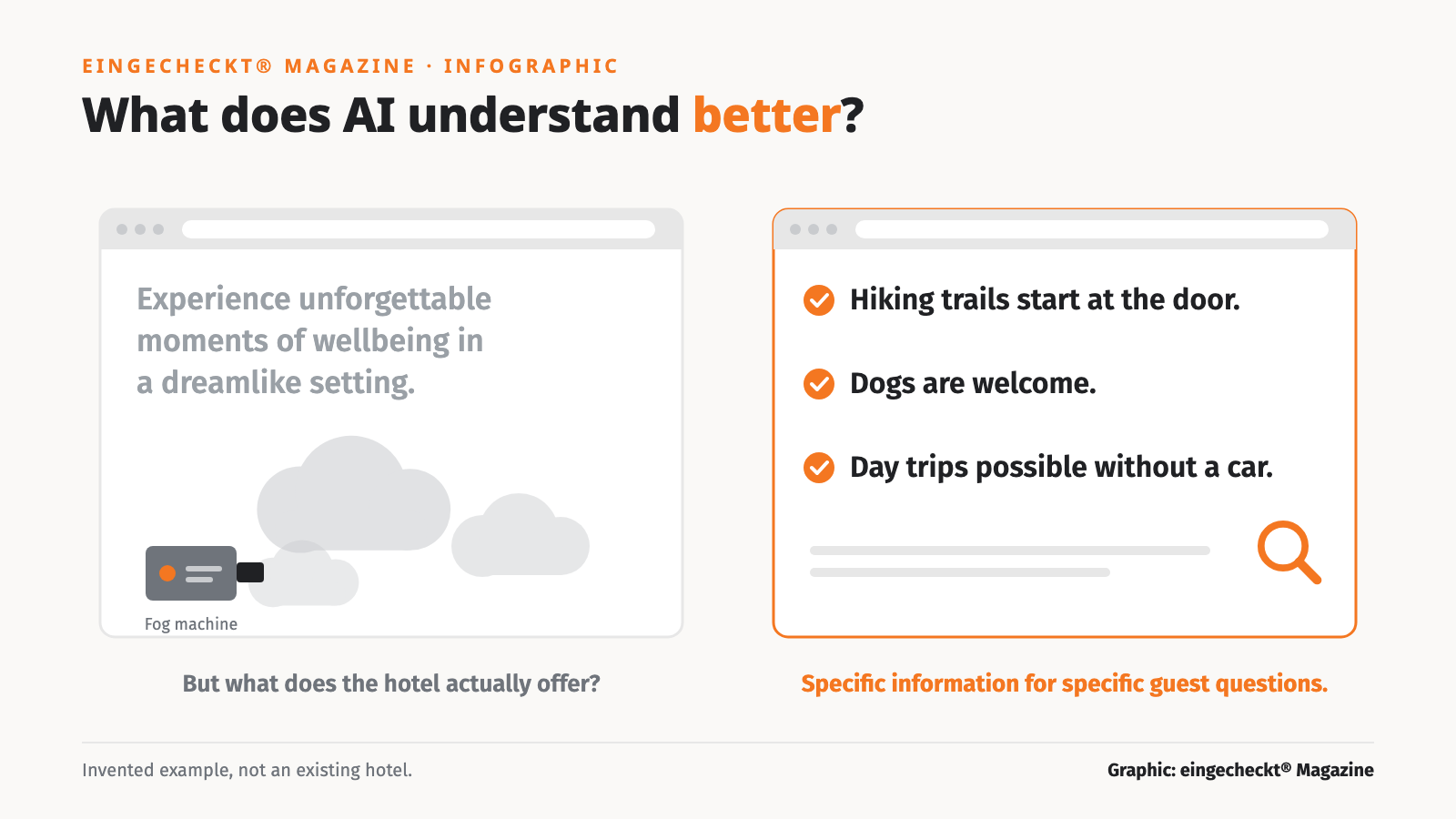
This is where things get particularly practical for hoteliers. Many hotel websites sound something like this: “Experience unforgettable holiday moments in a dreamlike setting and enjoy warm hospitality in a unique ambience.”
It reads nicely. Unfortunately, the text could belong to a mountain hotel in Tyrol, a country inn in Saxony or a holiday resort on the Baltic coast. It says practically nothing about whether the property suits a guest’s specific question.
It is a different story with a description that explains, for example, that hiking trails start right at the hotel, which routes are suitable for families, whether dogs are allowed and how to reach the nearest day-trip destination without a car. Such details can be verified and help an AI match a property’s features with a traveller’s wishes.
Manuela Machner sums up this change of perspective in one sentence:
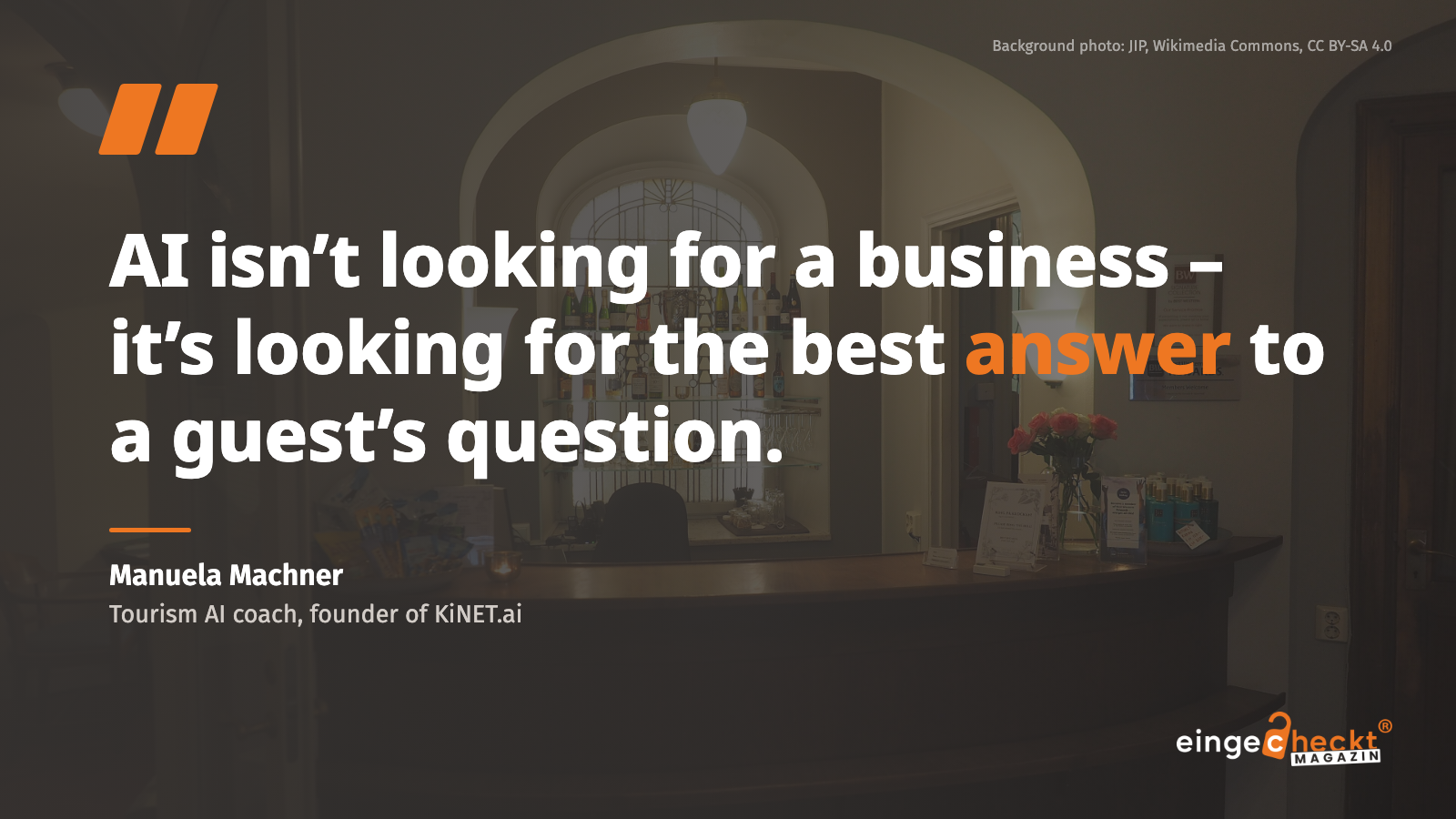
“AI isn’t looking for a business – it’s looking for the best answer to a guest’s question.”
Incidentally, this does not mean that a hotel has to commit to a single target group. A holiday hotel can cater for families, couples and seminar groups. It just needs to explain clearly to each of these groups what actually awaits them. AI does not need yet another declaration of love for the property’s unique atmosphere. It needs information it can work with.
Where AI actually looks
Anyone wanting to find out which information artificial intelligence prefers to use can hardly ignore Manuela Machner’s work. For her study on AI visibility in Austrian tourism, 154 German-language guest questions were examined every day between April and August 2026. In total, this produced 1,140,482 source citations from several AI systems.⁴
One particularly interesting finding concerns the hotel’s own website. Of the source citations leading to tourism business websites, almost half went to the home page. A further twelve per cent went to pages about the local area, day trips or similar content. Room, rate and booking pages together accounted for a mere two per cent.
This by no means suggests that a hotel should neglect its room pages. Guests still need to see what they are booking and what it costs. Rather, the study shows which pages often serve as a source of information when AI is first looking for suitable accommodation.
The development within just a few weeks is also interesting. According to Manuela Machner’s latest observations, ChatGPT named an average of seven hotel websites per answer to hotel questions in October 2026. In September, it had been around one and a half. By now, around six in ten of these citations led to the respective home page. The figures come from her Austrian monitoring and reflect the situation at the end of October 2026.
A hotel does not need a website with a hundred subpages for this. What matters more is a few well-made pages on which a visitor – and indeed an AI – gets the key questions answered.
Why the tourism region is suddenly your best ally
However carefully a hotel maintains its own website, AI also looks elsewhere when compiling travel recommendations. Tourism boards, booking portals, trade magazines, travel reports and reviews provide additional information. Which sources matter most differs from one AI system to another.
Regional tourism organisations play an interesting role here. According to Manuela Machner’s research, they are frequently used as a source of information, even if the name of the tourism board does not appear in the answer at all. The AI reads, for example, a regional theme page about family-friendly hiking and then names suitable properties.
For a smaller hotel, a carefully maintained listing with its own tourism board can therefore be extremely valuable. It becomes even more interesting when the region offers not just an alphabetical hotel directory but picks up specific themes: accommodation for cyclists, family-friendly holiday hotels or properties for seminars in the countryside.
Harald Fischl also observes from his project work that ChatGPT and Perplexity often draw on external sources such as magazines, portals and directories. Google, by contrast, relies heavily on information from its own search and business profile environment, he says. These are experiences from his agency’s practical work, not separately measured figures from the maxonline study.
For hoteliers, the consequence is pleasingly straightforward: don’t look only at your own website. The other places online where the property is talked about also deserve attention.
Google changes the rules – sometimes in the middle of the month
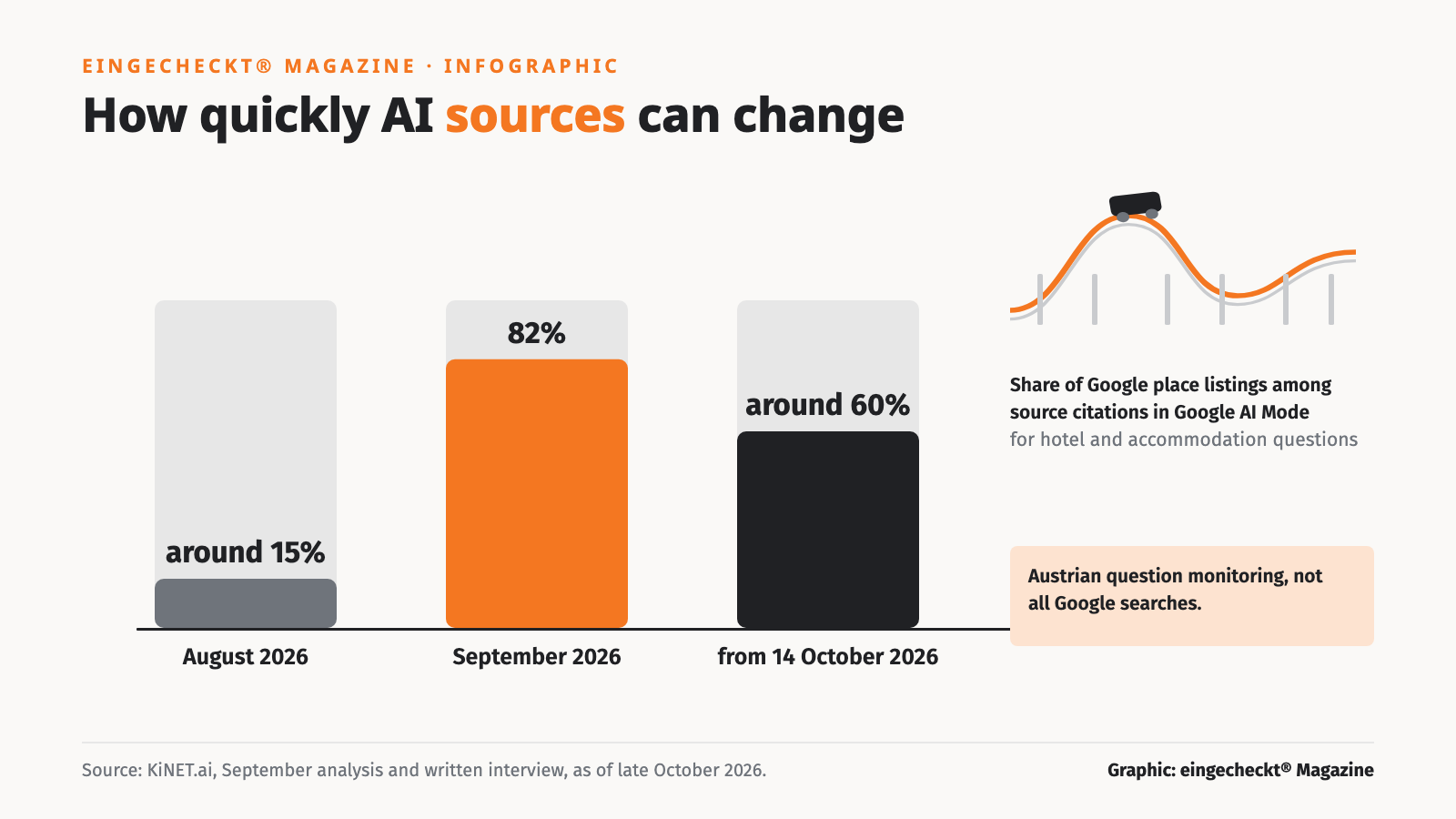
How quickly all this changes can be seen in Google Business Profiles. In Manuela Machner’s Austrian study, Google place listings accounted for only around 15 per cent of source citations for hotel queries in Google AI Mode in August. In September, the figure suddenly stood at 82 per cent.⁵
In October, this extreme spike initially continued. Since 14 October, however, the share has been around 60 per cent according to her further measurements. That is still considerable, but above all it shows one thing: an AI platform can change its preferred sources without a hotelier first receiving a friendly letter announcing it.
Anyone who has only opened their Google Business Profile for years when the phone number changes should therefore give it some attention. Are the services correct? Are the pictures up to date? Is the right website link stored? And does it still list a facility that disappeared during the last renovation?
Such contradictions are not just annoying for guests. They also make it harder for AI systems to form a reliable picture of the hotel.
Do you now need an AI technician?
At this point, a hotelier might start to get nervous. You have only just modernised the website, renewed the booking process and perhaps finally got the Wi-Fi under control. Now GEO is supposed to go on the to-do list as well?
GEO stands for Generative Engine Optimisation. The aim is to prepare information in such a way that AI systems understand it and take it into account in suitable answers. The term sounds more complicated than many of the measures required.
Prof. Roland Schegg of the Institute of Tourism at HES-SO Valais-Wallis in Switzerland has published a white paper on AI visibility for hotels together with Dr Jean-Claude Morand.³ His advice to smaller businesses: first improve the information you already have, rather than rushing into expensive technology projects.

The technical basics include so-called structured data according to Schema.org. Put simply, you can think of it as small, machine-readable labels. A program should be able to recognise, for example, that a number is the telephone number, that an address belongs to the hotel or that a particular facility is offered. This does not require rebuilding the website, though it may require support from your own web agency.
Google itself also explains that no special additional optimisation is required for websites to be included in AI Overviews and AI Mode. Pages essentially need to be indexable and suitable for display as a search result with a text snippet.⁶
The more promising start therefore lies not in some mysterious file that supposedly enchants all AI systems, but in understandable texts, accurate information and an easily accessible website.
Five good pages can be a start
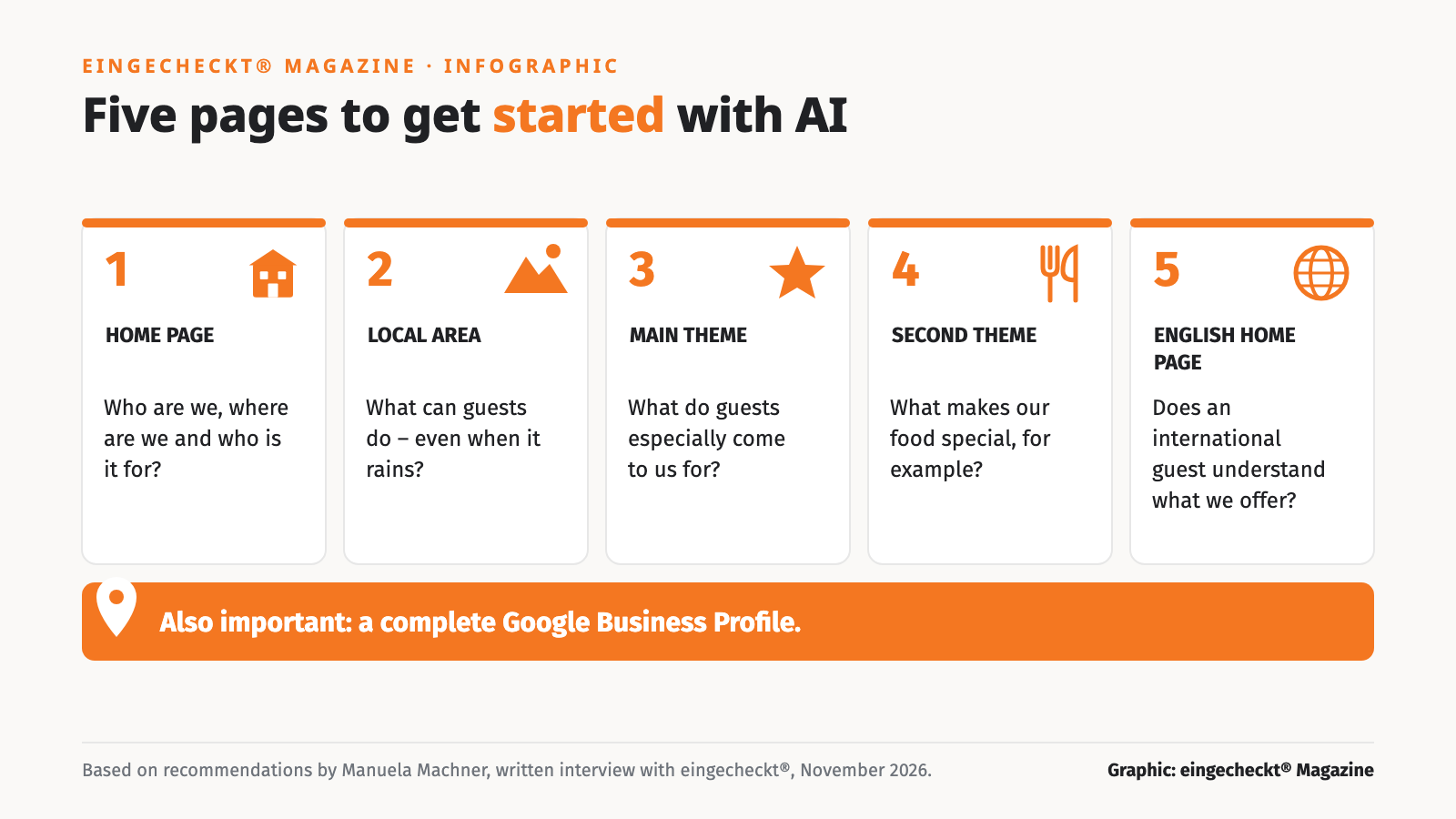
But what should a hotel with limited time revise first? For a smaller property, Manuela Machner recommends five specific pages: the home page, a helpful local area page, one page each on the property’s two most important themes and a complete English home page.
The English version in particular comes as a surprise. In her analyses, AI systems sometimes draw on English content even for German-language questions. A carelessly translated short version can therefore become a disadvantage. It is also worth tapping into the knowledge at reception: anyone who answers questions about day trips, children’s activities or travel options every day already has a small treasure trove of topics for the website.
And if nobody has time for this right now? Then it might be more sensible to make one of these pages really good first, instead of publishing twenty new texts about unforgettable holiday moments.
A smartphone video can say more than an image film
Another surprising finding comes from Manuela Machner’s video analysis. A YouTube Short of just 37 seconds about Lake Lünersee in Austria was used as a source more than 400 times in her measurements up to the end of October. The video did not even have a detailed description.
What evidently mattered was that the spoken text contained specific information, for example about the location of the lake and how to get there. For the videos cited by Google in her study, huge reach was not a prerequisite either: more than half of the most frequently cited YouTube videos had fewer than 10,000 views.
For hotels, this opens up an appealing opportunity. A short clip about the hiking trail on the doorstep or a day trip for rainy weather can be more useful than an elaborately produced image film that shows beautiful sunsets but hardly answers a specific question. The video should say what it is about, name the place and provide the key facts. Whether Google then cites it is, of course, not guaranteed.
The self-test: would AI recommend your hotel?
A first stocktake requires neither a consultant nor complicated software. Harald Fischl recommends thinking up ten realistic questions that potential guests might ask. The crucial point is that your own hotel name does not appear in them.
One possible question would be: “I’m looking for a family hotel in Styria with childcare and a thermal spa.” You then let ChatGPT, Perplexity or Google AI Mode answer, try out different phrasings and note whether your own property is named. The sources the systems rely on are just as important.
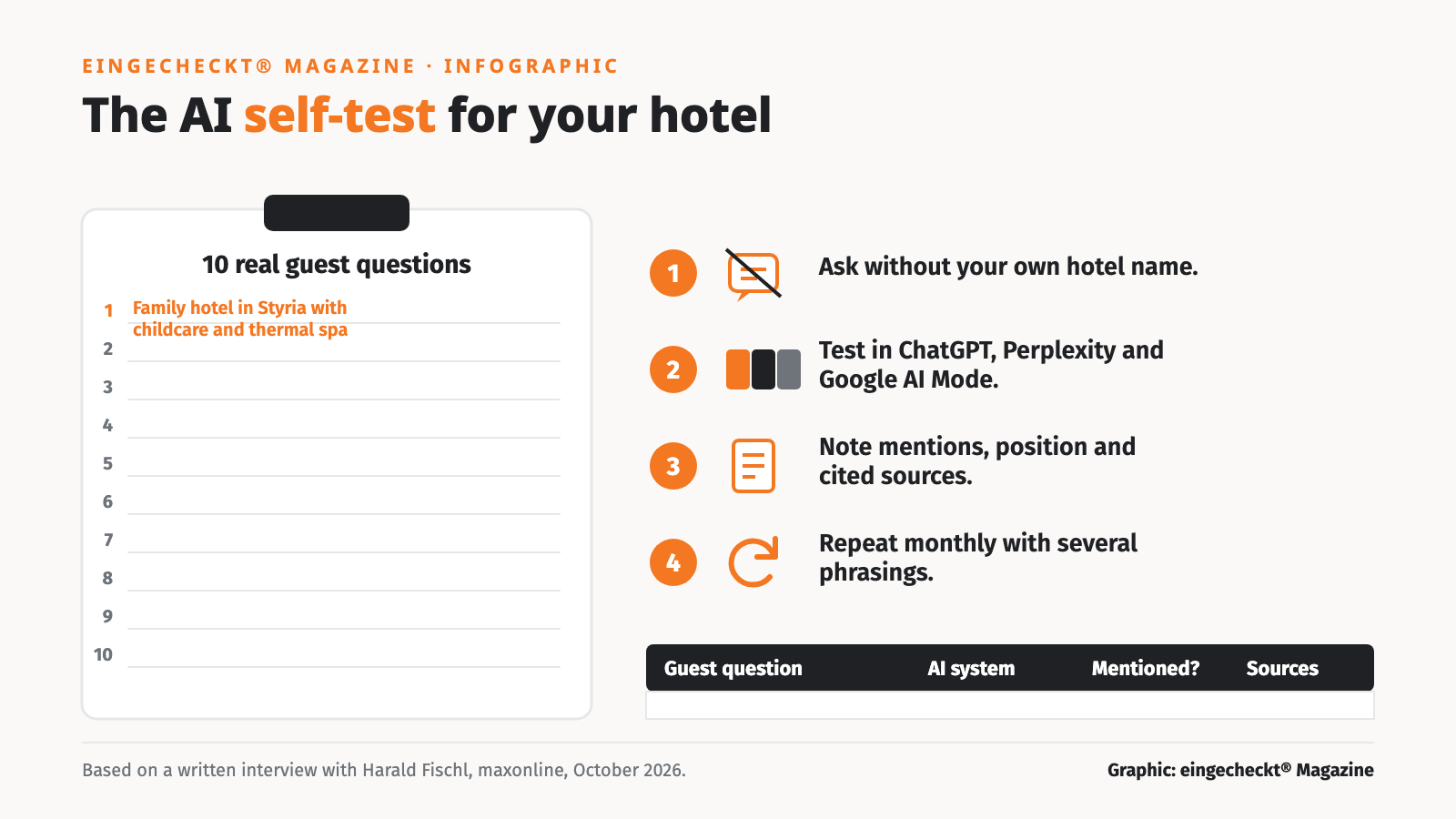
Anyone who repeats this little test regularly will at least see whether their hotel appears more often and which sources of information play a role. It does not produce scientifically exact visibility scores. But the exercise provides practical pointers to where information is missing.
Prof. Roland Schegg also recommends a designated person in the team who checks the most important digital listings for about an hour once a quarter. After renovations, new offers or major changes, this should of course happen sooner.
And when does a recommendation become a booking?
This brings us to perhaps the most important caveat of the whole development: a hotel can appear in an AI answer without anyone subsequently visiting its website. A source citation is not automatically a recommendation for that property either. And even an explicit recommendation does not necessarily lead to a booking.
Manuela Machner therefore recommends not only counting mentions but also monitoring visits from AI systems. This is partly possible with web analytics tools, though not without gaps. With Google, for example, visits from the AI search features are often recorded together with the rest of the search traffic. With other systems, information about where visitors come from may be missing.
A simple addition, on the other hand, requires no new technology at all: ask at booking or check-in how the guest heard about the hotel. “ChatGPT or another AI” can by now be a perfectly sensible answer option.
Booking.com and Expedia will not simply disappear as a result of this development either. Both have extensive data and technical resources. Prof. Roland Schegg nevertheless sees an opportunity for independent properties, because AI systems can take very specific travel wishes into account. A small hotel that matches these wishes perfectly can become interesting as a result, even if it is not an internationally known brand.
At the final step, however, everything remains remarkably familiar: the guest must be able to book easily.
The Swiss tourism expert says that he personally still often searches for hotels using map services, because he travels without a car and depends on good transport links. Once he has found a suitable property, he prefers to book directly on its website – at least when booking is straightforward and trustworthy.
Perhaps that is a fitting thought to end on. In an industry currently debating algorithms, data structures and artificial intelligence, it is still a human being who ultimately decides where to spend their holiday.
AI can show them a hotel. Whether they actually want to check in there is up to the guest.
The AI measurements by KiNET.ai relate to Austrian travel queries in German. The maxonline study examines four- and five-star hotels in the DACH region and uses model-based visibility scores.
Both studies provide indications of developments and patterns, but no reliable forecast of the booking figures of any particular hotel.
This article is based on a representative survey, two studies with a supplementary analysis, a white paper, Google’s documentation and our own written interviews.
-
Bitkom (2026)
Reiseziel, Restaurant, Route: Wo KI zum Reisebegleiter wird
Press release of 7 August 2026. Representative survey on the use of AI for holiday travel. Original publication in German. -
maxonline (2026)
GEO-Studie Hotellerie 2026
Study, July 2026. AI visibility of 515 four- and five-star hotels in Germany, Austria and Switzerland. Original publication in German. -
Roland Schegg and Jean-Claude Morand, HES-SO Valais-Wallis (2026)
Werden Sie für KI sichtbar
White paper, March 2026. Fundamentals of AI visibility for hotels. Original publication in German. -
Manuela Machner / KiNET.ai (2026)
KI-Sichtbarkeit im Österreich-Tourismus
Study, 2026. 154 German-language guest questions, April to August 2026, 1,140,482 source citations. Original publication in German. -
Manuela Machner / KiNET.ai (2026)
Google AI Mode setzt auf Google Maps
Analysis, September 2026. Share of Google place listings in Google AI Mode for hotel questions. Original publication in German. -
Google Search Central (2025)
AI features and your website
Documentation, accessed on 8 November 2026. Guidance on AI Overviews and AI Mode for website owners.


