


Key points
- Oliver Meyer, founder and CEO of HotelPartner Revenue & Profit Management, considers how much personal service remains in hotels as technology takes over routine work.
- In his view, it is not human presence that will become a luxury, but competent, personal attention.
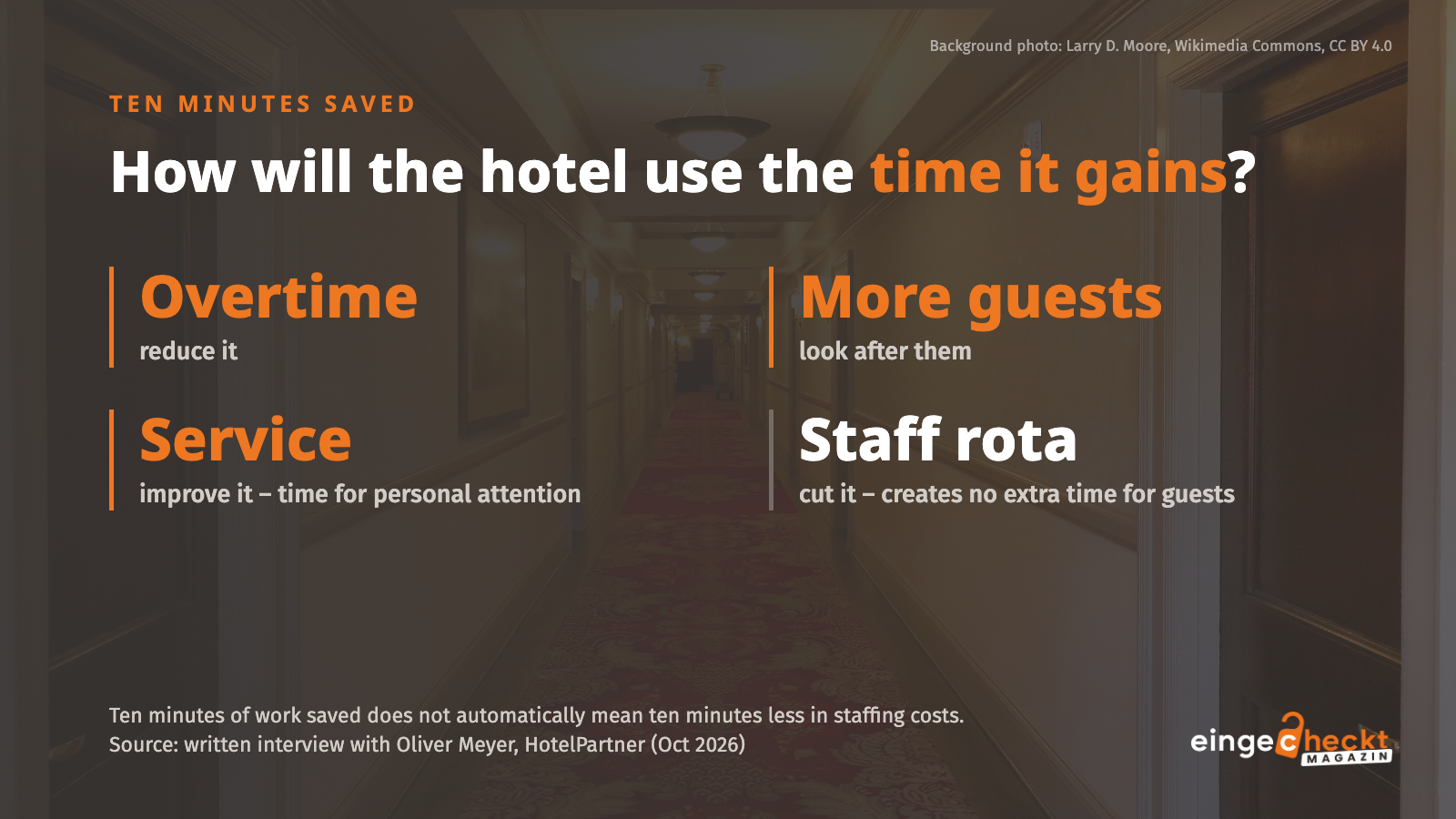
- Saving working time does not automatically cut staffing costs. How a hotel uses the time it gains is a management decision.
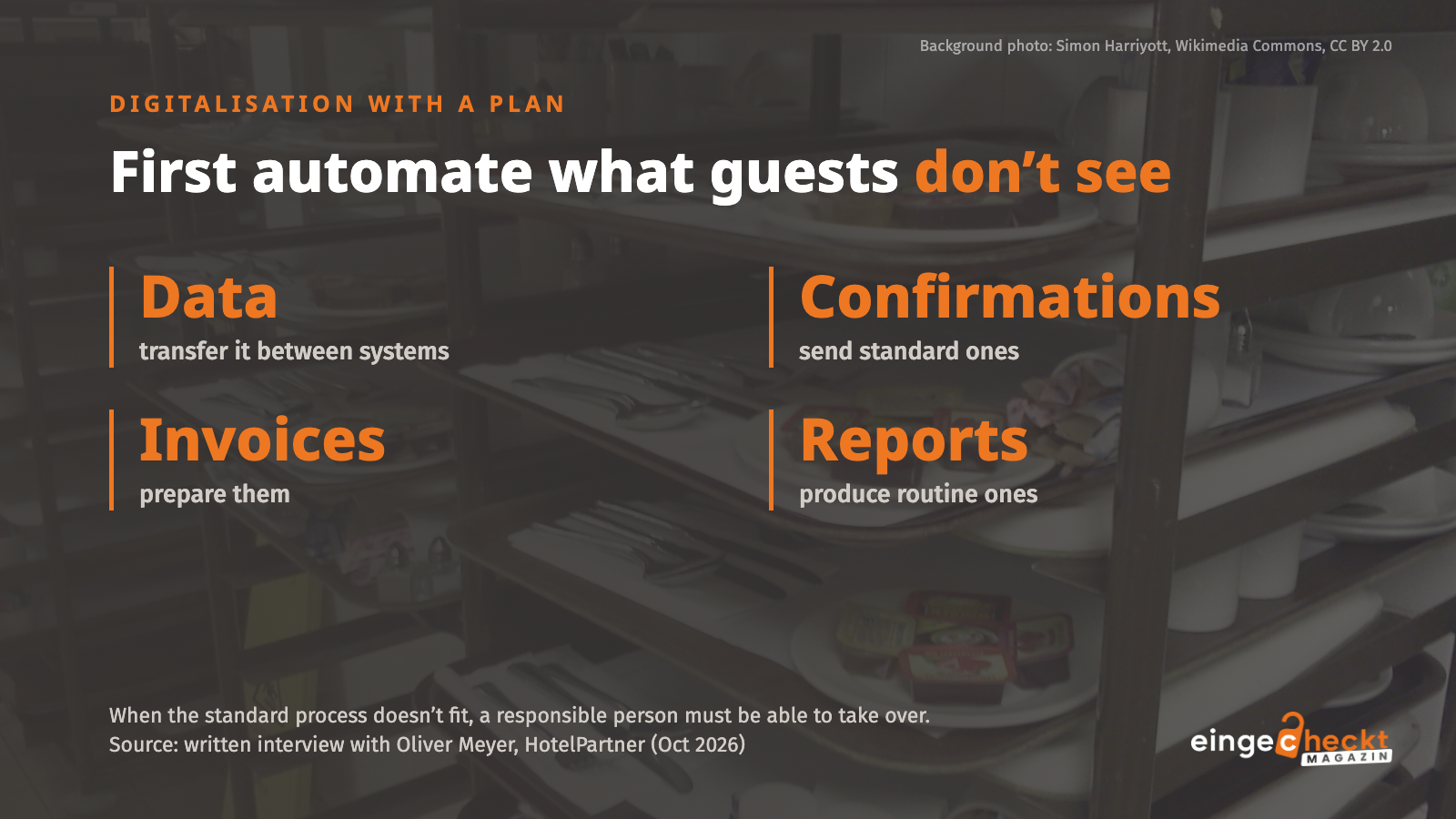
- Hotels should first automate work behind the scenes, such as data transfers, standard confirmations and invoice preparation.
Self-service check-in, automated booking confirmations and fewer staff at reception. Technology is changing the way hotels operate. But what happens to genuine hospitality when machines take over more of the everyday work? Oliver Meyer, founder and CEO of HotelPartner Revenue & Profit Management, believes automation offers more than a way to reduce costs. It could also give hotels an opportunity to improve the guest experience – provided their owners and managers make the right decisions.
When human attention becomes a luxury
At the live premiere of HotelPartner’s “AUSGEBUCHT!” performance podcast during the Independent Hotel Show Munich in September 2026, three industry figures discussed the financial future of hospitality. HotelPartner founder Oliver Meyer hosted the session on the Vision Stage, joined by Jörg T. Böckeler, former CEO of Dorint and now Managing Director of Invite Group, and hotel entrepreneur Vincent Ferdinand Wapler.¹
Böckeler described the growing financial pressures facing hotel operators. According to his market analysis, costs in the German hotel market have risen by 42 per cent since 2023, excluding index-linked lease increases. Wapler offered a different perspective, describing hotels that can operate profitably with very lean staffing thanks to extensively digitised processes.¹
During the discussion, Böckeler delivered a striking prediction: “People will become a luxury.”
For an industry built around hospitality and personal service, the implications are considerable. Could human attention eventually become a privilege reserved for guests willing to pay premium rates, while everyone else is left to deal with machines and digital applications?
Oliver Meyer, who has spent two decades helping hotels improve their financial performance, sees the question somewhat differently.
“It isn’t human presence that will become a luxury, but competent, personal attention,” he explains in a written interview with eingecheckt®. Meyer expects routine interactions to become increasingly automated, making it all the more important for hotels to decide where people genuinely make a difference: recognising a guest’s needs, offering a thoughtful recommendation or resolving a problem.
He is particularly clear about one thing: “Reliable assistance must not become a luxury product.”
Saving ten minutes of work doesn’t necessarily save money
Meyer knows the potential of automation first-hand. When he founded HotelPartner in Switzerland in 2006, he spent countless nights managing room pricing manually. Over time, the company developed technology that could handle such tasks far more efficiently. What began as a business built around revenue management has since grown into an international service provider with more than 70 specialists and approximately 500 partner hotels.²
Meyer has no doubts about technology’s ability to reduce workloads. Measuring the financial benefit, however, is more complicated. Eliminating a task does not automatically eliminate its cost.
“Ten minutes of work saved does not automatically mean ten minutes less in staffing costs.”
A hotel that automates invoice preparation may save a considerable amount of administrative time each day. Its employees, however, do not necessarily spend fewer hours at work. Whether the investment pays off depends on what the hotel does with the capacity it has freed up.
Could it reduce overtime? Allow staff to look after more guests? Or finally give employees more time for the personal attention that so often gets squeezed out of a busy working day?
For Meyer, this is fundamentally a management decision. Removing every minute saved from the staffing schedule will not create more time for guests. A hotel that deliberately uses those hours to improve service is pursuing a different objective. Both approaches may make sense, but each needs to fit the hotel’s business model.
The best digital improvements are often invisible to guests
Interestingly, Meyer would not necessarily begin a hotel’s digital transformation at reception. He would first look at the work taking place behind the scenes: transferring information between systems, sending standard confirmations, preparing invoices and producing routine reports.
There is often considerable potential to reduce workloads without removing the personal interactions guests value. Nor does every improvement require artificial intelligence. Connected systems and well-designed processes can frequently achieve a great deal on their own.
Digital check-in, Meyer believes, can certainly have its place. In a budget hotel, it may help reduce operating costs. In a luxury property, it might simply spare guests an unnecessary wait. The important question is whether the technology supports the experience the hotel has promised.
Problems arise when a hotel reduces its own workload by transferring it to the guest. Someone who has to navigate several applications, enter the same information repeatedly and resolve technical errors without assistance is unlikely to feel particularly well looked after.
“For me, the guest’s time must also be included in every assessment of efficiency.”
And when an automated process fails, there must be someone available who can actually resolve the situation.
A room preference, a complaint and €100 of discretion
How much personal service does a hotel guest really need? Meyer does not believe it can be measured by how often a member of staff offers a friendly greeting or how many automated messages address someone by name.
To him, genuine attention is often revealed in small details. A guest might mention a room preference during one stay and find it remembered on their next visit. Or an employee dealing with a complaint might be able to offer a suitable solution rather than simply expressing sympathy and referring the matter elsewhere.
Technology can support this kind of service. When information flows reliably between departments, guests do not need to explain their preferences afresh every time they interact with the hotel.
“Good data cannot replace a relationship – but it can prevent that relationship from having to start from scratch at every encounter,” Meyer says.
An example from his own podcast illustrates how this can work in practice. In an episode featuring Matthias Winkler, Managing Director of Sacher Hotels, the conversation turned to the freedom employees need to create memorable guest experiences.
At Sacher, employees have access to a monthly budget of €100 which they can use independently to do something special for guests. That might mean arranging a small treat, offering an upgrade or responding to an individual request without having to seek approval from several managers.³
Meyer sees an important lesson in this approach: “Personal service requires not only time, but also the freedom to make decisions.”
Hotels wishing to offer individual attention as a premium service therefore need to invest in more than staffing levels. Training, employee retention and the authority to act all matter. A thoughtfully arranged anniversary stay, for example, can mean far more to a guest than a standard package. The value lies not simply in having employees present, but in what they are able to do.
When a family hotel depends on unpaid work
The debate about automation extends far beyond the guest experience. For many privately owned hotels, the more pressing issue is whether their business remains financially sustainable.
Meyer sees particular risks where an elaborate range of services is combined with unclear market positioning and insufficient visibility over costs. Offers and routines that have developed over many years are often maintained without anyone seriously questioning their value.
“Not every additional service makes a hotel more attractive, but every service has to be organised and paid for.”
For family-run properties, that can lead to some uncomfortable questions. How much money really remains once all costs have been covered? Does the business generate a reasonable income for its owners? Is there enough left to renovate rooms, replace equipment and keep the property competitive?
“If the figures only add up because family members work without pay and renovations are continually postponed, that conceals structural problems,” Meyer warns.
These weaknesses can become particularly apparent when a hotel is due to pass to the next generation. A business needs to be financially viable not just for today’s owners, but for whoever may eventually take it over.
That is why Meyer encourages hoteliers to examine their offer regularly. What makes guests deliberately choose their property? And which services remain simply because the hotel has always provided them?
- Positioning: What makes guests consciously choose our hotel?
- Time saved: How will we use the time saved through automation?
- Viability: Does our business generate a reasonable income for its owners while funding necessary investment?
- Benchmark: Will the change improve the guest experience, ease the team’s workload and make the business financially sustainable in the long term?
The future of hospitality won’t be decided at the check-in terminal
Despite the increasing use of automation, Meyer does not expect the industry to split neatly into two separate worlds. Digital processes can make sense in both budget and luxury hotels. Equally, a mid-market property can continue to thrive on personal service if its positioning is clear and its operations are financially sound.
The challenge is finding the right balance. Hotels need not preserve every traditional routine simply because it is familiar. Nor should they remove personal contact wherever a technical alternative becomes available.
Seen this way, the prediction made at the Munich hotel show takes on a different meaning. Human attention may indeed become more valuable as technology takes over routine tasks. Whether guests benefit, however, will depend less on the software than on the decisions made by hotel management.
Meyer’s vision of the future is remarkably practical: technology handles the routine work, while people remain available wherever their attention can genuinely improve a guest’s stay.
His yardstick is not the number of automated systems or the size of the workforce, but a simple question:
“Does the change improve the guest experience, relieve pressure on the team and leave the business able to invest in its future?”
This article draws on industry publications, company information, podcast material and an original written interview.
-
PREGAS / HotelPartner (2026)
Wenn der Mensch zum Luxus wird: Live-Podcast von HotelPartner löst Debatte über die Zukunft der Hotellerie aus
Press release dated 6 October 2026. Report on the live premiere of the AUSGEBUCHT! podcast at the Independent Hotel Show Munich, featuring Jörg T. Böckeler, Vincent Ferdinand Wapler and Oliver Meyer. Original publication in German. -
HotelPartner Revenue & Profit Management (2026)
About us
Company website, accessed 24 October 2026. Company history since 2006, founder Oliver Meyer, development of its technology platform, staff and partner hotel figures. -
HotelPartner (2026)
Tradition trifft Innovation bei den Sacher Hotels: Wie CEO Matthias Winkler die Zukunft der Hotellerie gestaltet
Blog post dated 13 October 2026. Article accompanying episode 15 of AUSGEBUCHT!, featuring Matthias Winkler and the employee discretionary budget. Original publication in German.


