


Key points
- The family-run AKZENT Hotel Roter Ochse in Rhens has replaced its previous property management system, HS3, with Mews.
- According to Heike Kochhäuser’s estimate, automated payments and digital registration forms save 1.5 to 3 hours of administrative work a day.
- Guests check in on tablets at the front desk or at a terminal outside the entrance. Since early October 2026, a digital room key has been available as well.
- The time gained goes above all into conversations with guests and into developing the business.
Credit card details used to be transferred by hand, registration forms printed out and invoices drawn up manually. Today, at AKZENT Hotel Roter Ochse in Rhens, software takes care of a large part of these tasks. What sounds like an ordinary upgrade has fundamentally changed day-to-day work for the Kochhäuser family. Because it is precisely the growing use of technology that has given the front desk more time again for what the hosts value most about their job: personal conversations with their guests.
When the front desk has no time left for guests
There were Sundays at the Roter Ochse when almost the whole morning went on a single task. When the hotel was busy and many guests were leaving at the same time, payments, invoicing and check-out kept one member of staff occupied for two and a half to three hours. In between, there was ideally still meant to be time to ask how guests had enjoyed their stay. Often, however, the next guests were already waiting, and a personal farewell shrank to little more than a quick goodbye.
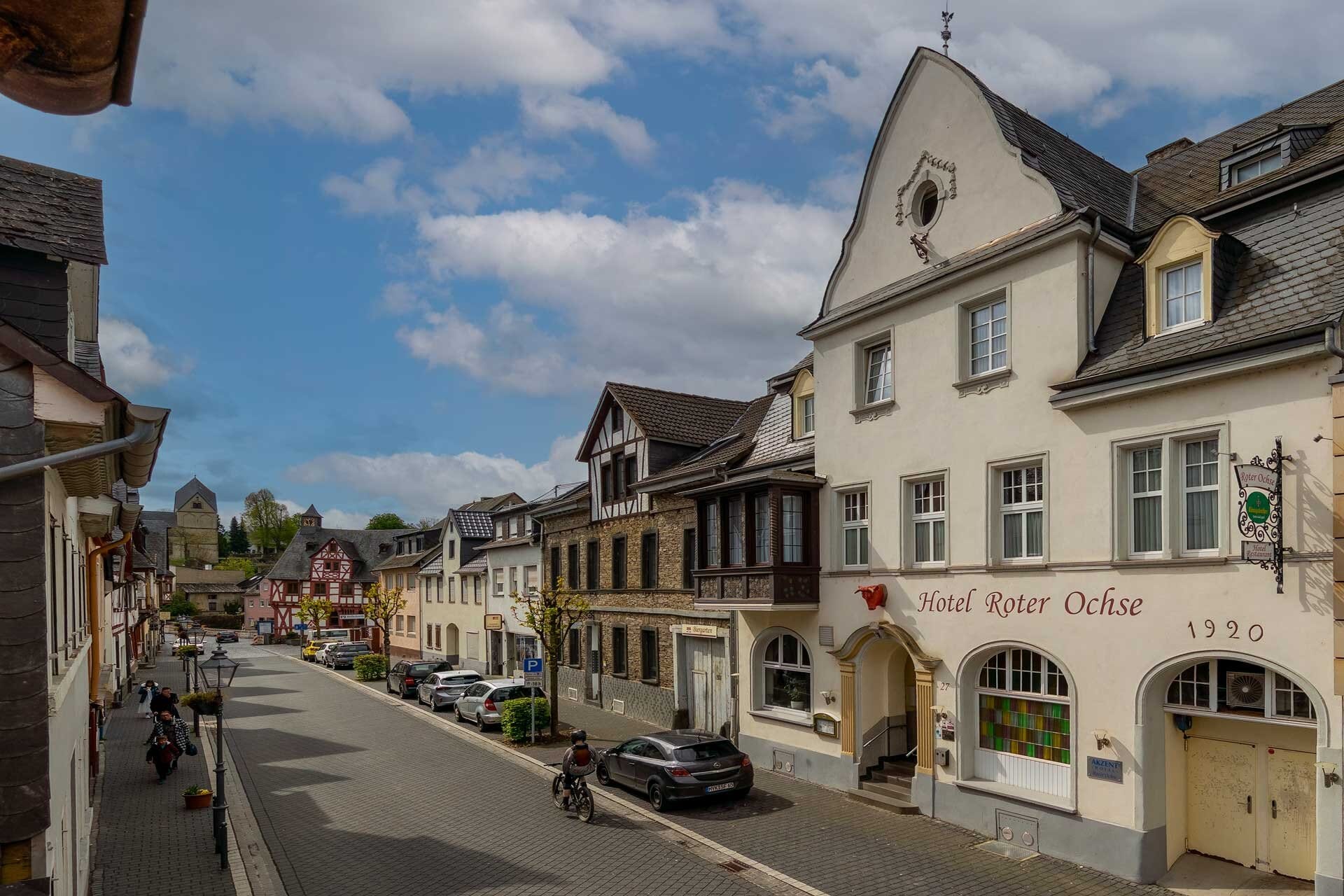
Heike Kochhäuser found this increasingly unsatisfying. Together with Werner Kochhäuser, she runs AKZENT Hotel Roter Ochse in Rhens on the Rhine. The family-run hotel has 31 rooms, lies in the Upper Middle Rhine Valley and mainly welcomes holidaymakers who use it as a base to explore the region.¹ For guests like these, personal attention plays an important role.
Before the switch to the Mews property management system, however, everyday life at the front desk often looked different from what the hosts wanted. Many hours were lost to recurring administrative tasks. Credit card details had to be looked up in bookings and keyed into payment terminals. Registration forms were printed, filled in by hand and then typed back into the system.
The decision to adopt new hotel software was therefore not driven solely by the wish to be technically up to date. The Kochhäuser family wanted to take administrative work off their staff’s hands and, at the same time, win back more time for guests.
How tedious paperwork turned into several free hours
Heike Kochhäuser uses concrete examples to show how much work used to go into the front desk routine. Processing credit card payments was particularly time-consuming. The encrypted data had to be released individually, looked up and then entered manually. Today, payment details are transferred automatically and in encrypted form. Depending on the rate booked, the system charges the card on file on the scheduled due date.
That alone saves the hotel around half an hour to an hour of working time every day, Kochhäuser estimates.
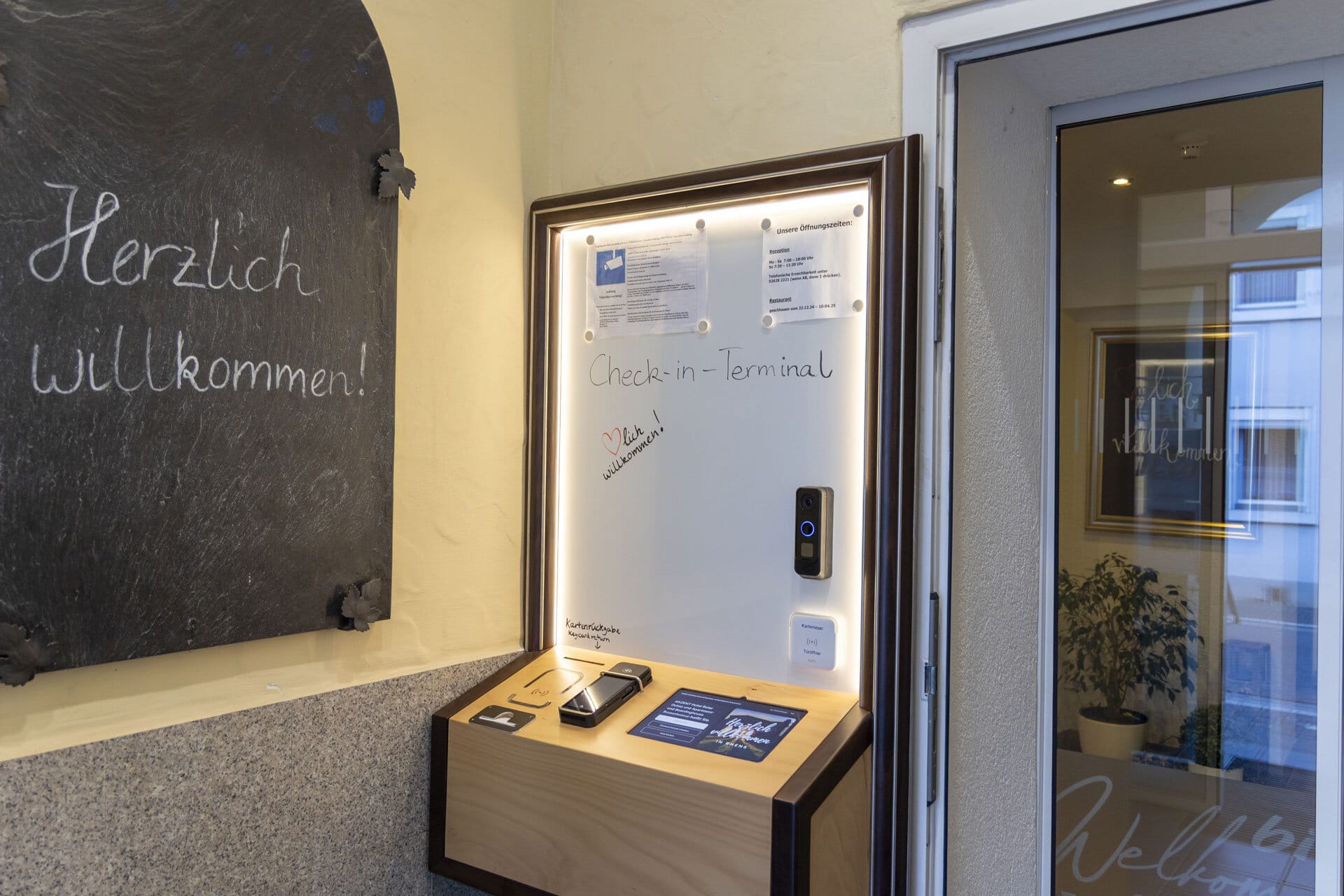
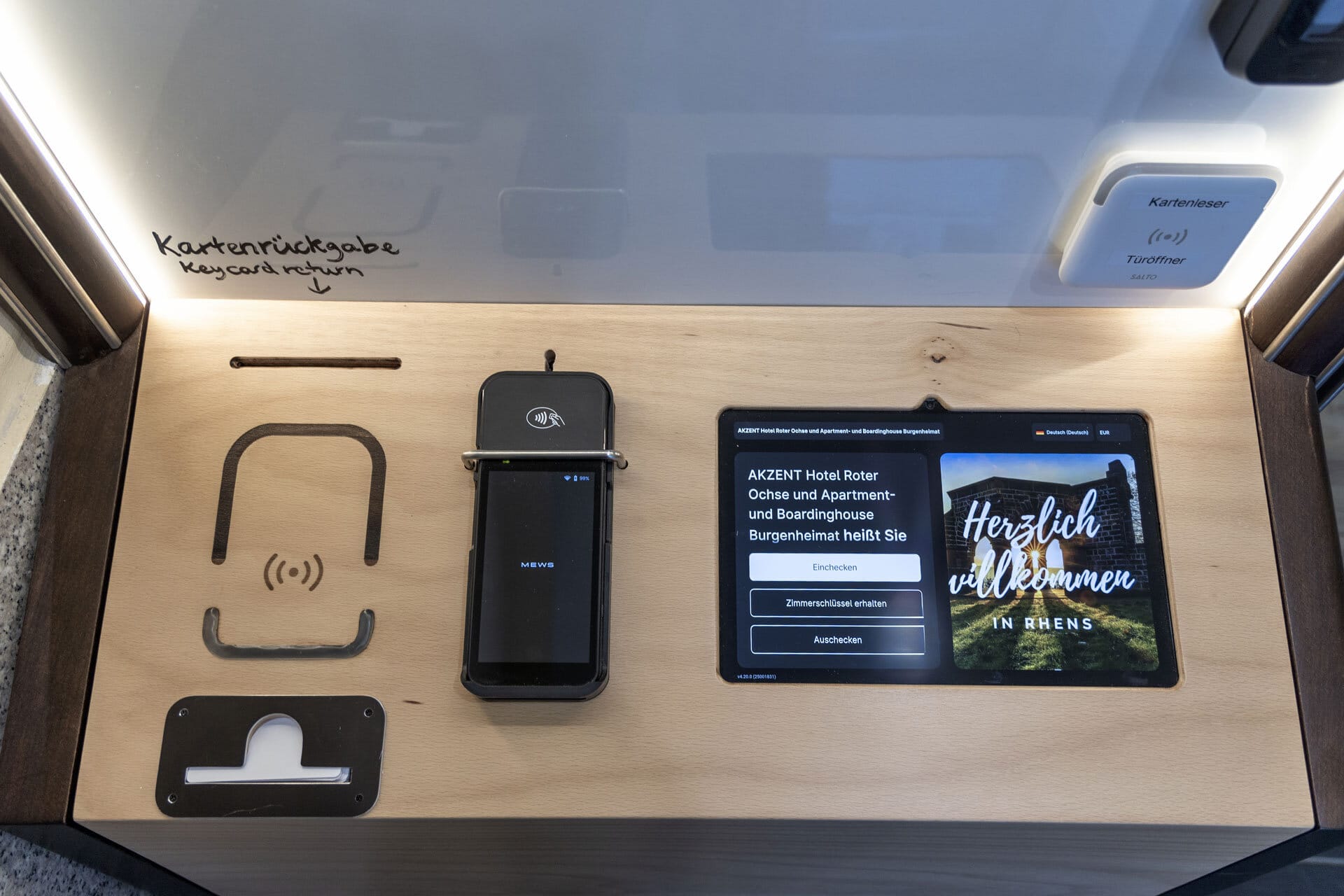
The difference is even greater with registration forms, she says. Booking confirmations now include a link to online check-in, followed by a reminder before arrival. Guests who do not complete their details in advance can do so on site on a tablet or, after the front desk has closed, at the check-in terminal.
In the past, the completed forms had to be processed a second time. Sometimes simply deciphering handwritten addresses was a time-consuming job. Today, most of this work has disappeared because guests enter their details digitally straight away. Kochhäuser puts the saving at another one to two hours a day.
On top of that, invoices are now created automatically and, if desired, sent straight away by email at check-out. Besides saving working time, this considerably reduces paper consumption.
Taken together, payments and registration forms alone add up to 1.5 to 3 hours less administrative work a day, according to the hotelier’s estimate. How much relief this brings depends on occupancy. On days with particularly many departures, the entire process changes as well, because payments and invoices are often settled before the actual check-out.
Check-in remains the guest’s choice
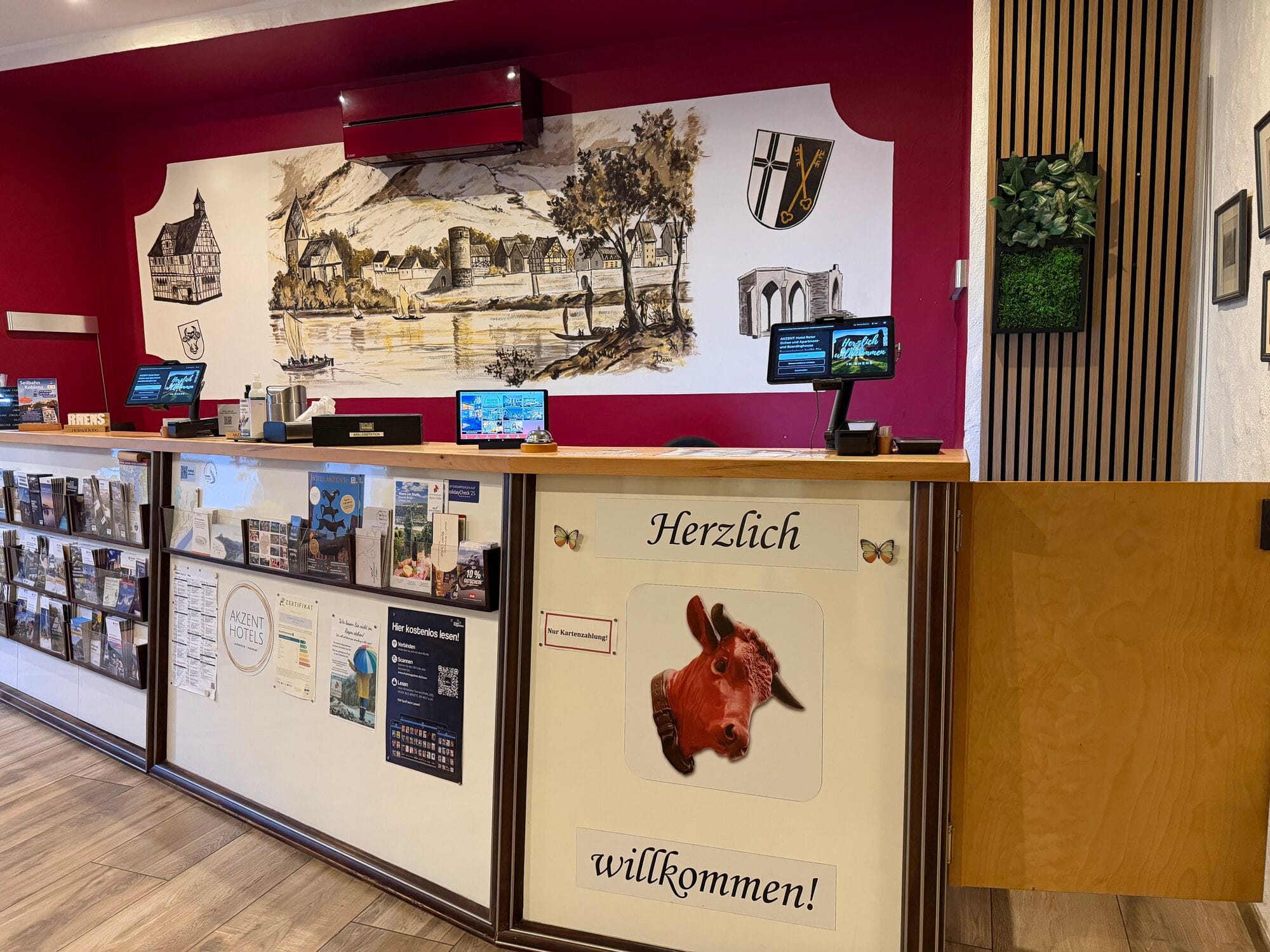
Anyone arriving at the Roter Ochse today finds a front desk where traditional hospitality and modern technology stand side by side. Tablets for self check-in sit on the counter. For late arrivals, there is a terminal that can be used after regular front desk hours. Guests can now also receive a digital room key on their smartphone.
Not all guests take to the change in the same way. In Kochhäuser’s experience, younger guests often use self check-in as a matter of course, even when staff are at the front desk. Others want to try out the technology but would like some personal help at first.
There are also guests who prefer to avoid digital check-in. Some call ahead to make sure someone will be there in person when they arrive. Others ring the bell after the front desk has closed without even trying the terminal. Such situations still happen, Kochhäuser reports, but they are becoming less frequent.
In her observation, regular guests also react mostly with curiosity. For many, digitalisation is one of a series of changes through which the hotel has been evolving for years. Not everyone wants to go along with every step. The hosts accept that and deliberately keep both options open during regular front desk hours.
Since early October 2026, there has been another option: a digital room key on the smartphone. It links Mews with the Salto locking system. The offer has already sparked fresh curiosity, including among guests who previously preferred a traditional check-in.
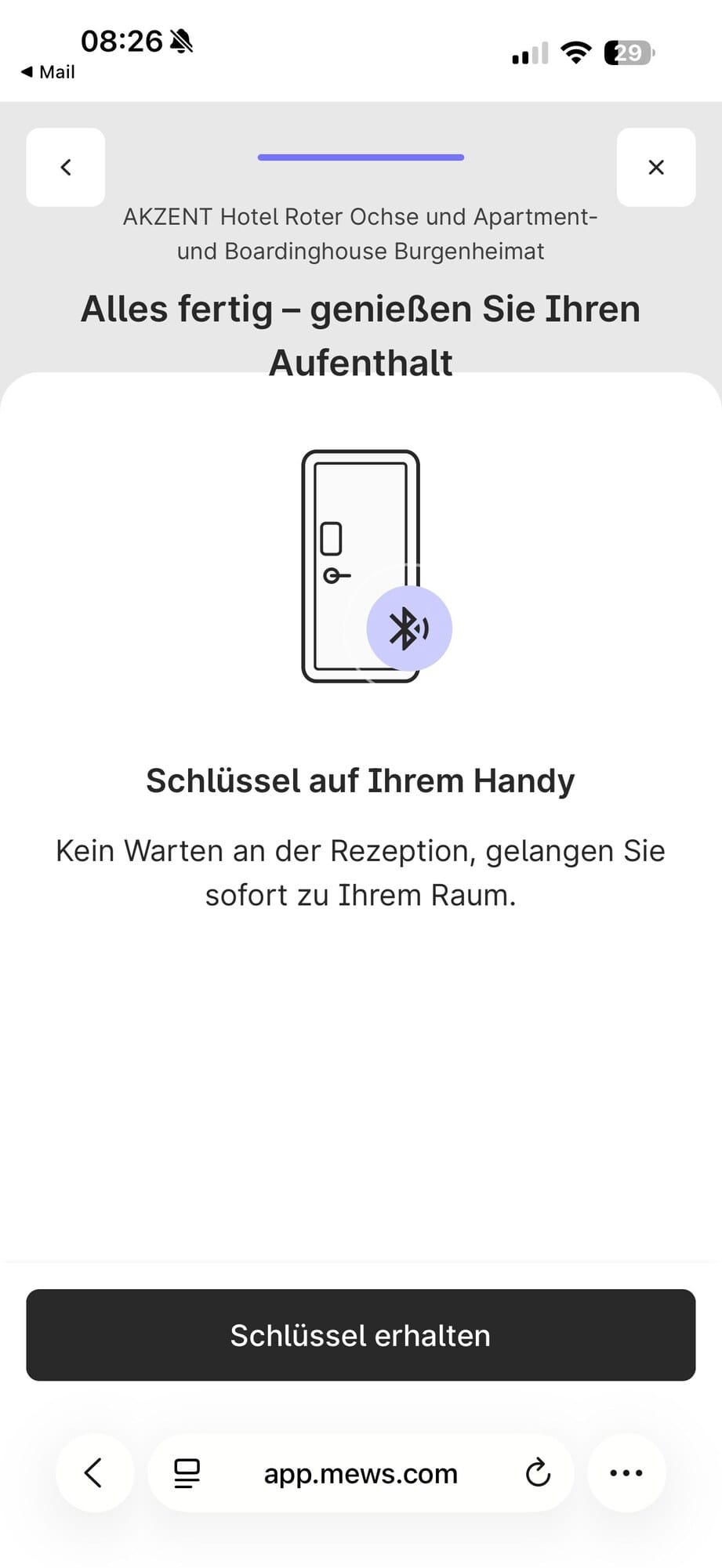
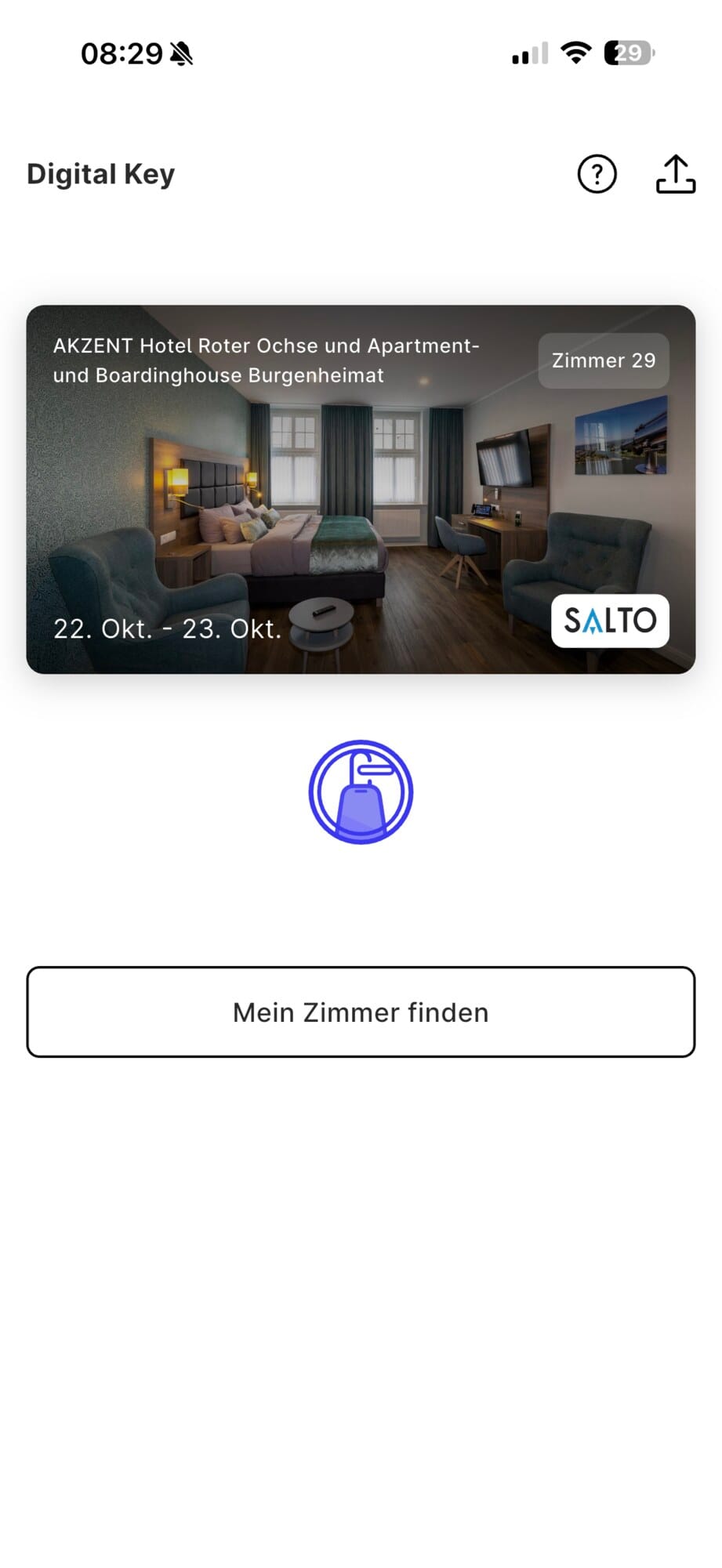
The digital room key is provided via smartphone. The screenshots show the process with Mews and Salto. Screenshots: AKZENT Hotel Roter Ochse
The introduction took its toll on nerves
Convincing as today’s processes are for the hotel, Heike Kochhäuser does not want to gloss over the difficulties of the switch.
The previous property management system, HS3, was replaced by Mews. According to a case study by the software provider, it took four weeks to go live.² That, however, was far from the end of the work.
The family did not just change software. They used the opportunity to reorganise existing workflows and the structure of what the hotel offers. Some settings turned out to be far more complex in day-to-day operation than expected. And the effects of individual decisions could not always be reliably judged in advance.
“It cost a lot of nerves and time, but now that everything is set up properly, it really pays off!” Kochhäuser writes, looking back.
In saying so, she touches on a point that is likely to be of particular interest to other hoteliers: a new system alone does not change a business. Only when booking terms, payment processes, responsibilities and internal workflows are aligned can automation take full effect.
The experience at the Roter Ochse therefore also shows why digitalisation projects are more than technical installations. They have a direct impact on how daily work is organised and require those in charge to be willing to question familiar routines.
More time for guests – and for the business itself
Perhaps the most important change cannot be read off a screen. It shows in the conversations that are possible again today.
When guests have already checked in and paid online, the front desk can focus more on what they actually want. Many holidaymakers come to Rhens without a detailed plan. They are interested in hikes, bike rides, places to visit or practical tips for their stay. Now there is more time for recommendations like these.
“Anyone can just offer beds. ;-)” writes Heike Kochhäuser, summing up her idea of hospitality.
She is explicitly not trying to replace personal contact with technology. Rather, she wants to be able to decide when human attention is really needed and when automated processes make more sense.
The team has changed, too. After the coronavirus pandemic, the team became significantly smaller, Kochhäuser reports. Digitalisation helps to make up for the missing staff. At the same time, the family can once again devote more attention to developing the business instead of being tied up entirely in day-to-day operations.
Artificial intelligence is now even used on the phone. When nobody can take a call in person, the system answers certain questions or records the request so that a member of staff can call back later. This solution does not meet with every guest’s approval either, but it gives the team additional flexibility.
Why the family would take the same path again
Werner and Heike Kochhäuser deliberately chose Mews after comparing several providers. It was important to them to bring as many functions as possible together in one system rather than having to manage numerous separate programmes. Later, they also switched to the provider’s solutions for revenue management and their point-of-sale system.
The case study published by Mews cites a self check-in rate of 60 per cent via the kiosks in use.² This indicates how naturally a considerable share of guests already use the new options.
Would she take the same path again? Heike Kochhäuser answers without hesitation: “Absolutely!”
What matters to her is apparently less that as many processes as possible now run digitally. Rather, the role of the front desk has changed. A place where forms, payment slips and invoices used to take up a large part of working time has once again become more of a place for personal service.
For other family-run hotels, this is an interesting experience. Digitalisation does not have to mean that the hosts disappear from everyday hotel life. At the Roter Ochse, technology mainly takes over tasks that do not require personal contact. This allows staff to focus more on the moments that cannot easily be automated.
And so, in the end, it is less administrative work that leaves more time for something thoroughly traditional: a proper conversation with guests before they set off.
AKZENT Hotel Roter Ochse
Check current rates and availability directly with the property.
Visit hotel websiteThis article is based on an original written interview, the official hotel website and a case study by the software provider Mews.
-
AKZENT Hotel Roter Ochse (2026)
AKZENT Hotel Restaurant Roter Ochse in Rhens
Official hotel website, accessed 22 October 2026. Location in the Upper Middle Rhine Valley, 31 rooms in the main building and guest house. Original publication in German. -
Mews (n.d.)
AKZENT Hotel Roter Ochse gewinnt mit Mews Zeit für das, was wirklich zählt
Case study by the software provider, accessed 22 October 2026. Switch from HS3 to Mews, four weeks to go-live, 60 per cent check-in rate via the kiosks. Original publication in German.


