


Key points
- Hotel Vier Jahreszeiten Starnberg opened in 2006. The idea grew out of the owners’ need for suitable hotel and meeting facilities for their IT company.
- With the Academy Room, the Creative Hub and the Boardroom, the hotel is adding three rooms designed for different ways of working.
- The new rooms are located in a separate building. This calls for extra coordination on guest support, coffee breaks and short-notice requests.
- General manager Tobias Baumann advises hoteliers to look closely at what their customers actually need before investing.
A conference room, a screen, a few rows of chairs and plenty of coffee: for a long time, that was all a successful hotel meeting required. Today, companies expect a great deal more. Teams want to develop ideas together, executives need to make confidential decisions and staff should learn as effectively as possible. At Hotel Vier Jahreszeiten Starnberg, this development has led to a notable decision. Instead of simply adding more conference space, the hotel has created three rooms that are deliberately designed for different tasks. For general manager Tobias Baumann, this is a response to the changing expectations of corporate clients.
A hotel born out of its own need for meeting space
The story of Hotel Vier Jahreszeiten Starnberg has an unusual beginning. When Dr Detlef Graessner and his daughter Cornelia Graessner-Neiss were looking for suitable accommodation with modern meeting facilities for their IT company Pharmatechnik around twenty years ago, they found hardly any suitable options in the district. Out of this need came the idea of building a hotel of their own. The four-star superior hotel opened in May 2006 and went on to establish itself not only as a business hotel but also as a culinary destination.¹
When Tobias Baumann took over as head of the hotel in autumn 2025, he had already known the business for twelve years.² Among other roles, he had worked in sales and marketing and had most recently been deputy director.³ His new role now takes him back to a question that already mattered when the hotel was founded: what do companies need for meetings and conferences to really work?
“Meetings are no longer just ‘a means to an end’; they are actively used for training or team building,” Baumann explains in a written interview with eingecheckt®. Companies no longer simply need a room, he says, but an environment that supports the meeting in question. It is increasingly about interaction, creativity and sharing knowledge. At the same time, expectations of technology, catering and service have risen.
Why an extra conference room is no longer enough
The specific trigger for the expansion was growing demand for different event formats. Rather than just offering additional square metres, the management wanted to distinguish more precisely which activities would take place in the rooms.
“Not every meeting needs a large conference room, and not every team works best at a classic boardroom-style table,” says Baumann. That is why three offerings were created that differ not only in size but, above all, in function.
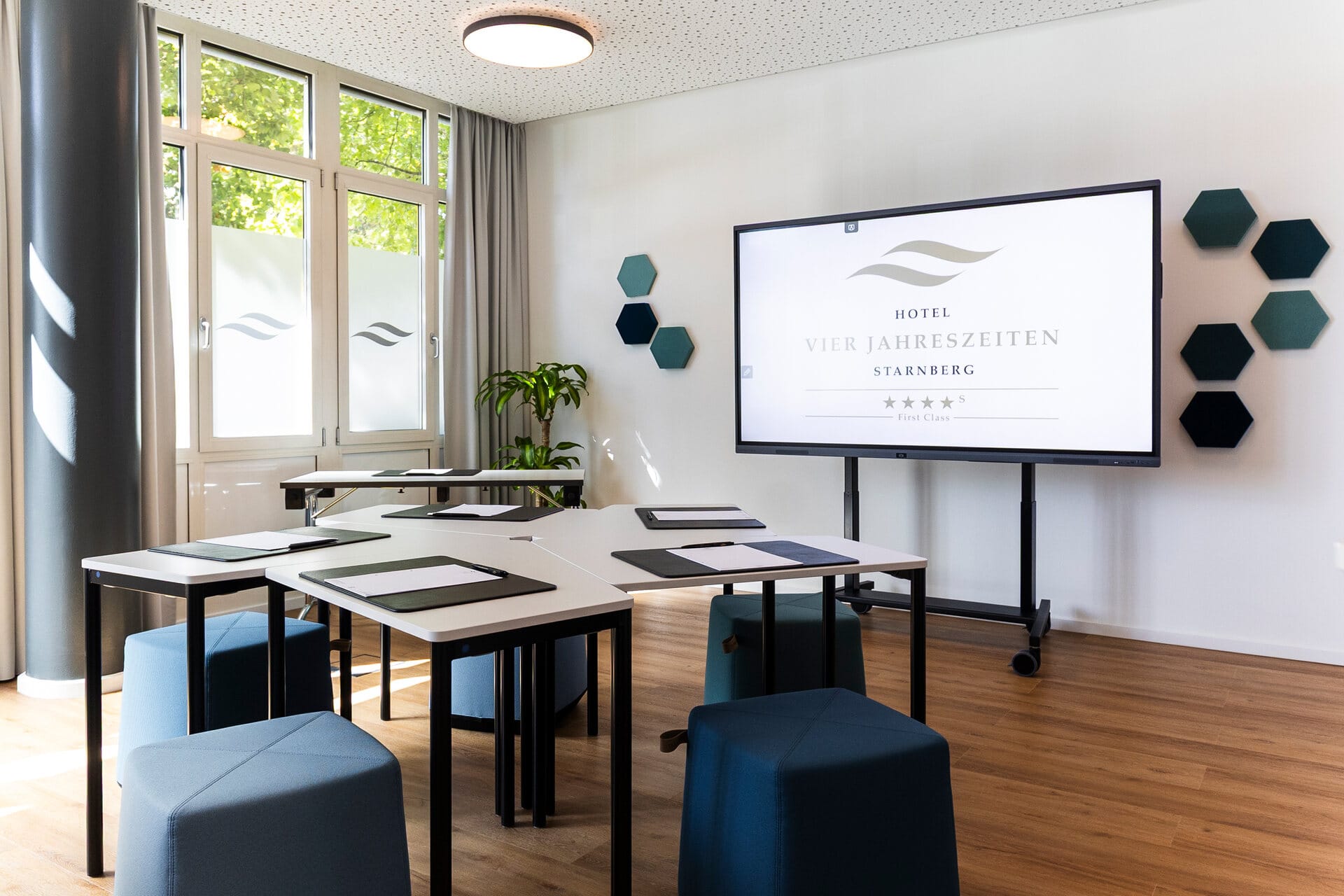
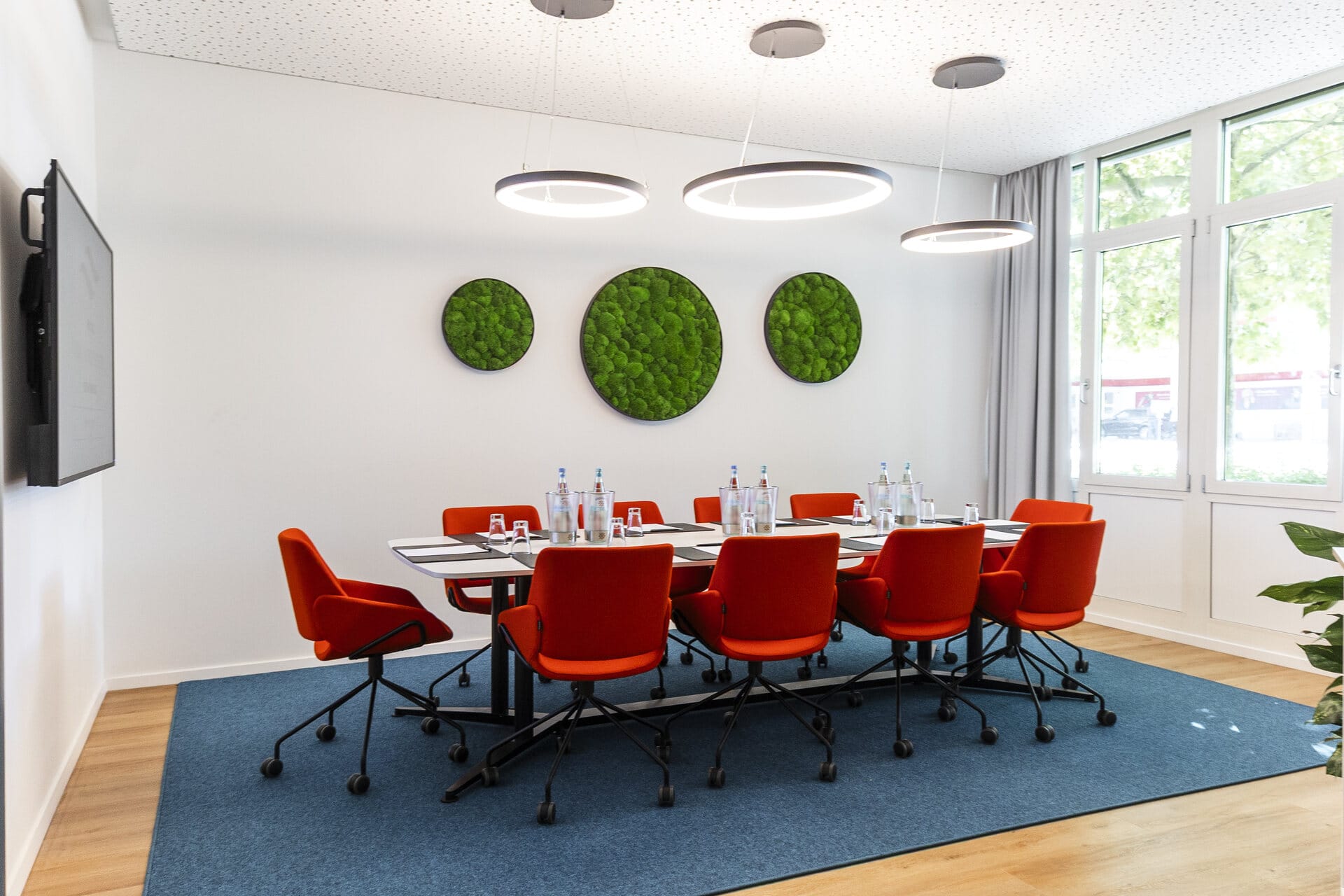
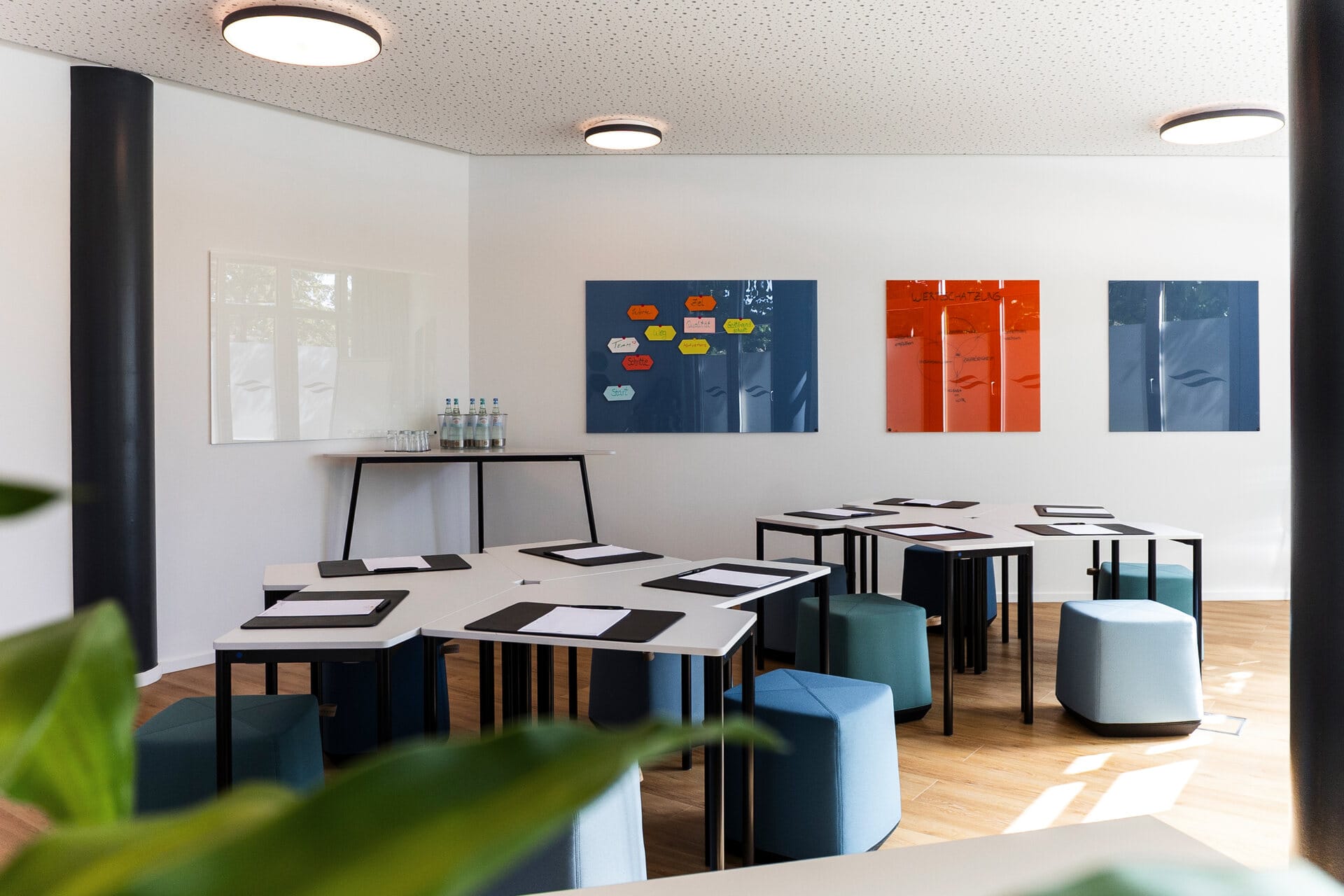
The 50-square-metre Academy Room is designed for training sessions, seminars and presentations. In the 41-square-metre Creative Hub, teams are meant to develop ideas together and work interactively. The smallest room, the 26-square-metre Boardroom, offers a focused setting for management talks, strategic decisions and confidential discussions.
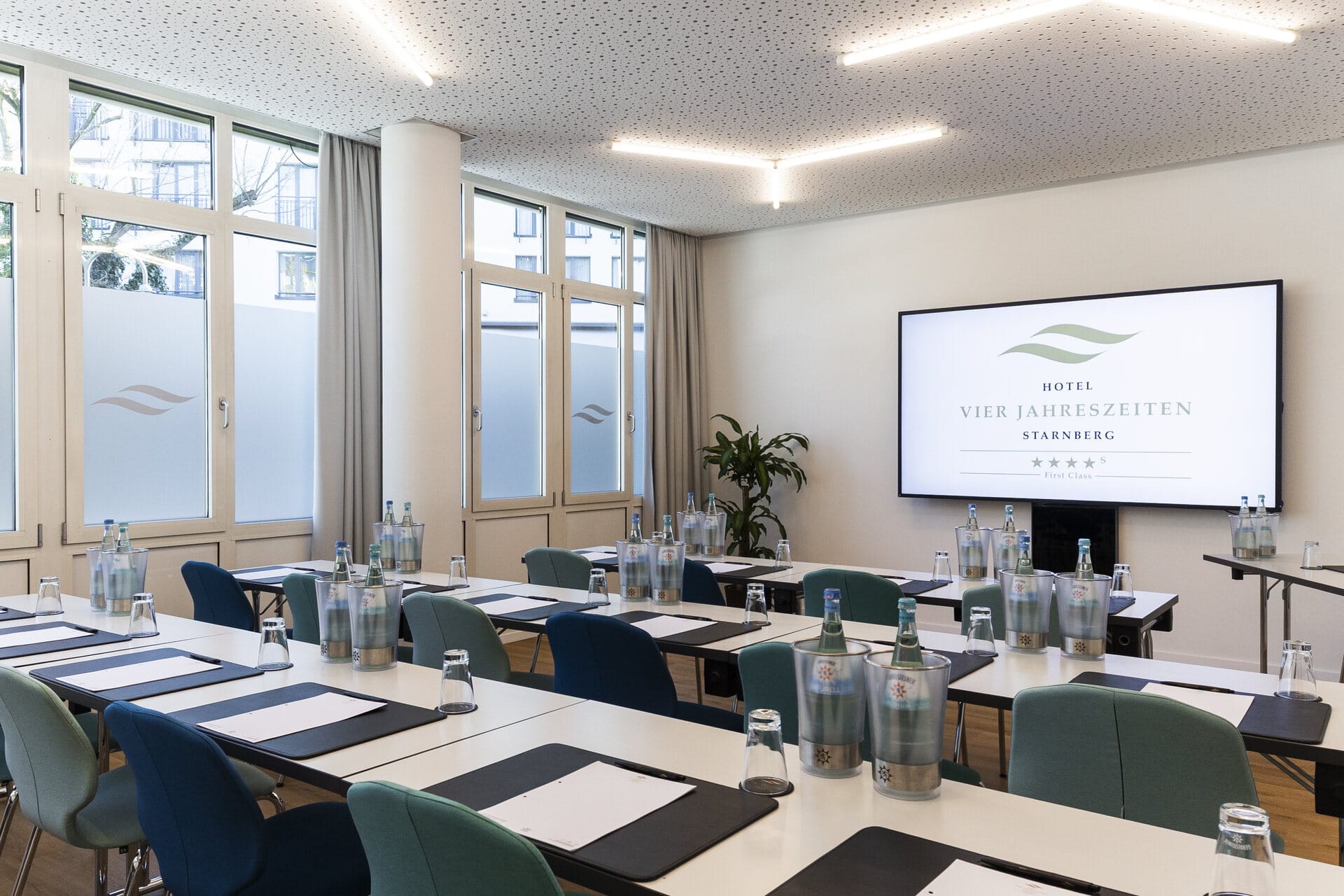
The interior design makes these differences visible. While the Academy Room is dominated by classic table layouts and a large screen, the Creative Hub offers small, movable workstations, stools and surfaces to write on. The Boardroom, in turn, relies on a single shared meeting table with striking red chairs. The new rooms therefore differ far more from one another than many traditional meeting rooms, where it is mainly the table arrangement and the number of participants that change.
One strategy day, three different working phases
Baumann explains how the rooms are meant to work together using the example of a typical strategy day. In the morning, a team develops new ideas and solutions in the Creative Hub. The participants then move to the Academy Room to present their results in a structured way and discuss them together. Finally, the Boardroom is available for the closing talks of the management.
The example shows that moving between rooms can itself become part of the event concept. After all, a creative working phase places different demands on its surroundings than a presentation or a confidential management meeting. A single room concept can accommodate different uses, but it inevitably has to make compromises.
For Baumann, the main advantage is that companies can organise different working phases within the same hotel. On top of that, he says, there is the hotel’s culinary expertise, which has been an important part of its positioning in the meetings market for years.
New rooms also mean new processes
From a guest’s point of view, the expansion may seem straightforward at first. A hotel provides additional rooms, adapts its offer and gains new opportunities as a result. Behind the scenes, however, things are more complex, as Baumann explains.
The new rooms are located in a separate building. The hotel therefore has to organise event support accordingly. Coffee breaks in particular need coordinated planning, while short-notice requests have to be bundled. For this, the hotel relies on digital solutions.
Little changes, on the other hand, in the basic event consultation. As Baumann explains, the hotel already works with an individual contact person for planning and looking after events. This principle is to be kept with the additional rooms as well.
This operational aspect is particularly interesting for other hoteliers. Additional rooms do not automatically mean more business with unchanged processes. The further apart event spaces are and the more individual their use becomes, the more carefully staff, catering and technical support have to be coordinated. Whether the expansion is a commercial success therefore depends not only on its occupancy but also on how efficiently it can be integrated into day-to-day hotel operations.
Why a meeting guest can be worth more than the room hire
For Hotel Vier Jahreszeiten Starnberg, the investment is not only about renting out additional event space. Baumann looks instead at the total value a corporate client can generate.
“A meeting guest not only uses a room but usually also our restaurants and other hotel services such as overnight stays and further services,” he explains. These cross-selling opportunities are particularly interesting for the hotel, he says. Smaller workshops and management meetings could open up new target groups, while existing business relationships could be developed further through additional offers.
The expansion thus fits in with the hotel’s established positioning. Over its twenty-year history, the hotel has increasingly combined its original business concept with high-quality cuisine. Its in-house gourmet restaurant Aubergine received its first Michelin star in 2014; the “Meet Culinary” concept developed from it combines meeting packages with fine dining.¹
This makes an important difference when assessing the economics of new meeting rooms: an event can be attractive even if the room hire itself accounts for only part of the revenue generated. What matters is which additional services are actually booked and what costs they involve.
What smaller hotels can learn from this
Not every hotelier has the space or the financial means to expand an existing meeting offer with three specially equipped rooms. Baumann, however, does not see this as the decisive requirement for successful modernisation.
“Before you invest in new rooms or expensive technology, you should understand which formats are actually in demand and where existing offerings can be sensibly improved,” he advises. At his own hotel, he says, they responded specifically to customer wishes. These included flexible furniture, a well-thought-out lighting concept, high-quality technology and attentive service.
Flexibility in particular is likely to be a sensible approach for smaller hotels. Those with only one or two event rooms may already be able to enable several uses through adaptable furniture, mobile presentation technology and different lighting settings. The prerequisite, however, is knowing what customers actually need. After all, a creative space for which there is little local demand would be just as poor an investment as a large conference hall that is mostly used for meetings of six people.
At Hotel Vier Jahreszeiten Starnberg, the decision was deliberately taken in favour of greater differentiation. The three new rooms are intended to support different ways of working while complementing the existing meetings business. Whether this strategy will also lead to higher occupancy and additional revenue in the long term will only become clear in day-to-day operation.
For other hoteliers, the most interesting idea therefore lies less in the number or size of the new rooms than in the thinking that preceded their planning. The hotel did not simply expand its offer; it first asked what its corporate clients actually want to do in a meeting hotel. That is a question that can be answered even without major investment.
- Academy Room (50 m²): For training sessions, seminars, presentations and structured knowledge transfer.
- Creative Hub (41 m²): For developing ideas, interactive workshops and creative teamwork.
- Boardroom (26 m²): For management talks, strategy meetings and confidential discussions.
Hotel Vier Jahreszeiten Starnberg
Check current rates and availability directly with the property.
Visit hotel websiteThis article is based on an original written interview, a press release and a news item from the hotel, and a trade media report.
-
Hotel Vier Jahreszeiten Starnberg (2026)
Vom Businesshotel zum kulinarischen Leuchtturm – 20 Jahre Hotel Vier Jahreszeiten Starnberg
Press release dated 29 April 2026. Opening in May 2006, the Graessner family as owners and the IT company Pharmatechnik, Aubergine restaurant, Meet Culinary concept. Original publication in German. -
Tageskarte (2025)
Tobias Baumann wird General Manager im Hotel Vier Jahreszeiten Starnberg
Trade media report dated 20 October 2025. Appointment as head of the hotel after twelve years at the property. Original publication in German. -
Hotel Vier Jahreszeiten Starnberg (2025)
Tobias Baumann übernimmt Hoteldirektion
News item on the official hotel website, accessed 22 October 2026. Career at the hotel in sales and marketing, most recently deputy director. Original publication in German.


