

Key points
- The Resort Hof Weissbad in the Appenzell region of Switzerland has used fully washable mattresses from Swiss manufacturer SWISSFEEL since 2014.
- The mattress core and cover are washed completely, dried and put back into use, instead of the mattress simply being vacuumed or replaced.
- In the scenario of a Carbotech AG life cycle assessment, the washable mattress causes up to 77 per cent less CO₂ equivalent than an innerspring mattress.
- According to SWISSFEEL, the hotel has saved more than 200,000 Swiss francs. Owner Philipp Hangartner sees no minimum hotel size for the system.
A hotel mattress that can be washed in its entirety and is said to last up to 20 years? It may sound unusual at first, but at the Resort Hof Weissbad in Switzerland it has been everyday practice for more than a decade. Behind it is Philipp Hangartner, owner of SWISSFEEL, with an idea designed to bring hygiene, sustainability and economic efficiency together.
How a mattress became a throwaway product
Philipp Hangartner is preoccupied by a question that sounds surprisingly simple: why do we throw things away just because they have become dirty? Bed linen, pillowcases and duvets are washed regularly and then used again. With mattresses, by contrast, this has hardly been possible so far. Yet they are among the things people spend the most time with, and in a hotel they are used every day by a succession of different guests.
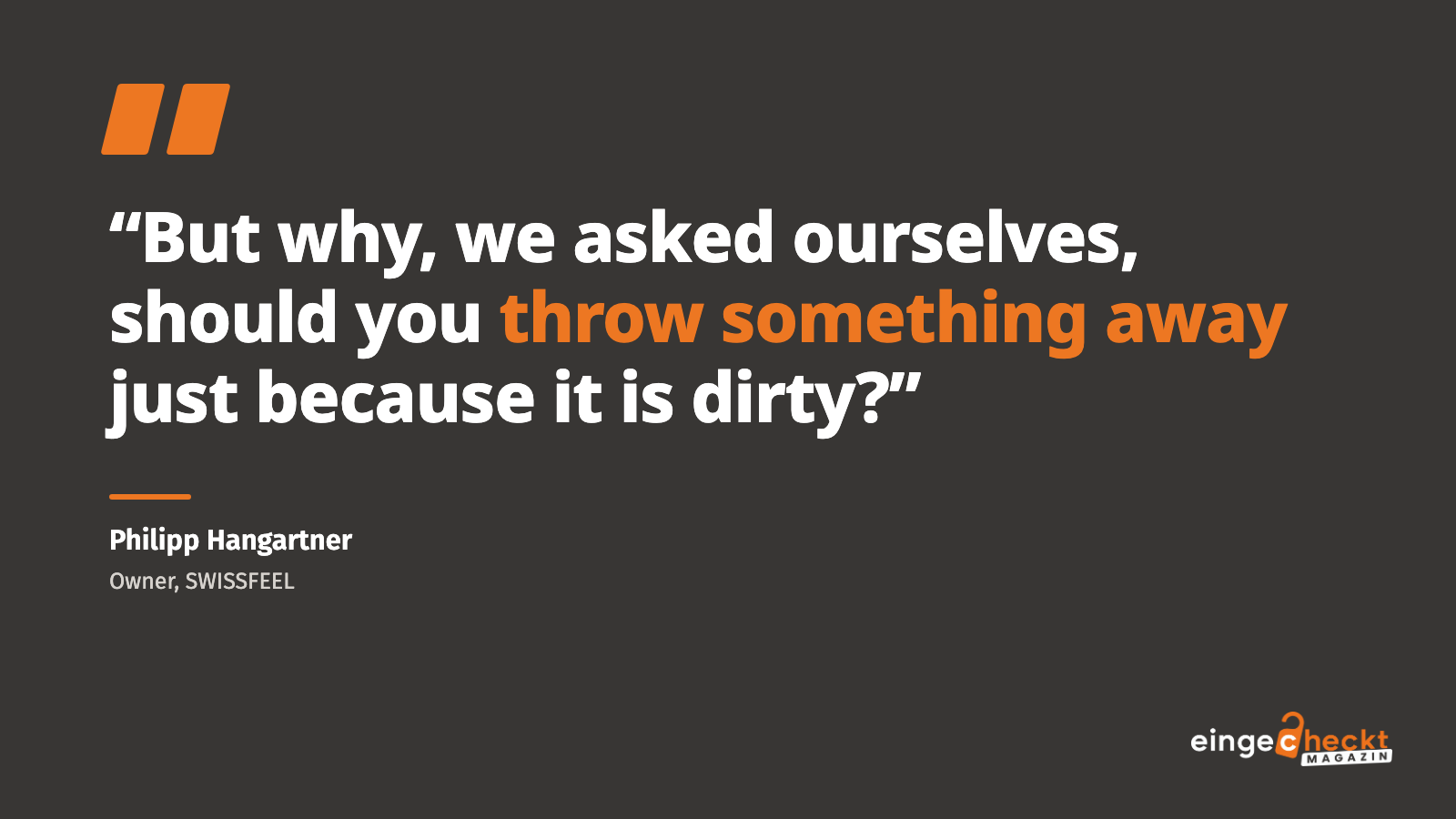
“But why, we asked ourselves, should you throw something away just because it is dirty?” Hangartner explains in conversation with eingecheckt. This thought gave rise to the idea of developing a mattress that could be washed completely rather than merely cleaned on the surface. Combined with a suitable washing process, the aim was a system that preserves hygiene and sleeping comfort while allowing the mattress to be used for much longer.
There is an environmental side to the idea, too. Mattresses are made of various materials whose production requires resources and energy. If they are replaced for hygiene or economic reasons even though they would still offer adequate support, avoidable waste is created. In a research report on the circular economy published in 2022, Germany’s Federal Environment Agency (Umweltbundesamt) also examined how the collection and recovery of discarded mattresses could be improved.¹
When the whole mattress goes into the washing machine
The solution developed by SWISSFEEL, a Swiss company founded in 2004,² differs fundamentally from the way conventional mattresses are cleaned. Usually only the covers are washed, or the surfaces are vacuumed or steamed. With the Swiss system, both the mattress core and the cover can be cleaned completely with water and detergent.
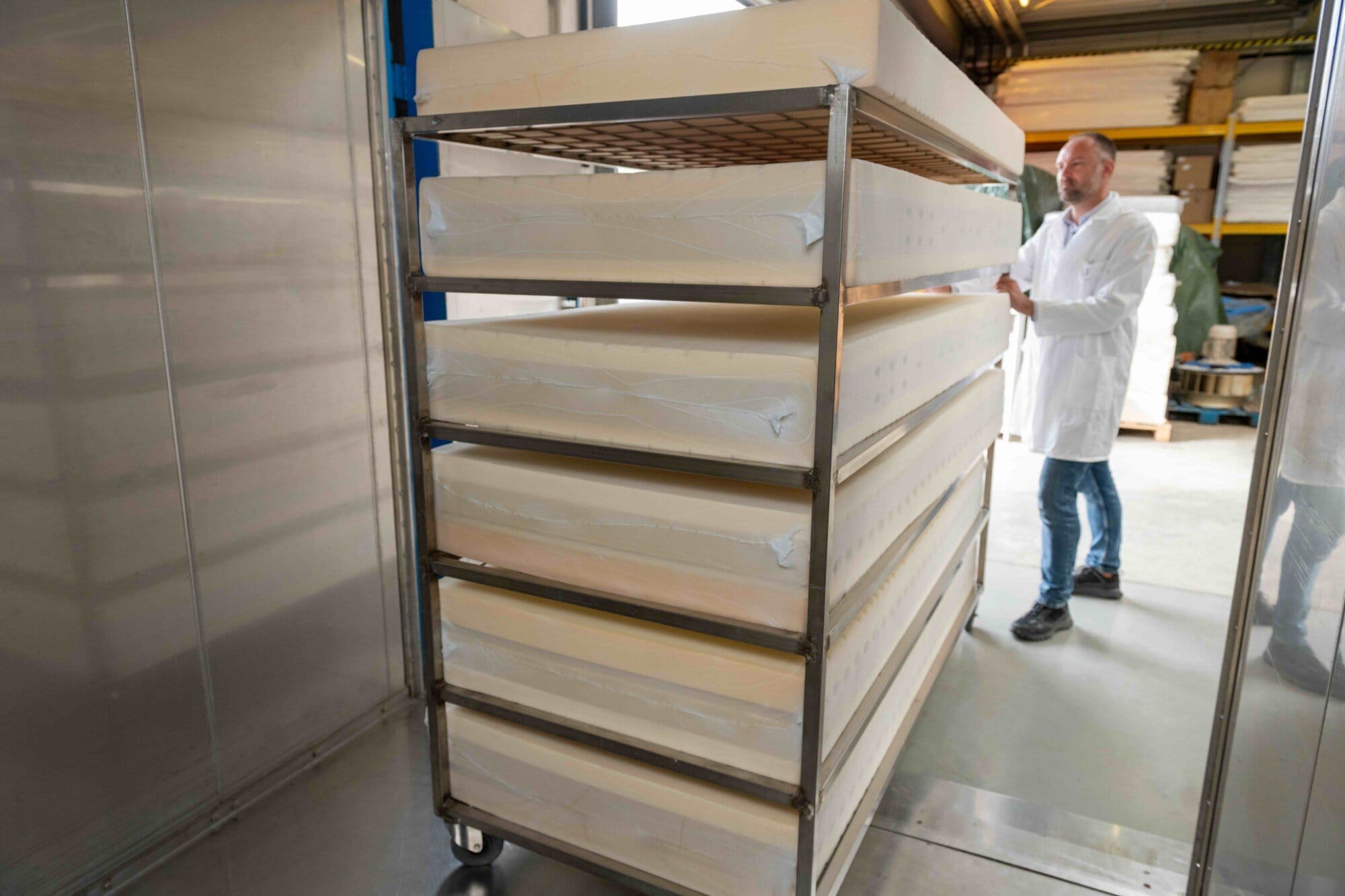
This requires special washing equipment whose dimensions have little in common with an ordinary domestic washing machine. During the wash, the mattresses have to be moved and flushed through in such a way that dirt is removed from the inside as well. The materials are then dried and prepared for use again.
Hangartner sees this as a decisive advantage in terms of hygiene. Over time, sweat, salts, skin particles and other residues inevitably accumulate inside a mattress. House dust mites and their droppings also play a part. Much of this dries over time and becomes ingrained, at which point vacuuming or steaming can no longer shift it. Washing the mattress completely is meant to remove precisely these residues rather than merely reducing them on the surface.
The specially developed materials do, however, need particular properties for this. Not just any mattress can be washed in such a machine. SWISSFEEL uses a mineral foam made in Switzerland that is designed to withstand repeated washing and drying.³
According to Hangartner, how far this extends a mattress’s service life depends on factors such as the load it bears and the base beneath it. His longest-standing customers, he says, have now been using their mattresses for twelve years. In tests, the company has determined a physical service life of up to 20 years under suitable conditions.
Such a long service life is therefore not a blanket guarantee for every bed. But it shows how fundamentally the economics could change if a mattress no longer had to be replaced simply because it had become dirty.
Twelve years of practical experience in the Appenzell region
The Resort Hof Weissbad in the Swiss canton of Appenzell Innerrhoden shows how such a concept can work over the long term. The resort combines classic hospitality with wellness, health and gastronomy. It comprises the four-star superior Hotel Hof Weissbad with 90 rooms and suites and the Lodge Hof Weissbad with a further 25 rooms.
According to its website, the hotel has relied on fully washable SWISSFEEL mattresses since 2014.⁴ In the Lodge, which opened in 2018, they have been in use from the outset.⁵ Regular professional reconditioning means the existing furnishings can be used for longer instead of being replaced entirely at the usual procurement intervals.
For the hotel, this decision has since become part of a broader sustainability strategy. This includes regional food, measures to reduce waste and the promotion of more environmentally friendly travel to the resort. The mattress system has a direct bearing on the hotel’s core product: the sleeping comfort of its guests.
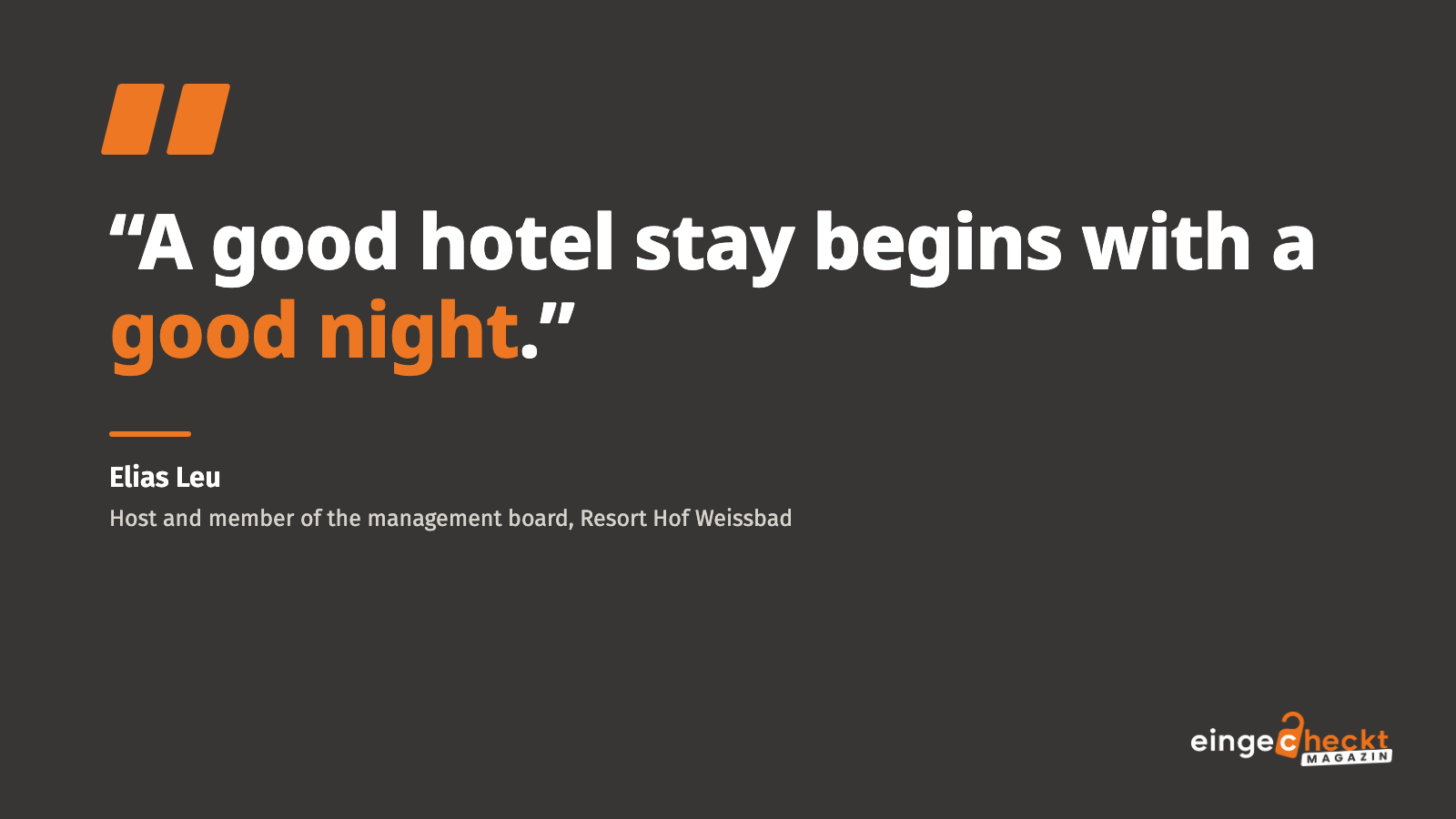
In September 2026, the resort received the Green Sleeping Award at the HSMAday in Berlin. In its announcement, the hotel emphasises that professional cleaning has a positive effect on both service life and resource consumption. “A good hotel stay begins with a good night,” says Elias Leu, host and member of the management board. He sees the award as recognition of the work of the entire team.⁵
What is particularly interesting is that the hotel did not acquire the mattresses as part of a recent sustainability campaign. The decision was made more than a decade ago. This sets Hof Weissbad apart from projects whose environmental benefits so far rest mainly on theoretical calculations or announced measures.
More than 200,000 Swiss francs saved
For Philipp Hangartner, the Resort Hof Weissbad is also an important reference project in economic terms. According to him, a total of 136 beds there were fitted with SWISSFEEL mattresses in 2014. The hotel, he says, has calculated that it has since saved more than 200,000 Swiss francs thanks to the longer service life and the possibility of cleaning.
The economic reasoning behind this is easy to follow. A mattress that can be used for longer needs to be replaced less often. At the same time, there are costs for cleaning, transport and reconditioning. What matters, therefore, is not just the purchase price but the sum of all expenses over the actual service life.
Hangartner admits that high-quality mattresses come at a price initially. Over the years, however, the investment is meant to pay off. In addition, he says, SWISSFEEL takes the mattresses back free of charge for recycling at the end of their service life.
For larger hotels in particular, long-term procurement decisions of this kind could have a considerable impact. But smaller businesses also benefit in principle when furnishings can be used for longer without compromising hygiene or comfort.
What does the life cycle assessment say?
Alongside the economic aspect, the environmental impact is at the heart of the concept. SWISSFEEL has published the results of a life cycle assessment carried out in 2023 by Carbotech AG in Basel, which compares different types of mattress over their life cycle.
The study takes into account production, materials, transport, cleaning and disposal, among other factors. In the scenario examined, the SWISSFEEL mattress comes to 92 kilograms of CO₂ equivalent, a conventional innerspring mattress to 398 and a foam mattress to 368 kilograms. This corresponds to a reduction in greenhouse gas emissions of up to 77 per cent compared with the innerspring mattress and 75 per cent compared with the foam mattress.⁶
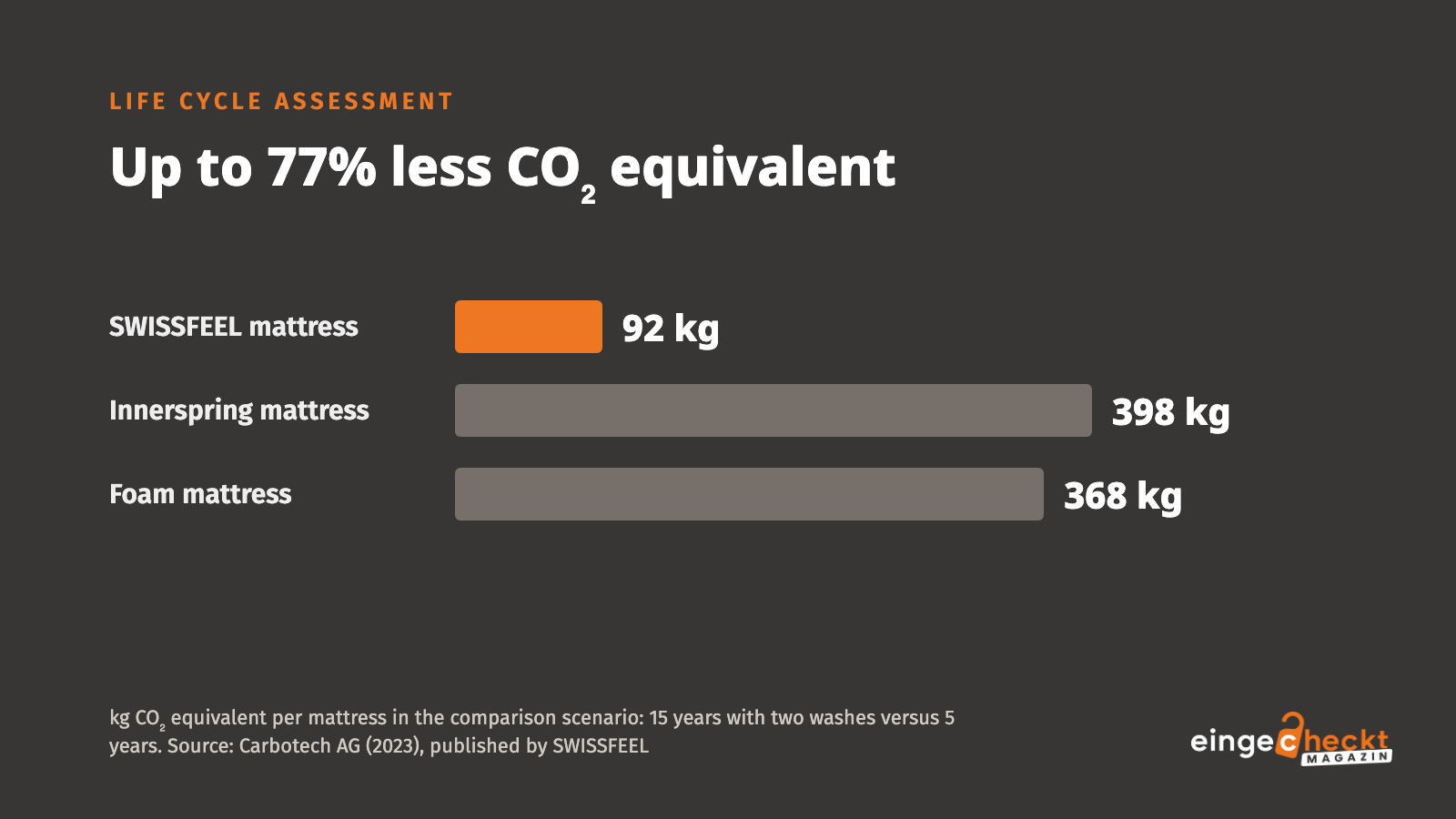
These figures are based on specific assumptions: 15 years of use of the washable mattress, including two cleaning cycles, were compared with conventional mattresses replaced every five years. This interval is based on the DEHOGA hotel star classification. The figures therefore describe the outcome of a defined comparison scenario, not the measured CO₂ savings of a particular hotel.⁶
At the same time, the calculation shows where a significant environmental advantage can arise. With long-lasting products, the impact of the original manufacturing is spread over a much longer period of use. If several new purchases are avoided as a result, the additional impact of cleaning and logistics can be comparatively small in the overall balance.
For the hotel industry, this offers an interesting change of perspective. Sustainability does not necessarily mean replacing existing products with new, supposedly greener alternatives. Sometimes the greater benefit lies precisely in continuing to use existing furnishings for as long as possible.
A solution for small hotels, too?
Not every hotel has more than a hundred rooms or a matching purchasing budget. This raises the question of whether the concept is also practical for smaller, family-run businesses.
Hangartner sees no minimum size as a matter of principle. Whether a hotel has ten, a hundred or five hundred rooms is initially irrelevant to the principle, he says. Larger quantities do, however, allow the logistics to be organised more efficiently.
For smaller hotels, the decisive factor is likely to be how transport, cleaning and any replacement mattresses needed during reconditioning can be organised. The economic benefit must therefore be assessed in each case on the basis of the specific operating conditions.
The Green Sleeping Award has since brought the topic additional attention within the industry. The award is presented by HSMA Deutschland and supported by SWISSFEEL.⁷ According to the resort’s announcement, it assesses the areas of hygiene, comfort and sustainability.⁵ The manufacturer’s support is disclosed transparently.
For Hangartner, the development of his mattresses has long been more than a technical innovation. It stands for the conviction that economic activity and the responsible use of resources need not be mutually exclusive. The example of Hof Weissbad at least shows that the approach can be used in regular hotel operations over many years.
The real change begins with an unusual question that occupied Hangartner years ago: why is a product disposed of when it could possibly still be used for a long time?
When it comes to hotel mattresses, there is now an alternative. They do not necessarily have to be replaced just because they have become dirty.
This article is based on a written interview with Philipp Hangartner of SWISSFEEL, official information from the Resort Hof Weissbad and additional editorial research.
-
German Federal Environment Agency (Umweltbundesamt) (2022)
Evaluation der Erfassung und Verwertung ausgewählter Abfallströme zur Fortentwicklung der Kreislaufwirtschaft
UBA-Texte 31/2022, March 2022. Research report covering end-of-life tyres, textiles, bulky waste and mattresses, among others. Original publication in German. -
Servitex GmbH / SWISSFEEL AG (2015)
Servitex GmbH kooperiert mit SWISSFEEL AG
Press release of 16 January 2015. Company profile of SWISSFEEL, including its founding year of 2004 and its mineral foam. Original publication in German. -
SWISSFEEL (2026)
Company website
Accessed on 16 October 2026. Information on materials, washing service, take-back and recycling. Original publication in German. -
Resort Hof Weissbad (2026)
Resort und Zukunftsfähigkeit
Hotel website, accessed on 16 October 2026. Sustainability measures and use of washable SWISSFEEL mattresses since 2014. Original publication in German. -
Resort Hof Weissbad (2026)
Resort Hof Weissbad gewinnt den Green Sleeping Award 2026
Press release dated 3 September 2026, published on 10 September 2026. Award, assessment areas, room numbers and statements by Elias Leu. Original publication in German. -
SWISSFEEL (2024)
Ökobilanz: Mit SWISSFEEL-2-CYCLE bis zu 77 % CO₂-eq. einsparen
Manufacturer’s leaflet of April 2024 with results of a study by Carbotech AG, Basel (2023), assessed according to IPCC 2021. Comparison of 15 years of use with two washes against five years for conventional mattresses. Original publication in German. -
HSMA Deutschland e. V. (2026)
Green Sleeping Award 2026 powered by SWISSFEEL
Information page, accessed on 16 October 2026. Award winner and support from SWISSFEEL. Original publication in German.


