Children want to splash, slide and move around. Wellness guests are looking for peace, privacy and relaxation. Two holiday worlds that, at first glance, hardly seem compatible. Yet at the Tratterhof Mountain Sky Hotel in South Tyrol, the aim is to welcome families and guests seeking tranquillity under the same roof. The key is not compromise – but consistent spatial separation. Can that work?
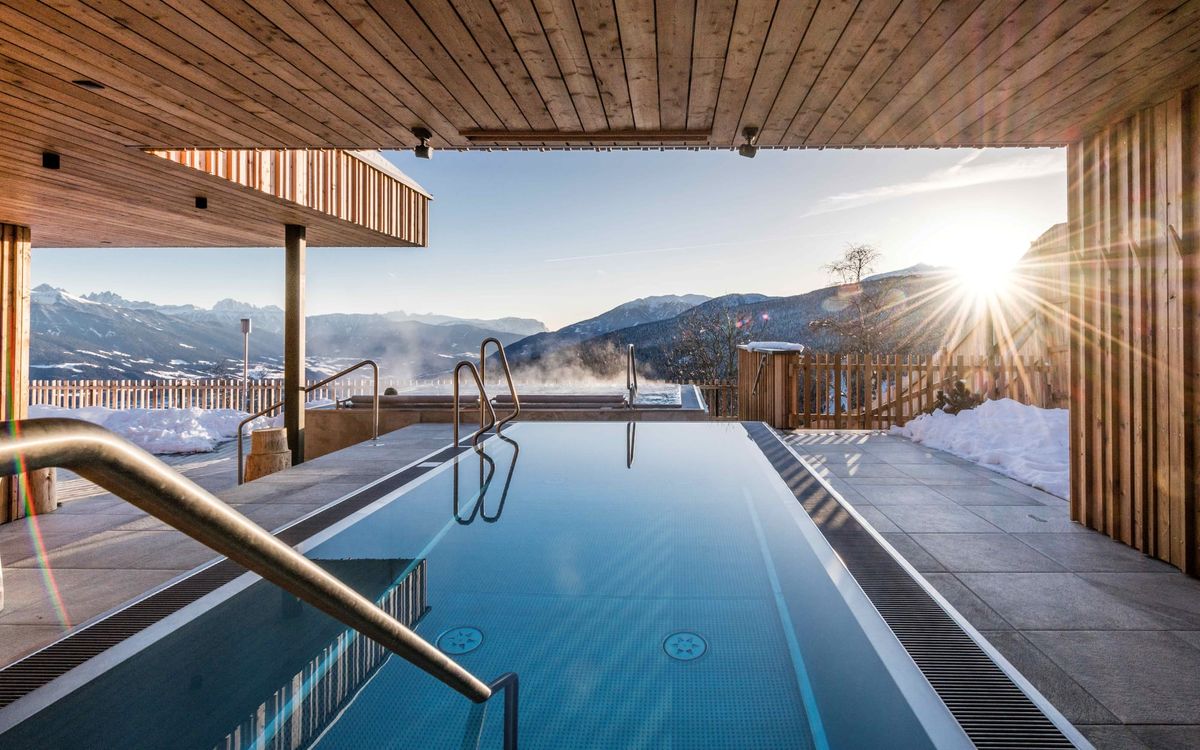
On one side, children race down the T-Wave water slide or the T-Tornado, play in the fun pool and splash around in the baby pool. On the other, adults are meant to enjoy the sauna in peace, retreat to quiet rooms or swim in an infinity pool overlooking the Dolomites.
Both are part of the same hotel.
What initially sounds like a difficult balancing act is a deliberate part of the concept at the Tratterhof Mountain Sky Hotel in Meransen, South Tyrol. The hotel does not want to be either a classic family hotel or a pure adults-only retreat. Instead, it is trying to bring together two guest groups whose expectations of a successful holiday can hardly be more different.
And that raises a question that goes far beyond one individual hotel:
Does a wellness hotel still have to choose one target group – or can different holiday worlds be organised under the same roof?
Two large markets – with very different expectations
Current figures from the Forschungsgemeinschaft Urlaub und Reisen show that families are anything but a niche segment in tourism.
In the 2025 travel year, 19 percent of all holiday trips and 21 percent of short breaks were taken with children.¹Family travel therefore represents a significant part of the German travel market.
At the same time, the wellness travel market continues to grow.
According to data from the Global Wellness Institute, around 348.4 million wellness trips were taken in Europe alone in 2024. Global spending on wellness tourism reached around US$893.9 billion in the same year. For the period up to 2029, the institute expects average annual growth of 9.1 percent.²
For hotels, both target groups are therefore attractive.
The problem begins where their needs overlap.
Parents on family holidays often deliberately look for places where their children can move around freely and enjoy themselves. Traditional wellness, by contrast, is built around peace, slowing down and retreat.
A child going down a water slide for the tenth time is not necessarily doing anything wrong. Nor is the adult just a few metres away who expects peace and quiet.
The real question is:
Can a hotel meet both expectations at the same time?
One door is not enough
At the Tratterhof, the answer is: only if the separation begins much earlier.
“A simple door would not be enough from our point of view,” says Hannes Weissteiner from the hotel’s Management & Marketing team. Circulation routes, lounge areas, acoustics and usage patterns all have to be considered at the planning stage.
The Tratterhof has one structural advantage in this respect.
The Family Area is located in the east wing and extends over two floors. The adults-only wellness area, by contrast, is in the west wing and is spread across several levels. As a result, families and guests who deliberately seek peace and quiet move through largely separate parts of the hotel.
Different restaurant and lounge areas also help the hotel respond to the needs of both groups.
What appears at first to be a simple target-group question therefore becomes an architectural one.
And research has indeed looked at precisely this issue.
A 2025 study published in the journal Buildings on the architecture of spa and wellness areas in European hotels concludes that spatial organisation can have a significant impact on hotel operations as a whole. According to the study, not only the size and equipment of a spa matter, but also its location within the building, functional zoning and circulation routes.⁴
The study distinguishes, among other things, between compact and spatially distributed spa layouts and shows that, particularly in more complex facilities, deliberate spatial separation can offer functional advantages.⁴
Or, put more simply:
Peace and quiet cannot be organised only at the sauna door.
4,000 square metres – but not for everyone together
At the Tratterhof, this principle is now implemented across a substantial area.
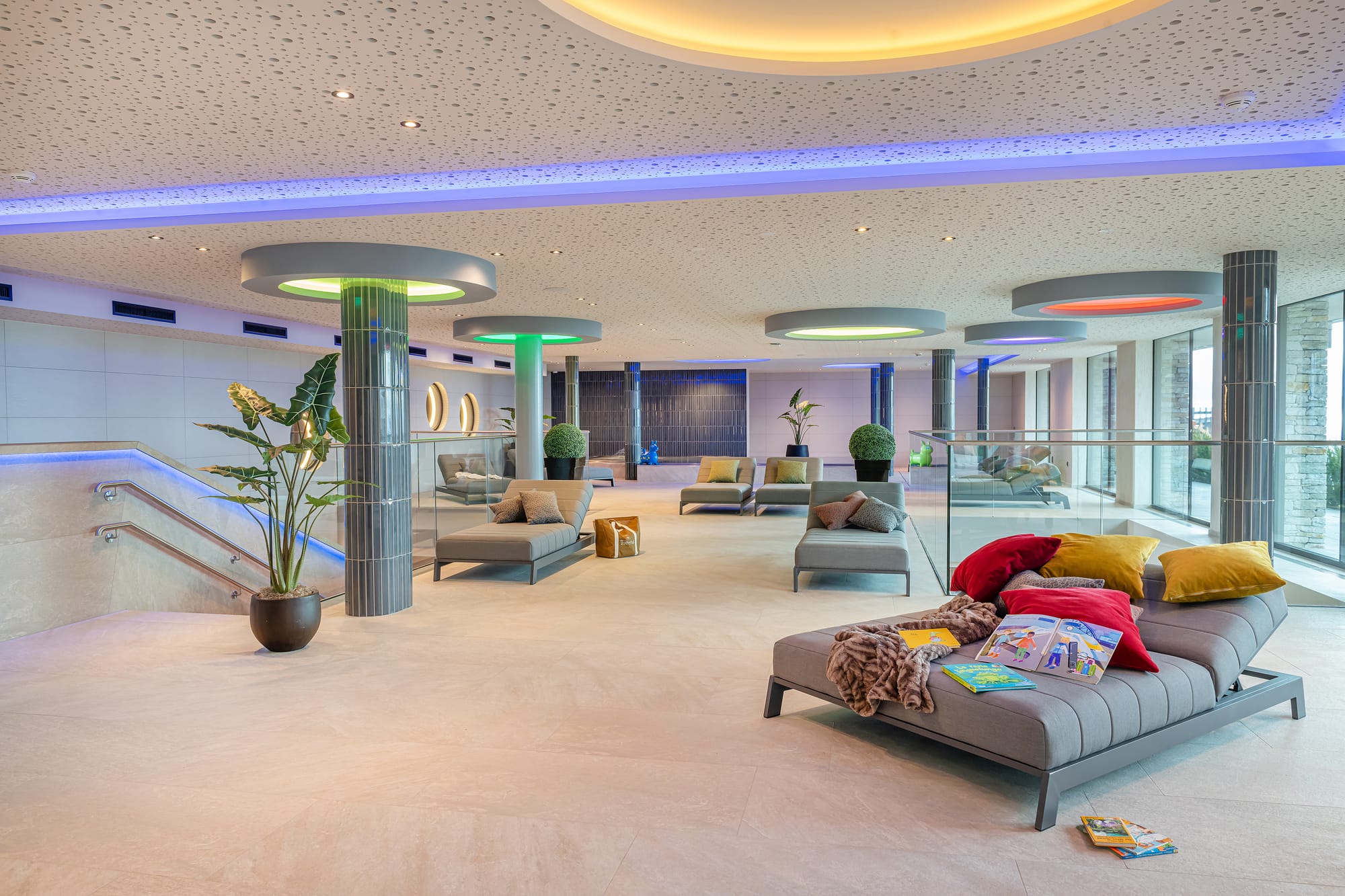
According to the hotel, the Monte Silva Mountain Spa covers around 4,000 square metres across four floors. The wellness area includes different sauna, pool and relaxation zones and separates family facilities from areas reserved exclusively for adults.⁶
In 2025, the family offering was expanded significantly.
The new Family Area includes a baby pool, a Teeny Fun Pool with basketball hoop and the two water slides T-Wave and T-Tornado. The extension opened in October 2025.⁶
What is remarkable here is not so much each individual attraction, but the decision behind the concept.
The Tratterhof is not trying to integrate children into an existing classic wellness area and then introduce rules designed to make sure nobody feels disturbed.
Instead, they are given their own holiday world.
Families should be able to enjoy their stay without constantly having to make sure they are especially quiet. At the same time, guests who deliberately seek peace and quiet should be able to find suitable places to retreat. The hotel itself describes this separation as a key part of the concept.
That changes the perspective.
The decisive question is no longer how quiet children have to be in a wellness hotel, but how a hotel has to be designed so that children do not constantly have to be quiet.
Why not simply go adults only?
The seemingly simpler solution would be obvious: if a hotel wants to promise peace and quiet, it could simply exclude children altogether.
Adults-only hotels have long established themselves as a segment of their own. Yet the Tratterhof has consciously chosen not to position itself that way.
According to Weissteiner, the hotel was never intended to become either a classic family hotel or a pure adults-only property. Instead, the structure of the building allows the different holiday worlds to be clearly separated from one another.
There is another idea behind this approach.
Hotels sometimes accompany their guests through many years of their lives. A couple who come for a wellness break today may return a few years later with children – and later again as a couple.
For a family-run holiday hotel, it can therefore make sense not to focus on one single target group, but to accompany guests through different stages of life.
The fact that family holidays and wellness are no longer automatically seen as opposites is also reflected in the international wellness industry.
For 2024, the Global Wellness Institute listed wellness holidays with children as one of its tourism trends. According to the institute, families are increasingly looking for trips that combine wellbeing, shared experiences, learning and child-friendly activities.³
And what do existing guests say?
Expanding the family offering does, however, create a risk for an established wellness hotel.
A hotel that has built up a particular audience over many years may also change how the property is perceived when it starts targeting new guest groups.
According to Weissteiner, the hotel has not seen any fundamental concern among guests in this respect.
One important reason is that the renovation did not increase the number of accommodation units. In other words, there are not suddenly significantly more guests in the hotel. Instead, the existing spaces and facilities were upgraded.
According to the hotel, both families and classic wellness guests have reacted positively to the expansion.
For long-standing guests without children, the key point was that their personal holiday experience had not deteriorated. Families, meanwhile, have particularly embraced the fun pool, water slide and additional family areas.
These are, however, the hotel’s own observations.
According to the management, it is still too early to determine clearly whether the Family Area opened in 2025 has measurably changed the guest mix, length of stay or booking patterns.
The hotel points out that booking behaviour is influenced by many factors at the same time: school holidays, economic developments, increasingly short-term booking decisions and changing travel habits. Attributing any change solely to the new Family Area would therefore be too simplistic.
A notably cautious answer – and probably the more realistic one.
Tratterhof Mountain Sky Hotel
Check current prices and availability for the hotel directly on Booking.com.
Check availability & prices
Two holiday worlds require space and investment
What sounds comfortable from a guest’s point of view is initially demanding from an hotelier’s perspective.
Two pool environments, separate sauna areas, dedicated lounges and an architecture designed to manage different guest flows all require space and investment.
This is likely to be one of the biggest limitations of such a concept.
The Tratterhof argues, however, that spatial separation does not necessarily mean duplicating the entire technical infrastructure.
Technical systems can in some cases be shared. The hotel cites heat recovery, renewable energy and interconnected technical circuits as examples. While the guest areas are spatially separated, parts of the infrastructure behind them can still work together.
That may sound like a technical detail, but economically it is crucial.
Because the key question for other hoteliers is unlikely to be whether a separate children’s pool would be nice.
It is this:
Is there enough space, investment capacity and structural flexibility to separate two different offers consistently enough for both of them to work properly?
That is exactly why the model cannot simply be transferred to every hotel.

From a 16-room guesthouse to the Mountain Sky Hotel
It is also worth noting that today’s Tratterhof was not designed from the outset as a large resort.
The story of the property leads from a small guesthouse with 16 rooms, step by step, to the extensive wellness hotel it is today.
According to the management, as the hotel grew, both guest expectations and the owners’ own standards grew with it. Today, the focus is not simply on size or the next new attraction, but on the interplay between architecture, wellness, cuisine, service, nature experiences and the quality of hospitality.
What is interesting is that this development did not result in ever greater specialisation around just one target group.
Instead, the hotel is trying to broaden its appeal – without mixing all guests together everywhere.
That is an important distinction.
A hotel that tries to appeal to as many target groups as possible can quickly run the risk of no longer being truly suitable for any of them.
The Tratterhof model attempts to solve this problem spatially.
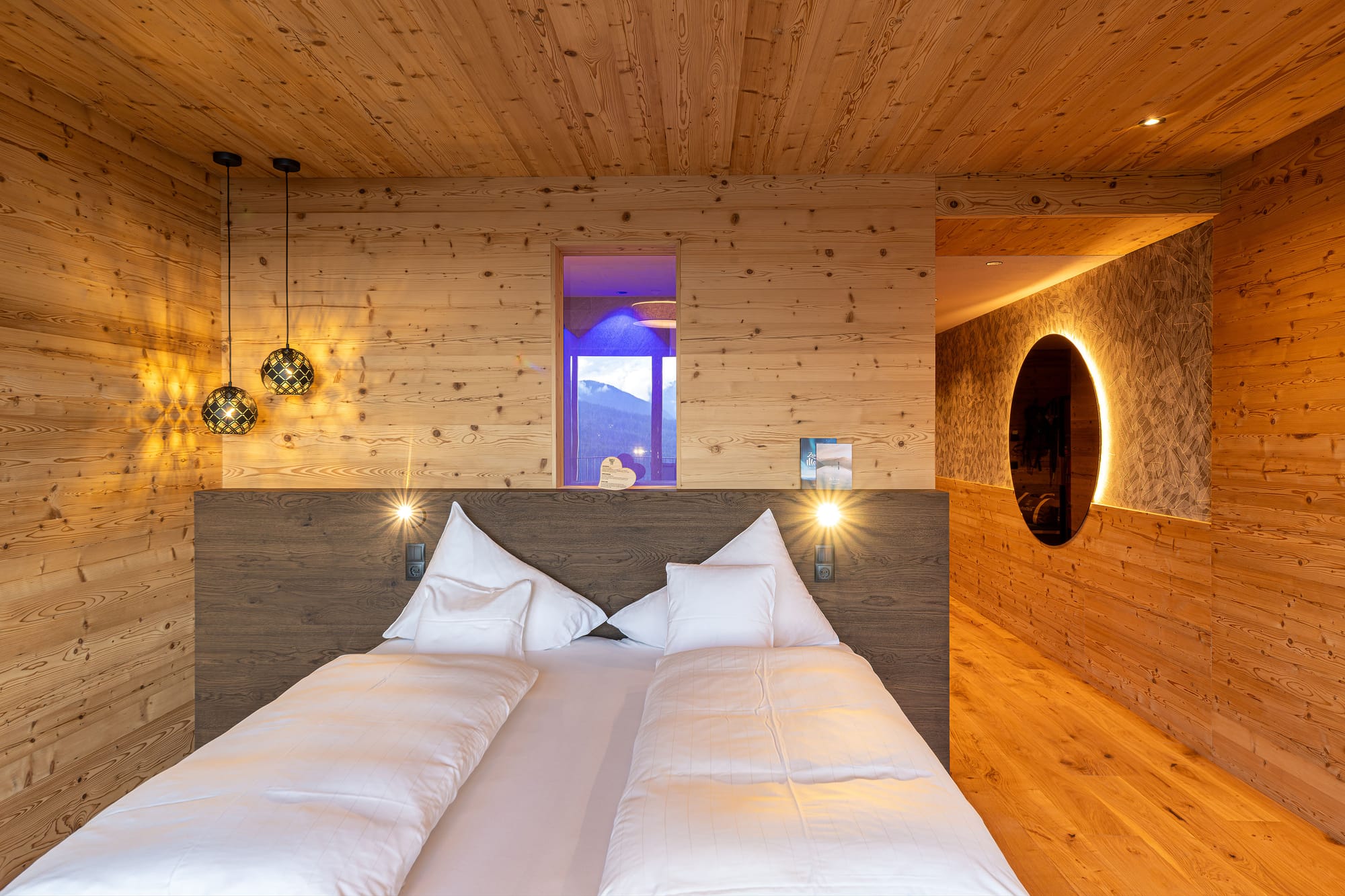
So can a family hotel and a wellness retreat work at the same time?
The answer is probably:
Yes – but not automatically.
A research note already available online in the International Journal of Hospitality Management offers an interesting perspective on the issue.
The study analysed 90,045 English-language TripAdvisor reviews from 72 international family-oriented resorts.⁵
The analysis shows that the mention or presence of children influences the criteria by which guests evaluate their stay.⁵
The authors also raise the broader question of whether adults-only concepts are sometimes a comparatively simple response to a more difficult management challenge: organising different guest segments sensibly within one resort.⁵
The Tratterhof provides its own answer.
Not every guest has to want the same thing.
They do not all have to use the same areas either.
What matters is that a hotel understands which needs are compatible – and where they need to be separated.
Hannes Weissteiner puts it in surprisingly down-to-earth terms. Alongside studies, trends and concepts, he says, hoteliers should not forget “common sense”.
They should ask themselves what they would expect on holiday, what would bother them, what a family actually needs and what someone looking for a few quiet wellness days is expecting.
At the same time, a hotel needs to know very clearly what it stands for. Not every concept works in every location, and not every hotel has to serve every target group.
Perhaps that is the decisive difference.
Not every hotel has to appeal to every target group.
But if it tries to, it should not simply place families and guests seeking tranquillity next to each other and hope for the best.
At the Tratterhof, the answer therefore does not begin with a set of house rules.
It begins with the floor plan.
This article draws on industry information, academic publications and original editorial sources.
-
Forschungsgemeinschaft Urlaub und Reisen e. V. (FUR)
Reiseanalyse – Family holidays / holiday travel with children. Data on the share of holiday trips and short breaks taken with children in 2025. -
Global Wellness Institute (2025)
Global Wellness Economy Monitor 2025. Data on the development of international wellness tourism and growth forecasts through 2029. -
Global Wellness Institute (2024)
Wellness Tourism Initiative Trends for 2024. Trend report including family-oriented wellness travel. -
Gronostajska-Kadecka, Joanna Anna (2025)
Spa and Wellness Zones in Contemporary Hotels in Europe: Typologies. Buildings 15(6), 952. DOI: 10.3390/buildings15060952 -
Grande, Kevin; Galan, Jean-Philippe; Séraphin, Hugues
Adult-only: When excluding children reveals a flaw in hospitality management approach. International Journal of Hospitality Management, Volume 141, Article 104904. DOI: 10.1016/j.ijhm.2026.104904 -
Tratterhof Mountain Sky Hotel
Information on the Monte Silva Mountain Spa and the Family Area opened in 2025.